
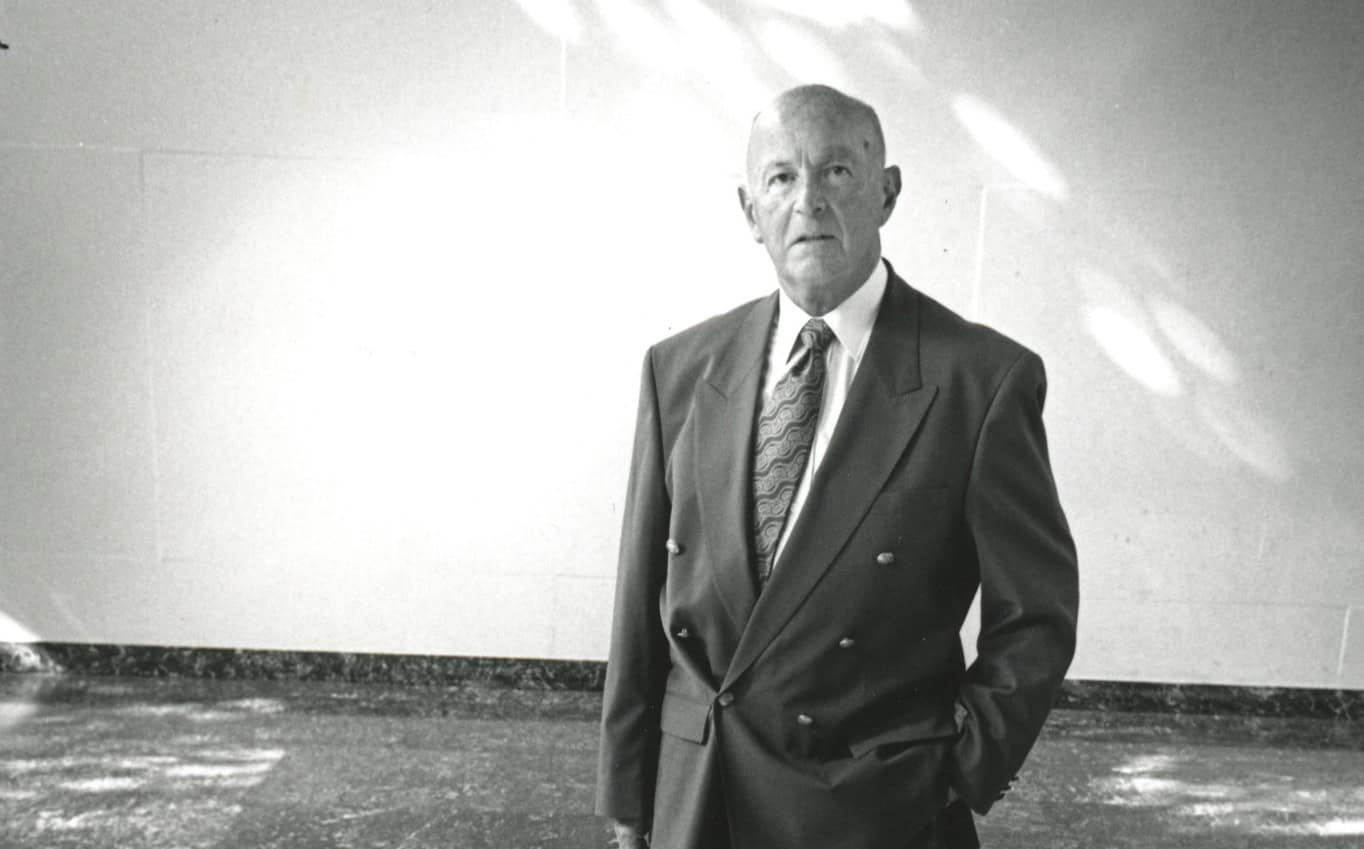
Last Thursday, the festival Lunalia 2023 was dedicated to the work of Karel Goeyvaerts (1923 – 1993), the Belgian composer who experienced all the colors of the rainbow in his career. An exercise in musical multilingualism.
The ensemble I Solisti (conductor Filip Rathé), Liesbeth Devos (soprano) and Jan Michiels (piano) presented in six pieces an overview of the later, more accessible work of Goeyvaerts, supplemented with a creation for piano and ensemble by Tim Mulleman.
The program curators were primarily guided by the works that served as building blocks for Goeyvaerts' opera Aquarius. He worked on this during the last ten years of his life. This is how Goeyvaerts made his mark on history. Liesbeth Devos opened the proceedings with Les Voix du Verseau (1985), a song cycle that serves as a sketchbook for his opera Aquarius (1993). The language use is largely indeterminate with some fragments of English and German, which means much depends on the suggestive talents of the soloist. With Devos, that was in good hands; she did what needed to be done: bring color and atmosphere. In this she aligned well with the instrumental ensemble. A clever choice was her positioning among the instruments, which created a unified whole from the vocal and instrumental forces. That worked. A surprise was Plikonamu Micucona for brass player and piano (1979), originally written as a required piece for participants in a music competition by the then bank Gemeentekrediet. Trombonist Jan Smets proved with an open and razor-sharp interpretation to be just as enthusiastic as the composer.
Lingualism
Language in writing, in spoken and sung word, in music – lingualism in all its forms seems to be the leitmotif of Karel Goeyvaerts. So also in La Flûte de Jade, a song cycle for soprano and piano on French translations of Mandarin texts. The cycle dates from 1949 and shows some traces of the twelve-tone technique that Goeyvaerts employed in his early years. Liesbeth Devos was, curiously enough, most expressive in the pianissimo sections, but the color remained generally within the same palette. Jan Michiels (piano) accompanied her with gentle thrust and nowhere obtrusively. A short but intense dose of lyricism was served up to the audience in a woodwind duet for flute and (bass) clarinet in the ode to three colleagues befriended with Goeyvaerts Voor Harrie, Harry en René (1990). Flutist Lieve Goossens and clarinetist Tomonori Takeda delivered an uninhibited, sprightly and dynamic bit of playing pleasure. They did honor to the combination of flute and bass clarinet that found love in each other at the moments when they found themselves – bien étonnés – in the same tonal registers. In Escale à Bahia, the soprano felt visibly at home. Accompanied by flute and cello (Jan Sciffer), Devos gave shape to the versatility of Brazilian culture and nature to a text by the traveling Swiss-French poet Blaise Cendrars. The fluid wandering through the Brazilian jungle proved an adequate introduction to the austere Litanie I for piano, performed by Jan Michiels. It is a minimalist repetitive piece in which the time modules are successively filled and emptied with motifs. No lack of volume, at least mezzo-forte with a preference for fortissimo and a bit more if possible. Fortunately, Jan Michiels was the performer. He is not only known as a master of the pianissimo but is also capable of keeping loud music audible. That came in handy and the result was an authoritative performance in which the fortissimos remained tight and controlled. That is no small feat, especially not in the Mechelen Baroque church Sint-Pieter-en-Paul where reverberation risks turning into acoustic mush. But Jan Michiels kept it firmly in hand.The evening concluded with the premiere of Movement for piano and ensemble by Belgian composer Tim Mulleman (°1993). The piece contains references to Litanie I by Goeyvaerts and was written by commission from I Solisti. After a chaotic and voluminous opening, from which one could hear that Mulleman has studied composition with Annelies Van Parys, followed a sensitive passage with a dripping piano (Jan Michiels) and feather-light trills that cleared the space for two string players. The trombone made use of four different mutes, through which nuance was maximized. The piano occasionally played passages from Litanie I, coming across more as a wink than as a theme. A long sustained lament from the tutti and a tight rhythmic piano led the listeners to the end in which Goeyvaerts remained present more suggestively than manifestly. That is perhaps how he would have preferred it.
WHAT: 100% Goeyvaerts
WHO: I Solisti (Filip Rathé, conductor), Jan Michiels (piano), Liesbeth Devos (soprano), Mark Delaere (interventions)
WHEN: April 27, Pieter-en-Paul Church, Mechelen
ORGANIZATION: Lunalia 2023, Festival van Vlaanderen Mechelen
AGENDA:
MATRIX (Center for New Music) has a pop-up exhibition Karel Goeyvaerts Mirrored running in the Cultuurcentrum Mechelen, Minderbroedersgang 5.
Until May 7.
Klara recorded this concert. Broadcast on June 8, 100th birthday of Karel Goeyvaerts
PHOTOS: © Wynold Verweij