
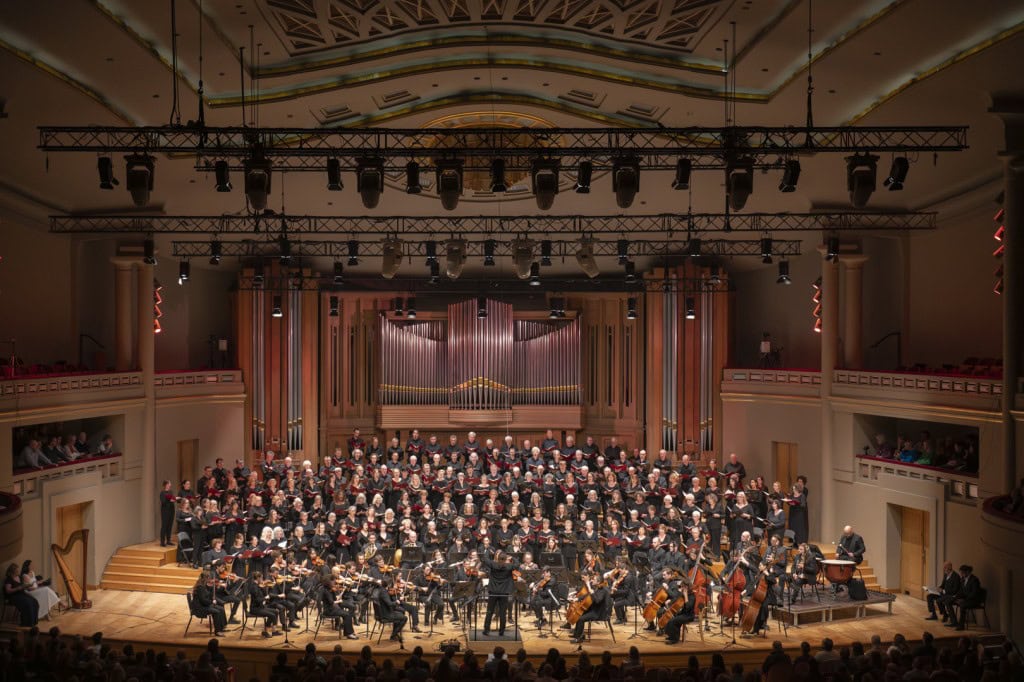
The Brussels Choral Society brought together with the Edinburgh Royal Choral Union at BOZAR on Sunday, December 7, a grand evening featuring the "d-Moll Messe" by Anton Bruckner (1824-1896) and the "Gloria" by Francis Poulenc (1899-1963).
It is a beautiful and engaging occurrence when choirs from different countries meet each other in a shared project; the warmth and enthusiasm that emerge from it are always valuable. However, such collaboration requires a repertoire choice that supports enthusiasm without overloading it.
Bruckner's "d-Moll Messe": monumental yet fragile
The "d-Moll Messe" belongs to those rare works in which Anton Bruckner reconciles his two souls – the architect of gigantic symphonic cathedrals and the humble, faith-driven church musician – intimately with each other. Where his later symphonies rise like massive mountain ranges, this mass presents itself as a finely cut diamond: outwardly simple, but inwardly suffused with symbolism, structure, and a carefully calibrated interplay of light and shadow.
Bruckner wrote the work at a moment of musical emancipation: he broke free from the strict tradition in Linz, but had not yet embraced the Wagnerian expansion of his later style. This gives this mass a ambiguity that defines its essence. It is simultaneously classically lucid and deeply romantic, a bridge between past and future, between liturgical simplicity and spiritual depth. The work reveals the composer both as a builder of future symphonic giants and as a simple, deeply religious person seeking a sound to house his faith. This mass already carries within it the seeds of Bruckner's later monumentality: compositional clarity bordering on the ascetic, combined with a harmonic language that says more than words ever can. This tension between devotion and mysticism, between modesty and monument, makes this mass a work that does not shout, but resonates all the more deeply, with the music unfolding like the space of a church one enters: first the hushed vestibule, then the broader nave, then the high altar where harmony and peace meet, and finally the silence in which everything dissolves. Listening to this mass is an inner journey and constitutes a restrained yet powerful testimony of a composer who was as much believer as artist.
With around two hundred singers, the united choir unmistakably made an impression, but it was precisely this scale that worked against Bruckner's transparent, finely crafted music. The massive scoring often produced sonic density rather than depth, with audible intonation problems and particularly difficulties in the higher register. Understandably – they are (sometimes overly) enthusiastic amateur singers, and their commitment is genuinely commendable – but precisely for this reason the repertoire proved too demanding for a homogeneous result. The Etesiane Orchestra, consisting of inspired younger musicians, stood opposite this choir mass cautiously profiled. The under-staffed orchestral scoring and intonation problems made finding balance an almost impossible task. The lofty architecture of Bruckner's music could thus never fully come into its own.
Among the soloists we fortunately found some solid anchor points. Romane Cabaret (soprano) and Julie Bailly (mezzo) sang with style and control; they brought the refinement that was sometimes lacking elsewhere. Mathys Lagier (tenor) remained rather colorless, while Jean-Manuel Candenot (bass) unfortunately did not offer the depth and authority his role demands.
Conductor Gabriel Hollander deserves special recognition in this context. With careful retards (for example at the "Cujus regni" in the Credo), subtle intensifications in the Benedictus, and a well-considered building of tension – such as at the beginning of the Kyrie and Benedictus as well as the build-up to the "Et ressurexit" in the Credo – he managed to capture attention at various moments. He gave the music shape and direction, even when the performance threatened to collapse under its too-large scale. His craftsmanship revealed what this project could have been with a more balanced scoring…
Poulenc's "Gloria": breath and expression
There are compositions that cannot simply be framed within the boundaries of a genre. Poulenc's "Gloria" is such a work: neither purely sacred music nor graceful concert literature, but a hybrid creation that breathes the spirit of the twentieth century: ironic and serious, light-footed and fervent, worldly and yet steeped in devotion. After the less balanced Bruckner, it became immediately clear that this work suited choir and orchestra better: the ensemble found audible relief and more focus.The opening measures, with their open, almost brutal chord and the propelling rhythm of brass and strings, set the tone immediately: this Gloria in excelsis Deo is not a pious genuflection, but a burst of joy that unites the human and the heavenly in one motion. The combined choral sound of Belgian and Scottish voices possessed an impressive breadth, which suited the work well. Hollander opted for an energetic, sharply forward-driving tempo. Thus the piece never lost its vitality. Yet not every entry was entirely together, and especially in the faster passages there was slight tonal diffusion. The orchestral texture brought out Poulenc's neoclassical character well, though refinement in phrasing was occasionally lacking.
Whoever knows Poulenc knows that he is not afraid to smuggle humor into the liturgy. In the second part Laudamus te he sketches – as he himself said – angels sticking out their tongues. The performance gave this playful character all the room it needed. Hollander kept the contours tight, but allowed enough air in the phrasing to let the music retain its quirky smile. The Etésiane Orchestra distinguished itself here especially in the woodwinds, which gave color with an almost French clarity, although the orchestral dynamic contrasts were not always sharply delineated, causing some details to come across less distinctly.
In the third part Domine Deus, Rex coelestis Poulenc becomes more introspective. Here the expressive burden rests on the soprano and the choir, and precisely here Romane Cabaret showed why she was the focal point of this performance. Her voice combined clarity, stability and natural phrasing, making the spiritual center of gravity of the work palpable. The choir listened attentively; their soft responses were not mere accompaniment but a supporting foundation.
Suddenly, after the restraint, Poulenc comes in the fourth part Domine Fili unigenite with a brief but fierce eruption of rhythmic force, whereby the polyphonic choir structure remained largely clear. In the fifth part Domine Deus, Agnus Dei Poulenc restores the stillness of the third part. This is perhaps the most intimate movement. Cabaret confirmed her strong role here: her entrance sounded like a gentle ray of light, with a melodic line she carried with fragile intensity. The choir provided a warm, breathing foundation without sentimentality. The blend of solo voice and choir beautifully exposed the vulnerability of human longing here: the longing for peace, for clarity, for reconciliation.
In the sixth and final part Qui sedes ad dexteram Patris Poulenc gathers all the material, all the contrasts, all the stylistic worlds that inhabit the work. The rhythmic drive of the opening sections returned; here the choir sounded resolute, although the balance between the voice groups was not always perfect. What followed was a controlled build-up to a powerful climax that abruptly stilled into the final Amen. The last sound, soft and almost fragile, fell like a snowflake in the space – and lingered for a few seconds. The result showed that Poulenc suited the ensemble better than Bruckner, with Romane Cabaret as a constant pivot and Hollander as a reliable guide.
Ambition versus feasibility
The programmatic idea of bringing two choirs together in Bruckner and Poulenc was noble and ambitious, but the performance showed a clear division. Bruckner was too often under tension, the size of the choir worked against rather than with and some passages lost their transparency and depth. Poulenc on the other hand showed what was possible when repertoire better matched the capabilities of the ensemble.
Conductor Gabriel Hollander gave the whole coherence and vision, while Romane Cabaret formed the vocal anchor on which choir and orchestra could build. The concert illustrated the tension in which large amateur projects move: between ambition and feasibility, between commitment and technical limits. An evening with beautiful individual moments, convincing passages in Poulenc, but at the same time clear limitations in Bruckner. A worthwhile undertaking, with commitment and musicality, but not entirely convincing as a total performance.