
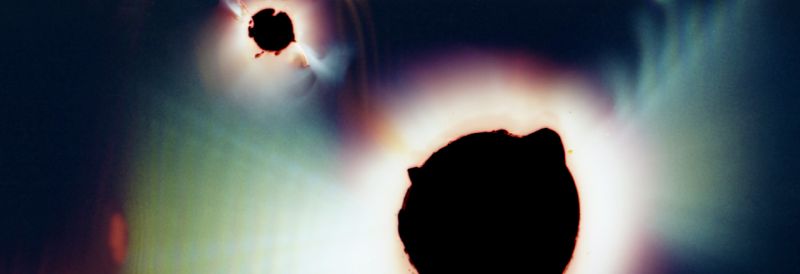
That cultural institutions take artists in residence is already a widespread practice, but hiring a "season thinker" is a novelty that Concertgebouw Brugge initiated. For their "cosmic season" they brought in a cosmologist, Thomas Hertog and they paired him with an artist who has long been fascinated by what happens in space in terms of sound, Arne Deforce.
In a "lecture-performance" both explored the similarities and turning points in the discovery of space and in the development of music. With a dizzying score by Catalan composer Hector Parra, Deforce on his cello gave voice to the last kiss that disappearing black holes can still give each other in the multiverse. The concert and the lecture were two highlights of the Kosmos Festival.
Arne Deforce emerges from the mist of the cosmos on stage and explains how Arnold Schönberg in 1909 with his Drei Klavierstücke freed sound from its classical chains and brought about the emancipation of dissonance. Thomas Hertog takes over and sketches how Albert Einstein at the same time wanted to capture the universe in a formula and free it from Newton's laws. Both performers continue to highlight and illustrate parallels between developments in the new understanding of cosmos and music. Hertog sketches the journey of Leuven astronomer George Lemaître - the Darwin of the cosmos - the man of the Big Bang and the expanding universe and thereby buried Albert Einstein's static and stable image of the cosmos. Deforce joins in and tells how the sound spectrum henceforth also expands over an infinite continuum and lets his favorite composers be heard: Edgar Varèse and Iannis Xenakis. This continues until the very latest insights about the cosmos: string theory which Hertog tries to explain and the strings of his cello which Deforce makes heard in all scales. They seem, albeit in a serious version, a duo of stand-up comedians, now faltering then seamlessly playing off each other. You would readily want to send them on tour with their instructive "Lecture Performance". Two experts on the history of their craft, cosmology and music and how they cross each other at turning points and propel each other forward.
How that sounds at this moment in music history, we should hear in the work that Hector Parra composed on commission from Concertgebouw: "…limites les rêves au-delà". The subtitle tells what it is about: "A journey into a black hole". It is music that should take us to that world of black holes and the expanding universe. That became a wondrous concert. For more than an hour cello and "6-channel surround live electronica", with Deforce in front on a small platform and the audience on the stage. With speakers in all corners. That becomes intense, I thought. But the earplugs you could get were not necessary. Even though sweat poured from a laboring Deforce into the hall. Together with his cello and the score, one bundle of energy. Actually, I even missed sound reinforcement under my seat and above my head, to be able to revel even more in all that multi-dimensionality and experience it even more intensely. The concert began with the deep fundamental tone of life on earth, expanding and varying on all strings of the cello. And you are immediately far away from any form of "traditional" contemporary music, far away from the atonal music of its great inventors and certainly miles away from the vague cosmic music industry. Anyone who measures themselves against the cosmos must burst with energy. No problem for Deforce, for whom one word from the program booklet is extremely fitting: "driven". "During such a concert my score comes straight from Deforce's body, limbs and cello" Parra told in the introduction. But it is controlled energy, also far from musicians who smash piano or guitar to pieces. Here respect for the beloved instrument remains upright. He plays it furiously, recklessly, restlessly and at times also motionless. With that 'surround sound' experience of a journey to and through the universe, black holes, bottomlessness and return to earth, you ask yourself: "Are there limits to the cosmos, are there limits to music?". Here they were in any case extended. The millisecond sound of gravitational waves observed by scientists that arise from colliding black holes, Parra stretched into hours-long galactic clashes. With all that trembling vibration of the strings of the cello you no longer need string theory to understand music or cosmos. You have enough with the strength and splendor of the performance of performer, composer and sound designers.
- WHAT: Lecture Performance, "Music and the Cosmos: Resonance"
- WHO: Thomas Hertog, (prof.dr. KULeuven) speaker and Arne Deforce, speaker and cello, Filip Standaert, direction
- WHERE: Concertgebouw Brugge
- WHEN: March 26, 2019
- WHAT: « … limite les rêves au-delà . A journey into a black hole » by Hèctor Parra for cello and 6-channel surround live electronica (commissioned by Concertgebouw Brugge & Grame for Ruhrtriennale)
- WHO: Arne Deforce, cello, Martin Antiphon (Music Unit), Thomas Goepfer (Grame-Lyon) and Hèctor Parra sound design
- WHERE: Concertgebouw Brugge
- WHEN: March 30, 2019