
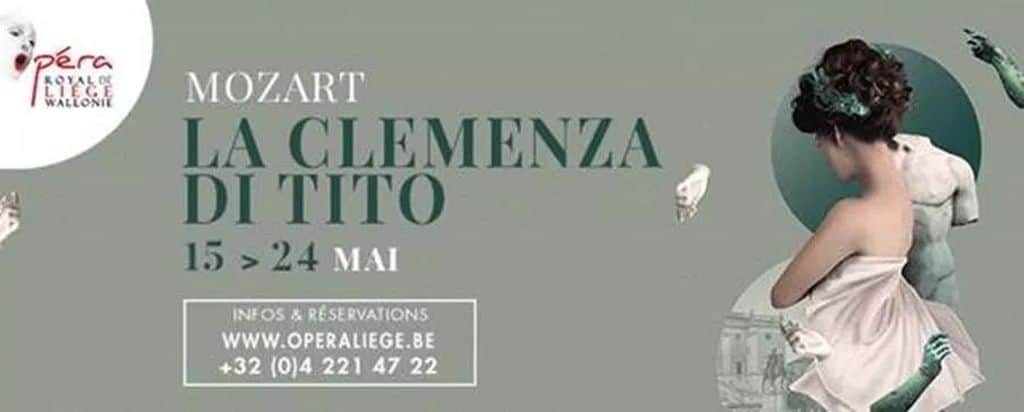
The classical opera curtain already provided a first impression before opening of a rather spectacular opera than the stately story that La Clemenza di Tito (KV 621), Wolfgang Amadeus Mozart's last opera, stands for. The duo Roussat-Lubek, who received a Golden Label Opera with their production of Die Zauberflöte, here ventures somewhat off course regarding the libretto by Pietro Metastasio (adapted by Caterino Mazzolà).
It is a spectacle piece with much acrobatics and a changing, almost ghostly set, with troll-like figures, a renaissance-angelic figure, an emperor as centaur and more characters that could refer to the mythology from Emperor Titus's time, creating a rather busy production.
Mozart was already not in good health when he quickly composed his last opera while still working on Die Zauberflöte and unable to complete his Requiem. Here, apart from a number of very beautiful and touching arias and noble choral singing, he doesn't really achieve an opera as we are accustomed to from him. Is it because his energy was already eaten away by the illness that would strike him down a few months later? Was it because it was a commission that brought in money, but at that moment, partly due to the short deadline, didn't interest him? One can argue that La clemenza di Tito lives on mainly in the overture and a number of arias, yet all the ingredients are present to create a Roman luxurious evocation of it, depicting life in Rome in the year 79.
The director duo Roussat-Lubek, who in addition to direction also took care of the costumes and choreography, deviates sharply from the Roman story. In that time there was a widespread belief in all sorts of devilish figures, half-angels/half-humans and persons with divine status, such as the emperor. There was a centaur, a figure from Greek mythology, but this was not at all as noble as Emperor Titus, quite the opposite. Perhaps the directors were referring to that one other, Chiron, the teacher of a number of heroes from Greek epic? And what is he doing in a Roman story?
Vitellia appears in a devilish form, she is dressed in red with two red false horns in her punk hairstyle. She urges, out of hatred and jealousy, the emperor's most loyal friend to commit the greatest treason by plotting the murder of his friend, the emperor, a devilish deed.
Why the leader of the Praetorian Guard, Publius, becomes a sort of swamp man, I don't understand. Sextus you can see as a military man, but why does Annius become a renaissance figure with one wing of an angel? Actually, the only character you can fit into the story as it should be is Servilia, adorned in wedding dress with a bridal veil meters long.
The set, a rocky area in a dark forest, is mobile and is (with creaking wheels) transformed into a sort of elements useful for the many acrobats who fill the stage, who lower themselves via ropes onto the stage only to climb back up, who do or do not jump through hoops and contort themselves in all possible shapes. Where the people praise and laud the emperor, that certainly fits, but excess harms.
Scenically I am partly satisfied, I understand the directors' intention, but due to the excess of activities on stage that don't connect with the story, it becomes somewhat difficult to maintain this until the end.
A world-class voice with a future!
I cannot avoid it, the discovery was the young Finnish bass-baritone Markus Suihkonen. He made his debut at the Opéra Royal de Wallonie and performed the role of Publius (Publio). He acted perfectly according to the directors' wishes, but of far greater importance was and is his interpretation. He is one of the finest young basses I have ever heard. He possesses a voice with enormous carrying power, rare suppleness, rich warm colors in all the pitches that he effortlessly reaches with his wide tessitura. Remember this name, because he will be (is?) the bass of the future!
With great conviction Anna Bonitatibus performed the role of Sixtus (Sesto). Few singers succeed so well in realizing a castrato role. She specializes in these roles and you can hear it. What enormous professionalism she combines with very refined musicality. These two singers made the opera into a musically solid event.
Less impressive was Patrizia Ciofi who performed the devilish Vitellia. In the upper register her soprano reaches particularly beautifully and richly, but in the lower register she is hoarse and her voice achieves too little.
Tito, performed by tenor Leonardo Cortellazzi, remains monotonous singing at equal volume. A pity, especially in the first aria which demands so much erudition. Cecilia Molinari, who sang the castrato role of Annio, convinced with the seriousness that Mozart has placed in this role. Here Veronica Cangemi, the soprano singing Servilia, joins in, delivering a responsible interpretation of a not so heavily laden role.
The orchestra, with conductor Thomas Rösner, didn't always come across equally well. All the better was once again the choir. Pierre Iodice is, as far as I'm concerned, one of the better conductors for opera choirs.
All in all it was a production that deserved to be, even if it was somewhat a matter of finding the red thread in the direction. It is a performance that fits into the vision of the director, Stefano Mazzonis di Pralafera, of the Walloon opera house.
- WHAT: La Clemenza di Tito, opera by Wolfgang Amadeus Mozart
- WHO: Direction / costumes / choreography: duo Roussat-Lubek – singers: Markus Suihkonen, Anna Bonitatibus, Patrizia Ciofi, Leonardo Cortellazzi, Cecilia Molinari, Veronica Cangemi – conducting: Thomas Rösner
- WHERE & WHEN: Opéra Royal de Wallonie, première 15 May 2019
- PHOTOS: © Opéra Royal de Wallonie-Liège
[embed]https://www.youtube.com/watch?v=xddb_circOk[/embed]