
Liège, April 6, 2018: premiere at the Opéra de Wallonie of Le Nozze di Figaro by Wolfgang Amadeus Mozart and Lorenzo Da Ponte. After what we felt was a failed Don Giovanni last season and a rather bizarre Carmen this season, the undersigned was somewhat anxious about what would be seen and heard. The anxiety disappeared immediately when the curtain opened.
The story is, like countless opera librettos, no masterpiece of literature. What it is really about is accusing the mighty pretense of decadent nobility that takes liberties with their subjects. There was the right of the first night for the lord when one of his servants married a virgin maiden. The noble lord in the present story, based on a novel by Pierre-Augustin Beaumarchais 'Le Mariage de Figaro', gave it up once. He thought it was a clever move to bind his subjects even more to him, and especially (shall we say) the female half of those subjects. However, he fails in this and even has to ask for public pardon. It is the complete humiliation of the lord for his shameful behavior that knows no love but only brutal sexual personal gratification that shows no regard for the partner. A perverse situation, and his subjects not only manage to turn the tide, they literally force him to his knees.
Everything else around the story to make it lighthearted, accessible and humorous is actually superfluous. It had to be that way at the time because with the (re-emerging) censorship, it was always a tightrope walk for the authors. How far could you go too far? And what if the censors immediately saw through where the criticism actually lay? What measures could befall you? It was therefore a matter of walking on eggshells... Mozart and Da Ponte handled the whole thing creatively and managed to ultimately satisfy the censors. Thanks to their ingenuity, we can still fully enjoy this masterful opera. For masterful it is. That mastery demands the best singers, the best director, the best orchestra and the best conductor.
A feast for the eyes
One less satisfying experience regarding the entire performance: the orchestra was not at its best, particularly the overture had musical lapses and came across very thinly. The musicians followed conductor Christophe Rousset, certainly not a second-rate amateur!, apparently either not or there was insufficient rehearsal time? In any case, it could be more beautiful, more accurate, fuller, more eloquently phrased. Once the opera was in full swing, the orchestra improved as well.
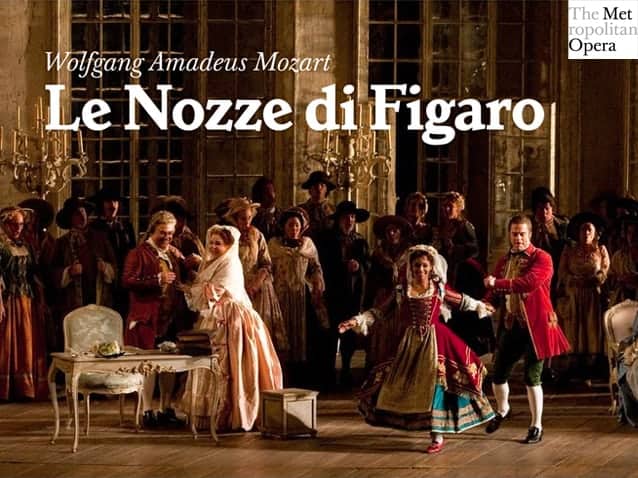
When the curtain opened, you immediately found yourself in the 18th-century palace of Count Almaviva. Soft creamy eggshell-colored walls, beautiful classical moldings, beautiful woodwork. Behind the large windows, the maids are making clothing and fabric decorations for the fast-approaching wedding. They all wear shades from soft yellow to creamy ochre, all in pastel, which brings much light to the scenery and emphasizes the atmosphere of celebration, cheerfulness and happiness.
The sets that follow in the palace and especially in the garden are also very beautiful, highly artistic. Particularly the garden scene that ends with a rising full moon is like a living painting from Mozart's time. The arrangement of the plants in and around the colonnade, the costumes of the different singers and their positions on the stage complete this living painting. The numerous young people in the audience thoroughly enjoyed it. Next to me sat some young people around 20 and younger, and their commentary basically said everything about the complete direction: "Beautiful, sweetie, that's exactly how it was in Mozart's time. That fits so well with the music. You don't see that in any other opera where they always make it something modern."
The ear also enjoyed itself
Apart from my rather strict comment about the orchestra, the crowd of singers was ideally chosen for the role of their lifetime. Written perfectly for each singer, as if Mozart and Da Ponte had personally chosen them and then set about writing the text and music.
Let us go through the singers in the order they appear in the program book.
Il Conte Almaviva, the count, was sung by baritone Mario Cassi. A far-reaching voice, full maturity and very conscious. He also acted perfectly. What a count!
La Contessa Almaviva – the countess – was portrayed by Judith Van Wanroij. A less powerful voice, but that is exactly what is needed for this sorrowful lady who has been insulted for years by her husband's numerous women-conquering and simultaneously intensely jealous behavior. She managed to convey the suffering, the melancholy mood almost grippingly.
Figaro took shape through younger baritone Leon Košavic. A portrayal of the better kind you could wish for. Musicality and acting talent went hand in hand. This was further confirmed by Susanna, that sweet honest treasure of a Susanna, a clever maid who gets the count on his knees and is rewarded in Love. This blissful role was brought to life with every imaginable perfection by soprano Jodie Devos. What a singer! She gets better at it every time, this is absolute world class. It makes me a bit prouder each time that she sang at our annual Golden Labels Award Ceremony in 2014, right after she won second prize in the Queen Elisabeth Competition singing. We had already booked her before she became a laureate. It's gratifying that we at Klassiek Centraal are sometimes very alert to young talent, honor it and see it succeed. It is one of our tasks and when it succeeds, we smile with satisfaction. Enough self-praise, back to the singers.
Certainly also cleverly cast was Cherubino by Raffaella Milanesi. It remains difficult for a woman to play that male role and it was achieved here like a "piece of cake". Very good!
Julien Véronèse, a robust bass, gave delightful shape to Dottore Bartolo while the somewhat older soprano voice of Alexise Yerna was perfectly suited to the role of Marcellina. Not the voice type that normally appeals to me, but in this role: ideal. The limited role of Don Basilio, Enrico Casari, was just as aware as the others of adding colour to the whole. Patrick Delcour is one of the better regular fixtures for minor roles at the Opéra de Wallonie and as Antonio, the annoying gardener and father of the bride-to-be Barbarina, he knew how to win over the audience. Barbarina, the good little daughter, as smitten as could be with Cherubino, was Julie Mossay who was allowed to perform the role.
Conductor Christophe Rousset signed for the direction of the whole, the direction was in the hands of Emilio Sagi, the sets were a design by Daniel Bianco and Gabriela Salaverri designed the costumes. For a very appropriate choreography, Juria Castejón stood as guarantor – her Spanish dancers brought a perfect little ballet with castanets that played very well with the orchestra. Eduardo Bravo was allowed to do the lighting again and as always Pierre Iodice for a choir that sang to the best of its ability.
With this Le Nozze di Figaro it was largely enjoyable and reminiscent. It could hardly have been more Mozartian. In short, a production worth seeing again.
- WHAT: Le Nozze di Figaro, opera by Mozart (music) and Da Ponte (libretto)
- WHO: Orchestra and choir of the Opéra Royal de Wallonie, conductor Christophe Rousset, director Emilio Sagi, sets Daniel Bianco, costumes Gabriela Salaverri, choreography Juria Castejón, choir direction Pierre Iodice. Singers: Mario Cassi, Judith Van Wanroij, Leon Košavic, Jodie Devos, Raffaella Milanesi, Julien Véronèse, Alexise Yerna, Julie Mossay, Enrico Casari, Patrick Delcour, Stefano De Rosa, Myriam Hautregard, Anne-Françoise Lecoq
- WHERE & WHEN: Opéra Royal de Wallonie, Liège, Friday 6 April 2018
- PHOTOS: © Opéra Royal de Wallonie