
Click here for the table of contents
Exactly two years ago I discussed Fastes de la Grande Écurie from the same label, by the same ensemble: Syntagma Amici, then supplemented with Giourdina (click here). That album was dedicated to music from the Grand Siècle, the period in which two Ludwigs held sway: XIII and XIV. Music that also came with much spectacle. At and around the court of Versailles many lavish celebrations were held but also many processions, for which of course appropriate music was provided. This musical accompaniment was provided by the various departments of the Grand Écurie, the musical 'arsenal' of the court, with drums, timpani, trumpets, cornets, sackbuts, trombones, horns, oboes, bassoons, pipers, etc.
In 1651 a fifth department was added: containing the 'cromorne' (a typically French wooden wind instrument of unknown origin that belongs to the oboe family and has nothing to do with the German Krummhorn) and the 'trompette marine', a string instrument with only one string (monochord) that in terms of sound somewhat resembled that of the trumpet (hence the name). The origin of 'marine' is moreover uncertain.
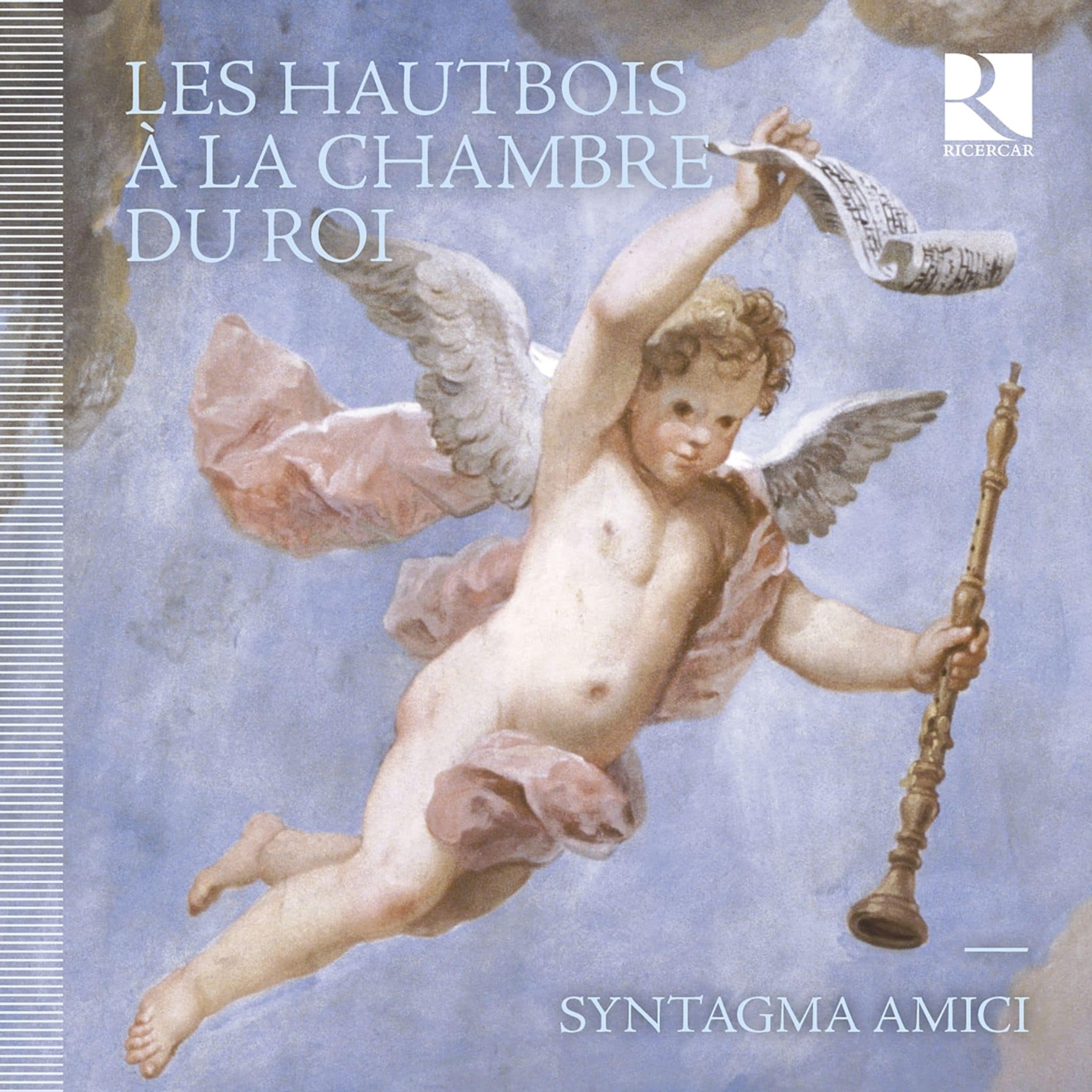
On this new album, the title says it all: Les Hautbois à la Chambre du Roi, the woodwind players are central, instruments that played a role in virtually all courtly musical activities, with a prominent role for oboes and bassoons, instruments that due to their powerful and penetrating sound were difficult to blend with other instruments. Adding to this was that they were tuned much higher than the standard tuning as used by the 'Académie', the 'Chapelle' or the 'Chambre'. This is described in Mémoire de M. de La Barre sur les musettes et hautbois from 1735, of which a fragment appears below:
'La musique retomba dans le barbare, et elle y est restée à très peu près, jusques au tams de Louis quatorse, sous le célèbre raygne ou tous les arts on esté portez a leur perfection, la musique a brillé infiniment. Le Camus, Boisset, Dembris et Lambert ont estez les premiers à faire des airs qui exprimassent les parolles, mais surtout le celebre Luly; on peut dire que on devroit l'apeller l'apollon de la France, mais son elevation fit la chute totalle de tous les entiens instrumens, a l'exception du haubois, grâce aux Filidor et Hautteterre [Philidor et Hotteterre, AvdW], lesquels ont tant gâté de bois et soutenus de la musique, qu'ils sont enfin parvenus a le rendre propre pour les concerts.'
Philidor and Hotteterre were not only renowned instrument makers, but also reputable instrumentalists who from their primary profession were able to adapt the instruments to the timbre of the string players (violins, viols) and moreover succeeded in lowering the tuning by almost a quarter. That made a real difference. Moreover, they did everything they could to make their instruments longer and thinner. With a view to more refined tone and better chromaticism. As the development progressed and the various parts could be easily separated, it also became simpler to adjust the bore.
In this way a veritable metamorphosis of almost revolutionary proportions came about, not only for oboe and bassoon, but also for recorder, flageolet and musette. From this fascinating historical perspective, Les Hautbois à la Chambre du Roi originated.
The French ensemble Syntagma Amici, founded by Jérémie Papasergio, uses - it hardly needs saying - 'authentic' instruments (though mostly replicas, as time marches on and playing very old instruments is no sinecure despite restorations). I give you the instruments used for this album in their original French nomenclature: hautbois, taille de hautbois, flûte à bec, basson, basse de cromorne, flageolet d'oiseau, violon, taille de violon, basse de viole, basse-taille, dessus de viole, petite basse de violon, théorbe, guitare, chapeau chinois, clavecin, orgue.
This is catchy and mostly spicy music in beautifully stylized performances and in an appropriately matched recording technique that gives the instrument ensemble a warm as well as striking glow. Thus it is an extremely colorful reflection of the music and the instruments that went with it as they were used in those long-forgotten times. Unreservedly recommended!