
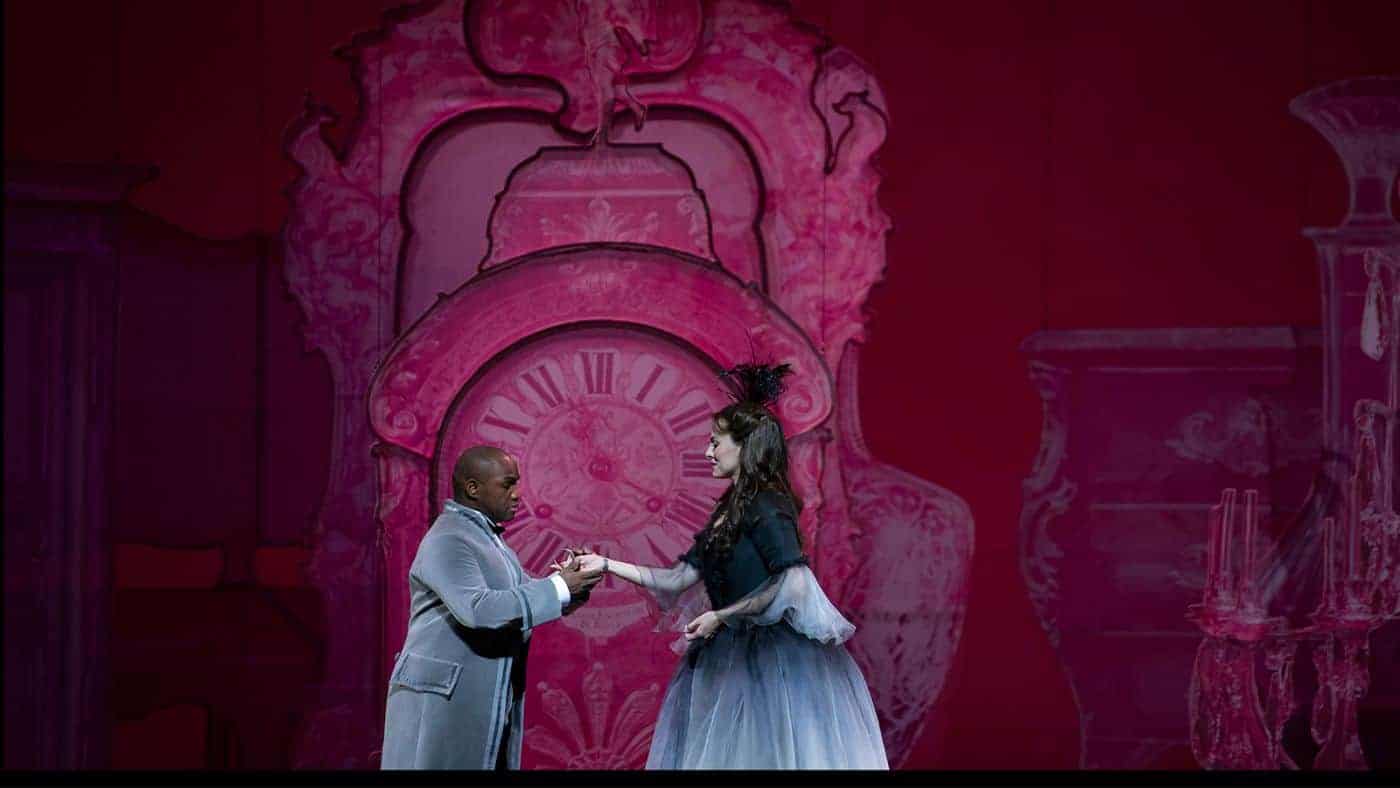
If there is one director you associate with the imaginative and magical in opera, it is Laurent Pelly. In La Cenerentola by Gioacchino Rossini, the year-end production of the National Opera in Amsterdam, he gives his exuberant and at the same time refined imagination free rein. Combined with the super-rhythmic musical performance of the orchestra and the singing and acting talent of the performers, it creates an opera experience that brings joy and contentment.
Una volta c'era un re … Once upon a time there was a king. With such an opening line from Rossini's La Cenerentola, you can only expect a fairy tale. But Rossini did something more with Charles Perrault's original fairy tale. The spiteful stepmother is here the father, baron Don Magnifico. There is no pumpkin that becomes a carriage. The fairy is the "philosopher" Alidoro, who first presents himself as a poor beggar. Last but not least: the slipper is a bracelet, of which the second copy must be found! Typical of Rossini is of course also the world of confusion and deception he conjures up through the mistaken identity of the Prince and his servant Dandini. The mixing of pronounced buffo characters like Don Magnifico with more sentimental characters like the Prince and Cenerentola gives the opera the character of tenderness and romance. So La Cenerentola, through the mixing of the comic and the sentimental, is a typical piece in the mixed genre of semi-seria opera.
Comic and moving
Surprising is the construction of Pelly's stage: he starts with an empty stage on which the poor Cenerentola's maidservant - duster and bucket in hand - sings her sad cavatina Una volta c'era un re. Cecilia Molinari does this with longing and yearning and immediately characterizes her character as a lonely and humble girl. Very cleverly, movable platforms are then rolled on with rooms from the family home: bathroom, bedrooms of the stepsisters, kitchen table and cupboard, laundry room with washing machines. A colorful medley with a standing lamp by the sofa, porcelain figurines and so on. Very realistic and movable depending on the content of the scene. Useful especially to clarify the relationship between Cenerentola and on the one hand her stepsisters and father and the "magical" figure of Alidoro and on the other hand the prince and his servant.
Pelly indicates with details in the decor that the castle is in disrepair. Everything is poor and worn and the wallpaper is half hanging off the walls. But then Pelly provides a magical transformation: at the moment when Cenerentola and the Prince (at that moment still in the form of his servant Dandini) look each other in the eye, he suddenly lets a pink glow light up the stage. It is a lovely moment during that beautiful aria Un soave non so che, for which Rossini had the brilliant idea of writing the aria in the same rhythm as the melancholic opening melody of Cenerentola, albeit with a faster melody. Laurent Pelly, for his part, has had the lovely inspiration from that moment on to illustrate the scenery having to do with the ball and the Prince's search for a fiancée with translucent pink decorative elements: enchanting and entirely in the spirit of the unreal magical world of Gioacchino Rossini. Carriage for Cenerentola, chandeliers in the palace: it belongs to a translucent world that is pure fantasy and scene after scene leads to a fantastic ending. That Cenerentola and the Prince do also escape the pure enchantment is also shown by their costume. As long as Dandini plays the pseudo-prince, he wears a pink costume. Once the prince no longer plays in disguise, he wears an elegant gray suit, in keeping with the magnificent gray tulle dress of the enchanted Cenerentola as future bride. Pelly plays with details and subtle references that are now funny and then moving again, and continuously emphasize the ambiguity of the story.
Rhythm and confusion
Pelly also succeeds excellently in showing and directing the contrast between the characters of Rossini's opera to the rhythm of the music. The sensitive and condemned-to-servitude Cenerentola who undergoes a metamorphosis from "ugly duckling" to adult, attractive woman. The wise Alidoro, plays perfectly his role of initially beggar, but then philosopher "with the golden wings" (his name) and the motor of Cenerentola's transformation. Rossini also gives them arias that match their character in melody and rhythm. The tenderness of Cenerentola and the wonder of Alidoro in his impressive aria La del ciel nel arcano profondo.
In contrast are the ludicrous pseudo-aristocratic Don Magnifico and his two vain daughters. For them Rossini has music that is full of irony, such as in Don Magnifico's aria about his dream with the winged donkey. Or the jerky music as Don Magnifico and the stepsisters discover who Cenerentola is, as if their jaws drop in surprise. The directing adapts each time to the rhythm of the music, also at each appearance of the choir, the Prince's entourage. The rhythmic direction culminates of course in the typically Rossinian crescendi in the ensembles, such as in the bustling sextet of the "denouement" (Questo è un nodo avviluppato) in which the servant turns out to be the Prince and the kitchen maid the lady of the ball. The characters form while they sing those extra accentuated consonants literally a tangled back and forth wriggling bundle.
Brilliant bel canto
The entire entertaining story with its enchantment and deception is at the same time a musical feast with an orchestra brimming with energy and wit under the direction of the driven conductor Daniele Rustoni, who consistently applies the right and often changing tenor of musical style. The poetry of Cenerentola and her meeting with the Prince sounds wistfully and romantically as a counterbalance to the ridiculous nervousness and irony of the sisters and Don Magnifico. Vocally we enjoy a top cast with as a standout the very beautiful tenor voice of Lawrence Brownlee with his excellent command of the light-sounding head voice. Nicola Alaimo confirms his reputation as a born and bred buffo-baritone, Roberto Tagliavini lends his warm and imposing voice to the wise philosopher Alidoro. In the performance of 22 December, Cecilia Molinari sang a touching and disarming Cenerentola with much suppleness in the demanding coloraturas. Sometimes the voice sounds a bit hard, but in her famous final aria Nacqui all'affanno e al pianto she delivered a delightful varied vocal apotheosis. Musically therefore also a magnificent performance, where incidentally the numerous young audience in the hall enjoyed it boundlessly!
- WHAT: Gioacchino Rossini (1792-1868) | La Cenerentola
- DIRECTION: Laurent Pelly
- VOICES: Cecilia Molinari, Lawrence Brownlee, Nicola Alaimo, Roberto Tagliavini, Alessandro Arduini, Julietta Aleksanyan, Polly Leech
- ORCHESTRA: Nederlands Kamerorkest en Koor van de Nationale Opera
- WHERE: De Nationale Opera, Amsterdam
- WHEN: Sunday 22 December 2019 (performances until 28 December)
- PHOTO: © Matthias Baus