
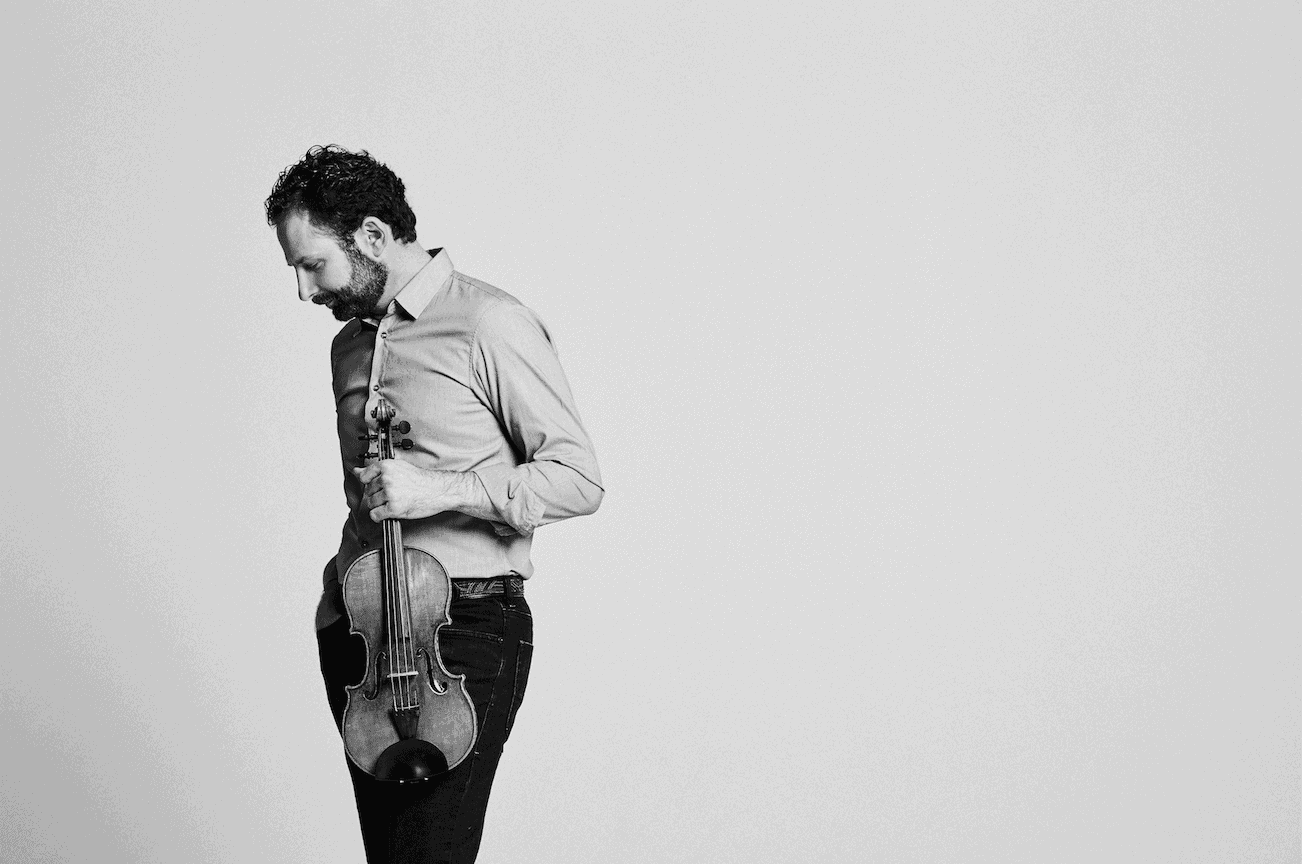
Breathtaking virtuosity paired with charming and ingenious melodies, that is what Ilya Gringolts presents to us. This Russian violinist takes on the challenge with the outstanding violin passages from the baroque repertoire. Locatelli's masterwork is demanding, both for musician and listener.
The Italian baroque composer Pietro Locatelli (1695–1764, Bergamo) evolved from an (unpaid) 3rd violinist in the Cappella of his birthplace to one of the greatest hidden violin virtuosos of his time. Hidden away in Amsterdam, he played only for the 'happy few'. As a catalyst of the virtuosic style, Locatelli was an example for generations after him — Antonio Lolli (ca. 1725–1802) and Niccolò Paganini (1782–1840) are well-known examples.
Solitary genius
Locatelli found inspiration in Rome and Venice. Rome had a magnetic pull on violinists because of the presence of the Novello Orfeo, or grand master Arcangelo Corelli (1653–1713). Venice had the rising star Antonio Vivaldi (1678–1741). In this Italian trading city, Locatelli composed his most influential work Arte del violino, op.3 (1733). However, the first edition was not printed until 1743 and was published in Amsterdam.
Despite his exceptional technique and virtuosity, Locatelli received much criticism — mainly for his playing in the highest register (beautifully illustrated in capriccio no. 22, track 6). Eventually, "il Bergamasco" moved to Amsterdam for unknown reasons. There he gave scarcely any performances and exclusively for amateurs — no professionals — to prevent his style from being copied. He was also a violin teacher and music publisher.
Devilish virtuosity
Locatelli pushed the boundaries of violin technique to unprecedented virtuosity. Examples include double stops and position stretching in the left hand, alongside the use of innovative bow techniques. In short, virtuosity was his all-consuming trademark and for this reason he was often (and sometimes still is) called 'merely a virtuoso'.
That seems a bit shortsighted. His concerti consist of three movements: a fast movement (allegro), followed by a slow movement (largo) and ending with another faster (allegro) or moderate (andante) movement. Herein Locatelli displays his musical richness and charm through unparalleled technical demands. In the faster movements, an ad libitum solo capriccio always follows the final ritornello. Virtuosity takes precedence here. These capricci impress the listener in such a way that they completely capture the spotlight and the lyrical Largo, perhaps too quickly, is forgotten.
Harmonic labyrinth
Violinist Ilya Gringolts, who has previously recorded the better-known capricci (op.1 and op.38) by Paganini on cd, now ventures into those of Locatelli. Together with the Finnish Baroque Orchestra, he brings three of the twelve violin concerti from Arte del violino. Here Gringolts takes on, as was historically customary, both the solo violin passages and the musical direction.
Even in the last concerto, which is renowned for the extreme difficulty of the capricci, Gringolts maintains the balance between technical precision and melodic fascination. In the first capriccio of this last concerto, Locatelli wrote: "Harmonic labyrinth: easily accessible; difficult to escape". The work begins in that manner. The continuo part sets the playful melody of the ritornello, after which this tutti is repeated. But soon the violin part evolves from a single note as melody to double stops and even triple stops. The first capriccio immediately takes us to the renowned higher register. Normally the second movement is a moment to catch your breath, but here the slower movement (largo-presto-adagio) is interrupted by technical acrobatics. The closing section is a culmination point of techniques heard earlier and serves as the longest section as a marathon for the soloist. After Gringolts' impressive final capriccio, the tutti final ritornello comes as a breath of relief before the music comes to rest.
Information
- WHO: Finnish Baroque Orchestra led by Ilya Gringolts [violin]
- WHAT: Il labirinto armonico: Violin Concerti op.3 No. 9, 11, 12
- RELEASES: BIS Records 10401701
- PHOTOS: © Kaupo Kikkas
- ORDER: JPC