
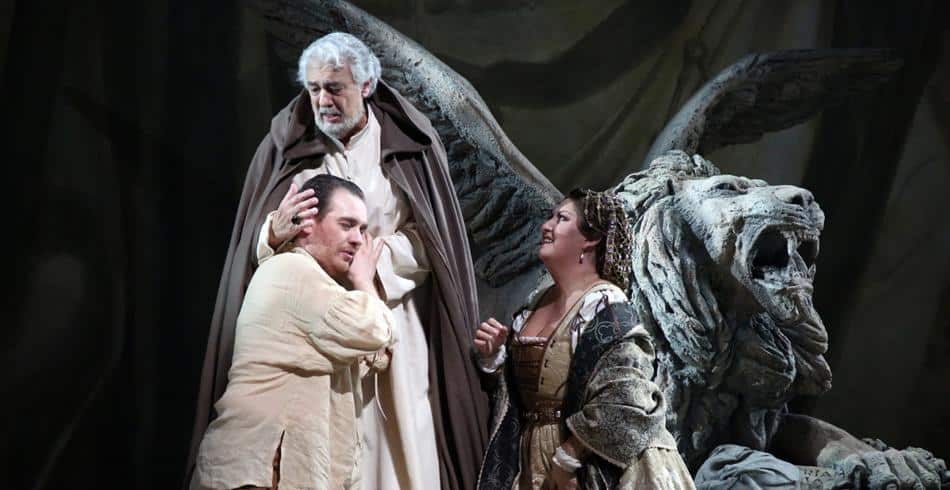
**** The opera I due Foscari still belongs to the early period of Giuseppe Verdi, which in his rich oeuvre is often synonymous with a (too) little-known opera. This recording from the Teatro alla Scala in Milan is an excellent remedy for that. Thanks to a top-notch performance by the lead singers, with Placido Domingo at the helm, and the very carefully crafted and beautiful staging.
The story takes place in Venice in the middle of the 15th century. The two "Foscari" in the title are father and son Foscari. Francesco Foscari is the doge of Venice. His son Jacopo has been sentenced to lifelong exile by the "Council of Ten," a kind of Venetian inquisition. The verdict was provoked by a member of another Venetian noble family: Jacopo Loredano, who believes that the Foscaris are responsible for the murder of his father and uncle. Throughout the opera, Francesco Foscari struggles with the dilemma between love for his son and acceptance of the just punishment for a crime. Moreover, Jacopo's wife, Lucrezia Contarini, and his two children also become victims of the banishment. Lucrezia's pleas cannot sway Loredano to mercy. Eventually, Jacopo Foscari departs into exile and then fate strikes doubly cruel: the doge receives word that another Venetian nobleman has confessed on his deathbed to the murder of which Jacopo was accused, but at the same time Jacopo Foscari dies on the ship as it leaves Venice.
The tragedy of the irreconcilability between social and private life leads, as always with Verdi in this opera, to very moving and painful scenes. Already in the first act, every aria, every confrontation is marked by the overall sadness of the situation. The sorrow of the doge, trapped in the rules of the Council of Ten (Eccomi solo alfine in the first act), the painful confrontation with Jacopo's wife Lucrezia (Di sua innocenza dubiti?): everything is dark and somber. Director Alvis Hermanis, who also designed the sets, has created an atmospheric image of a misty Venice, with the iconic lion of San Marco as a symbol for the doge city. As in his 2014 production of Jenufa at the Munt, he draws inspiration from the "local color" of the setting, in this case evocative Venetian views. The opera opens on a scene where Domingo sorrowfully leans on the powerful Lion. A dark foreshadowing of the fatal outcome. The setting is faithful to the period of the events and the sets and costumes are magnificent. The ballet occasionally gives an aspect of ironic detachment from the seriousness of the historical weight. In the third act where it suggests the gondoliers (in harmony with the music) it makes sense, but during the very beautiful aria of Jacopo in the second act, the ballet in the background is a pointless distraction.
Grandiose applause
The entire opera rests on three main characters – each in their own way a victim: father Francesco and son Jacopo Foscari and the wife Lucrezia. Curiously enough, the one who is the cause of the drama, Jacopo Loredano (also a baritone) has only a secondary role and not even a real aria. As an old father (according to the libretto he is a man of eighty-four years) Placido Domingo plays his role wonderfully. He completely inhabits the character of the father, wrestling with the conflict between paternal emotion and concern and the inflexibility of the law he is expected to respect. In the trio in the second act, he is literally torn between "Padre" and "doge". In this beautiful baritone role, Domingo once again demonstrates masterful acting and vocal expressiveness. Also in the fateful scene in the third act, Domingo is unique. He has a grin in his expression towards his adversaries, is authoritative and self-assured, but at the same time there is that suppressed anger in his voice. What a singer! The two other leading roles are also excellently cast. Francesco Meli is probably one of the best Verdi tenors of the moment. He receives a beautiful opening aria with a rousing cabaletta typical of early Verdi. Francesco Meli has a nice homogeneous timbre and dramatic power, which remains controlled, so that in the long role we never hear a screaming tenor. As Lucrezia, Anna Pirozzi makes a beautiful impression with a powerful and expressive voice. Her resistance to the fatal and cool inexorability gives her a noble character and so Pirozzi also sings her role as a wife. No wonder she received grandiose applause at the end of the performance. Conductor Michele Mariotti also rightfully shared in the enthusiasm of the audience. He drew the right accents from the orchestra to bring to life the emotionality and intense drama of Verdi's music.
A performance that hopefully can boost the reputation of this early Verdi a bit, thanks to the beautiful production with a carefully crafted, atmospheric and historically faithful staging by Alvis Hermanis, good singers and a masterful performance by Placido Domingo.
- WHAT: Giuseppe Verdi (1813-1901) | I due Foscari
- DIRECTION: Alvis Hermanis
- VOICES: Placido Domingo, Francesco Meli, Anna Pirozzi, Andrea Concetti, ...
- ORCHESTRA: Choir and orchestra of Teatro alla Scala conducted by Michele Mariotti
- RELEASE: Dvd CMajor Unitel 742104