
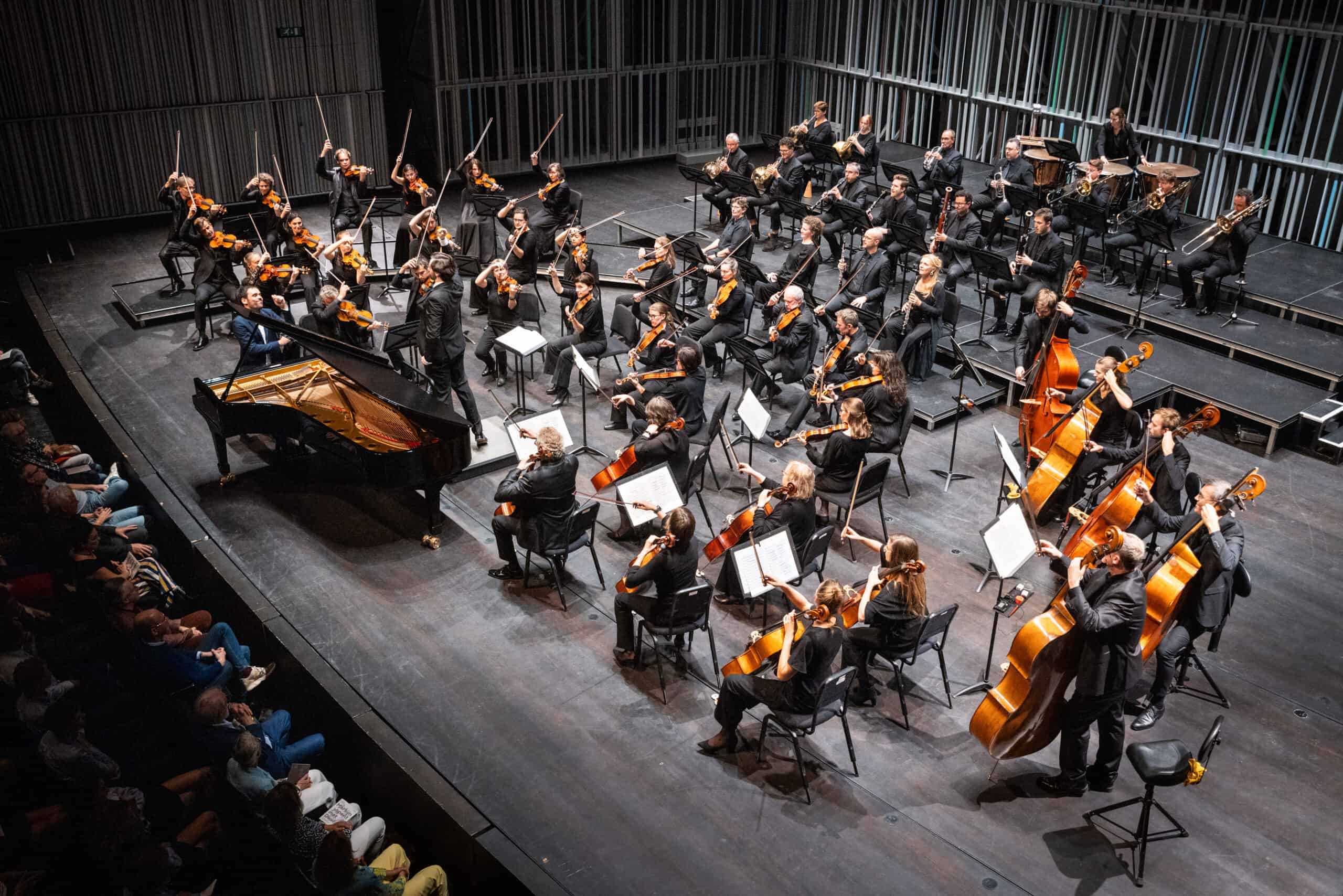
The title of the concert 'Kosmopolitische Flair' lives up to its promise, testifying to the musical wealth in which fascinating musical worlds are explored.
Concerto for piano and orchestra no. 1 in B-flat, opus 23 – Pjotr Iljitsj Tsjajkovski
The Concerto for piano and orchestra no. 1 in B-flat opus 23 resounded as the opening work.
Composed in the 19th century, it has lost nothing of its grandeur. We can even call it a highlight of the Romantic era. The beginning was nevertheless in a minor key. When Pjotr Iljitsj Tsjajkovski presented it to pianist Nikolaj Rubenstein on Christmas Eve 1875, he reacted rather bluntly. He called it worthless and unplayable. It hits hard for the 35-year-old composer. Yet he refuses to change anything about the music. Just as well. What probably bothered his teacher was the innovative form. Instead of recurring themes, he uses melodies that evolve throughout the music and the movements. Nowadays, this concerto, whose imposing opening measures are world-renowned, is one of the most popular works.
Although Tsjajkovski adopted Western musical theory through his studies at the Conservatory of Sint-Petersburg, he wanted to express the typical Russian mentality. He liked to use Russian folk melodies, also to be found in this composition. In the fast passage of the second movement, one can even recognize the melody of a French song 'Il faut s'amuser, danser et rire'.
The 33-year-old Parisian Tanguy de Williencourt appears as soloist. He is praised as one of the future greats of the piano. Recently he recorded a cd with music by Belgian composer César Franck together with Symfonieorkest Vlaanderen for the Mirare label. In 2022 he appeared on the big screen in the company of the great American soprano Renée Fleming.
With bravura he pulls out all the pianistic registers. The score demands speed, control, personality and fantasy. He performs the different tempi brilliantly, powerfully or delicately. His interpretation is impressive and expressive. A grand display of virtuosity. He knows how to inspire the audience. Yet he retains boyish qualities. Whenever he is not at the keyboard, he runs his hand through his hair.
This concerto is a volcano of sound. You feel yourself drift away on the powerful swelling tones. The lightness that sometimes bubbles up is like water from a fountain. Conductor Martijn Dendievel conducts with flair and finesse. A conductor of broad gestures who plays and carries along the entire orchestra. He lets the music shimmer. The audience enjoyed it to the fullest. Quite unusual, but well-received: as a finale, conductor and pianist played à quatre-mains: 'Le jardin féerique' from Ma Mère l'Oye by Maurice Ravel. A trifle from two top musicians.
After the interval
Symfonieorkest Vlaanderen creates opportunities for young musicians, composers, soloists and conductors. After the interval, a composition by Murielle Lemay was performed
'Augur' a creation as part of the SOV Composers Academy
Canadian Murielle Lemay studies at the Royal Conservatory of Brussels in the class of Annelies Van Parijs. It is a visionary work in which she expresses our current zeitgeist. Fragments of themes and harmonies from the Seventh Symphony by Antonin Dvořák resound throughout. Turbulence and serenity find a harmonious balance in her work.
Symphony no. 7 in D, opus 70 – Antonin Dvořák
Dvořák was a cosmopolitan who, born in Bohemia, traveled during his lifetime to Austria, England, Russia, and from 1892 to 1895 was artistic director of the New York conservatory. He emerged as the figurehead of Czech classical music. In which he manages to seamlessly weave together various elements of Bohemian folk music and classical music. These patriotic sentiments were also the inspiration for his Seventh Symphony. He wrote the music on commission from the Philharmonic Society of London.
On the score he noted "God, love and fatherland", an associative sequence that reflected his disposition and work. Yet this composition does not sound like his other work. There is a clash between patriotism and cosmopolitanism, between 'service to his country' and his ambitions for international success. There are lyrical themes, but there is also a dark side to this symphony. It is also called the 'tragic' symphony. What is beautiful about this composition is that many instrumentalists get a solo part. Martijn Dendievel conducts the orchestra flawlessly through the long arcs of tension. With great expressiveness in his conducting, he is a fine figure to watch. From the 2024-'25 season, he becomes chief conductor of the Hofer Symphoniker.
WHAT: Kosmopolitische Flair with works by Pjotr Iljitsj Tsjajkovski, Antonin Dvořák, Murielle Lemay, Maurice Ravel WHO: Symfonieorkest Vlaanderen conducted by Martijn Dendievel; soloist: Tanguy de Williencourt WHERE & WHEN: deSingel, Sunday 8 Oct. 3 p.m.