
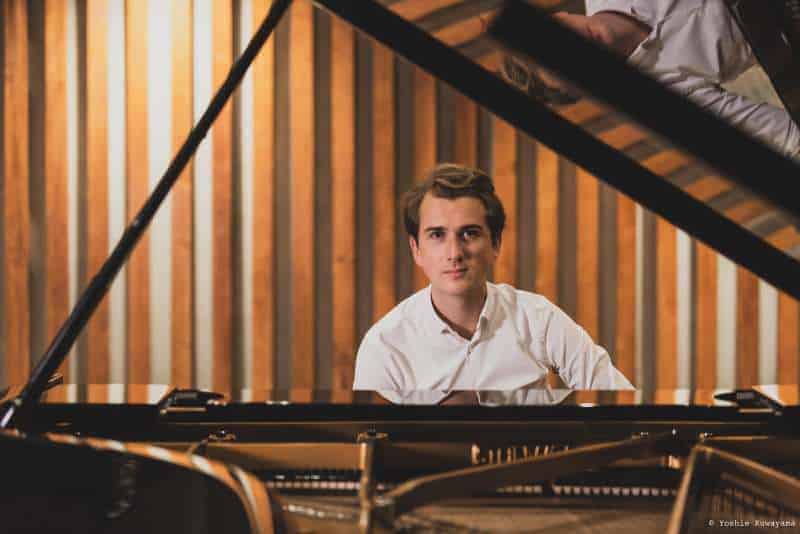
Interview by Johanna De Jong
Matthieu Idmtal is one of the most distinctive personalities among young pianists. His interpretations are always original, testifying to great refinement, and reveal a predilection for poetry. These are qualities that he showcases in the form of a third cd, which will be released soon. Reason enough to bring this Belgian pianist out of the shadow that covid-19 casts over cultural life, and to ask him some questions about his work and life as a musician.
Let's start with an obligatory question: how have you gotten through the past year?
Actually quite well. To begin with, neither I nor my immediate surroundings experienced the darkest sides of corona. That helps a lot. And professionally, I can't complain either.
Since I perform more than half the time in the Netherlands, and the corona policy there was much more relaxed for a long time than here, I was fortunate to be able to perform a few times while things were at a standstill in Belgium. I also played some livestream concerts and used the given time to make a new cd recording, so I was able to keep myself occupied in that sense.
But I do miss concert life, of course. And everything that comes with it. The traveling to the concert venue, stopping at a gas station for a coffee,... And good, long meals with friends, I miss that too.
You mention a new cd recording that will be released. This is entirely devoted to Edvard Grieg. May I see this cd as a sequel to the recording with the complete violin sonatas of Grieg, together with violinist Maya Levy?
Not really. In any case, I don't see it that way myself. The cd will be released on a different label, and it's rather coincidental that it has become a second Grieg cd. I wanted to do something with Grieg's piano sonata for a long time, which I've been carrying with me for quite a while. It is Grieg's only piano sonata, a youthful work, which is not very well known among pianists, and unfortunately is virtually never heard on concert stages. Yet it is a particularly attractive work.
Just the second movement alone, every music lover should know the sonata. Furthermore, this sonata is also a symbolic work for me. The third movement was the first piece I studied with one of my main teachers as a teenager. In any case, I find that Grieg is often treated with some condescension. Apart from perhaps his piano concerto - which was incidentally Rachmaninoff's favorite concerto - his music is too often sidelined at conservatories. Totally unjustified.
When I listen to your recordings, I am immediately struck by a great poetic freedom, with much attention to the left hand. A kind of piano playing that leans more towards an older generation of pianists.
Can we stop the interview here? Then I can go home with these compliments! You mention some keywords that are essential to me for a pianist, and for making music in general. You know, all my heroes have been dead for a long time.
Who are we talking about then?
Pianists like Friedman, Rachmaninoff, Ginzburg, Horowitz, Cortot,... In themselves very different personalities, but what binds them is that they all sing at the piano. They are poetic, narrative interpreters. That is my primary concern. Singing. Telling a story.
Did your teachers teach you in this tradition as well?
I have been influenced by a thousand and one things, but I was fortunate to come across a few good teachers at important key moments. When I think of my piano education, I think of three important personalities. The teacher of my childhood, the teacher of my teenage years, and the instructor at the conservatory, who was perhaps the most influential. With Vitaly Samoshko it was very much about sound. I don't think I ever heard him play an aggressive note and I am eternally grateful to him for that. But I have also had less fruitful encounters.
In Belgium you have something like the kunsthumaniora, a secondary school that is supposed to prepare you for the conservatory. I have very good memories of that school, but you were simply assigned a piano teacher there. That sudden change created such a conflict with the principles that had been taught to me until then, that I had many disagreements with a certain teacher. Then I thought: well, here I learn how not to play. That's also important. (laughs)
When I observe your concert programs, I notice that they consist mainly of Romantic repertoire.
I know. And sometimes I kick myself for not programming more classical repertoire. I think I play Haydn or Mozart not so badly, but I have more problems with Bach or Beethoven. For some reason, I have to work twice as hard with those two to reach the same level of satisfaction.
Let it be that I play the music that is closest to my heart. And music that I understand. It's wonderful that you can do what you want, right? There's no one forcing you to play three hundred years of music. If you want to devote your entire career to Bach, you can do that.
And what about contemporary music?
It happens that I play those. Perhaps more often in chamber music formations than solo. I can really enjoy new compositions, but if I get to choose I always go for music that still exists within a tonal framework. Really advanced contemporary music, or music that involves electronics I let pass me by. First of all, there are a lot of pianists who can do that much better than I can, and secondly my heart is not there. Perhaps those two things are linked. As I said, I try to sing at the piano. Much contemporary music is too melody-less and too percussive for me. A large part of those compositions are also a kind of sound experiments exploring boundaries. It's too conceptual for me, too mathematical, too little heart, and I'm not attracted to that.
Now, I'm convinced that quality can be found in every genre, but often I have the feeling that the filter of time still needs to pass over it. I do hear a lot of rubbish. But that reluctance is perhaps subjective. The conservatory where I studied was keen to profile itself as a conservatory with the greatest attention to contemporary music, and in my perception that often came at the expense of the classical repertoire. There prevailed such a blind glorification of everything that hurt the ears, that I still have to kick off certain figures. There were, so to speak, compositions performed for piano, Mandarin, and two ping-pong balls, but when I played Schumann's piano quintet at my chamber music exam, the jury rolled their eyes. I could hear them thinking: Schumann again. Their intention may have been well-meaning by awakening enthusiasm for contemporary music in the students, but it had the opposite effect on me.
Have those kinds of experiences also had an effect on how you teach yourself?
Yes. I hate authority, and so I fear that I myself am also not the most authoritarian teacher. I prefer suggestion to obligation. In life as well, by the way.
Wanting to push your own ideas or your own personality at all costs doesn't make much sense. But I'm enjoying teaching more and more. I now have some students who want to start at the conservatory, and also conservatory students who occasionally come to ask for advice. Then you know you're getting old. (laughs)
In another interview I read that Alexander Scriabin is your favorite composer. In 2022 his 150th birthday is being celebrated. Are there any special plans?
Just between us: when people ask me about my favorite composer I usually answer with a straight face: Johann Strauss. The look of confusion you get then is priceless. (laughs) Besides, in all seriousness: I love Johann Strauss and Viennese waltzes in general. But you're right. If I were forced to choose, the answer to the question would perhaps be Scriabin.
If all goes well, that year I will have two concerts that will be dedicated to Scriabin, both in the Netherlands by the way. But I fear the worst and think that they won't do much around Scriabin in either Belgium or the Netherlands. Yet he has lived in both countries.
Are there any other projects you dream of being able to realize?
What I like most about this profession is the creative aspect. First and foremost at the piano, but also with the concert series I organize. I mainly hope to be able to continue doing that.
Perhaps I would also like to play a couple of concerts with a distinguished song cycle. Bringing Dichterliebe or Winterreise with a good singer seems fantastic to me.
To conclude: there has been a lot of fuss over the past year about how essential art and music is or is not. What do you think about that?
Certain composers have changed my life. How essential do you want it?
That's clear!
- WHAT: interview with Matthieu Idmtal by Johanna De Jong
- PHOTOS: © Yoshie Kuwayama