
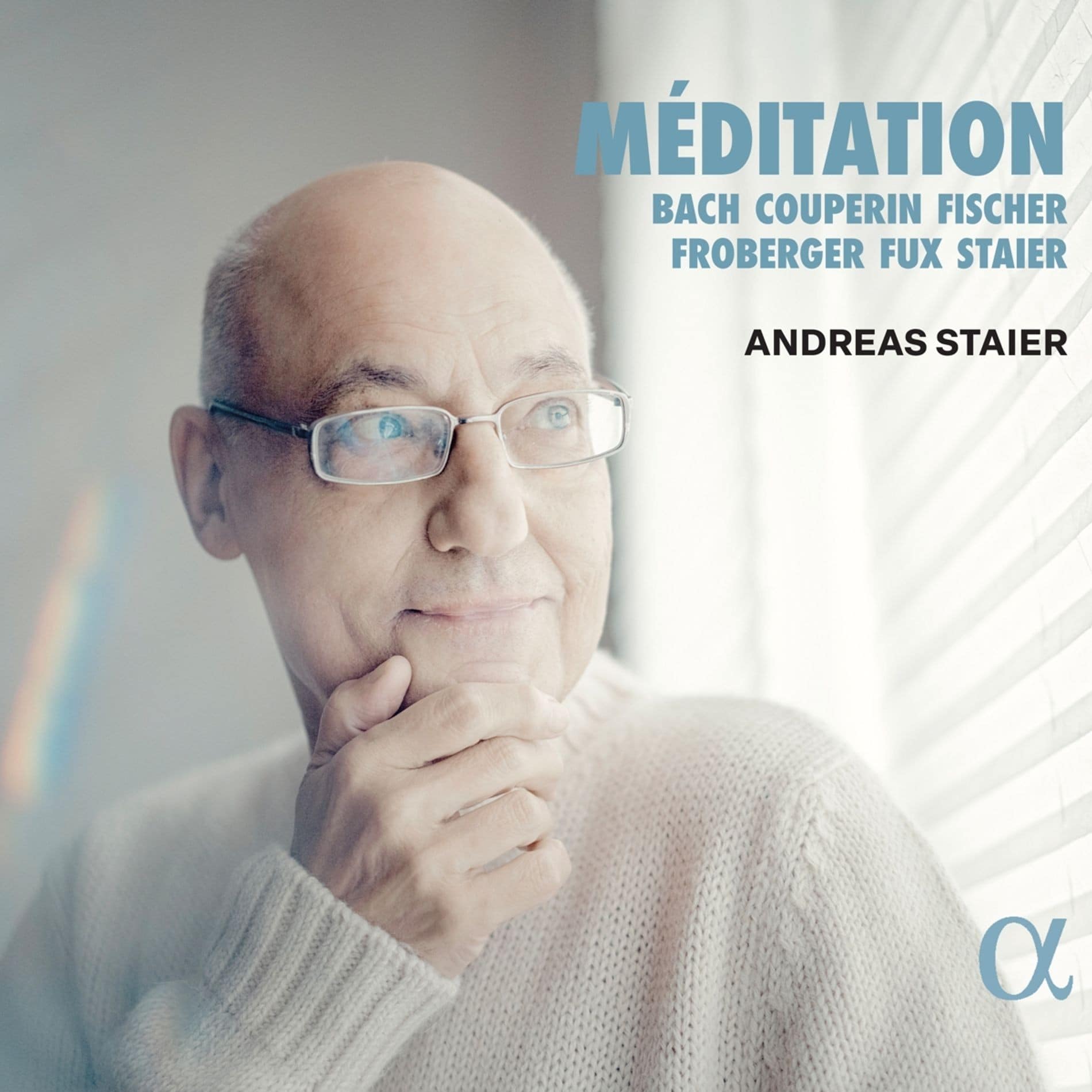
Click here for the table of contents
Andreas Staier (68), has made some 70 recordings to his name, most of which have scored highly both in and outside the press. This is due both to his extensive repertoire and his technical and interpretative skills, not only on harpsichord but also on fortepiano. An equally important factor is his knowledge and experience in the field of historically informed performance practice, which goes far beyond mere ornamentation, as will become clear later in this account.
Shortly before the outbreak of the coronavirus pandemic, Staier learned that he suffered from myelofibrosis, a fairly rare bone marrow disorder, which results in fewer and fewer blood cells being produced. It is the uncontrolled proliferation of connective tissue that gradually displaces the bone marrow. This results in an increasing shortage of normal white blood cells and platelets. Depending on the stage of the disease and the age of the patient, life expectancy varies from only a few to many years.
I do not know what Staier's current health situation is, but it is a fact that he has bitten off even more than before in recording new repertoire. His composition Anklänge from 2020, also represented on this album, is a direct result of the coronavirus pandemic which forced him into inactivity (most theaters and studios were closed) and the diagnosis given shortly before.
Staier explains the chosen repertoire in the CD booklet itself. It is too interesting not to reproduce it in full here. The translation is mine:
"Music is often written about music. Certain themes and problems cannot be solved quickly enough and persist across multiple generations. Two motifs in particular form a red thread running through most of the works on this album.
The first of these motifs is an old cantus firmus that also determines the structural framework of this program. The fugues in E by Johann Caspar Ferdinand Fischer and Johann Sebastian Bach make clear use of this theme - the second line of the communion hymn Pange lingua (c. 1264), attributed to Thomas Aquinas - at the beginning and end. This series of notes - in E major: E-F#-A-G#-F#-E - was repeatedly taken up and reused or reworked over many centuries. Famous examples of this include not only the Christe eleison from Josquin's Missa Pange lingua (c. 1515), but also the finale of Mozart's Jupiter symphony (1788); in the latter work the cantus firmus is concentrated in the first four notes of the theme and transposed to C major: C-D-F-E.
Bach is the vanishing point in this program, which immediately raises the question of which of the various arrangements of the Pange lingua presented here were known to him. In a letter from Carl Philipp Emanuel Bach to Johann Nikolaus Forkel, the first biographer of J.S. Bach, we read that the very young Bach 'held and studied' Froberger's works alongside works by many other composers, although we do not know specifically which; it is impossible to deduce from this whether Bach knew Froberger's Ricercar IV and Fantasia II or not. We can be certain, however, that Bach was extraordinarily familiar with Fischer's Ariadne musica, a collection of preludes and fugues in nineteen of the twenty-four major and minor keys arranged in ascending chromatic order. Since it was clearly one of Bach's most important sources of inspiration while he was preparing to compose the Wohltemperierte Klavier, he also honored Fischer by including two of his fugal themes untransposed and almost literally in that WTK: the fugal theme in F major in the first book and the fugal theme in E major in the second.
The example of Fux's counterpoint leads us to the direct intellectual context of Bach's Fugue in E major. Fux's Gradus ad Parnassum, written in the 18th century, was long the most influential textbook on counterpoint. It deals with the stile antico, the style of Italian vocal polyphony from the late Renaissance; this style appeared in its purest form in the works of Giovanni Pierluigi Palestrina (1525-1595), whose masses and motets were regarded as the ideal of Catholic church music for many centuries. Bach's Fugue in E major was probably composed in the late 1730s and is the purest example of the stile antico in his entire oeuvre. His exploration of this style should certainly be seen in connection with his decision to compose the remaining parts of the Mass in B minor (BWV 232) around the same time, in addition to the Kyrie and Gloria that he had already composed in 1733, resulting in the Missa tota that would later become known as the Hohe Messe. This was the moment of Bach's (renewed?) engagement with the Gradus ad Parnassum. At that time he also befriended the young philosophy and music student Lorenz Mizler, who - as Christoph Wolff plausibly conjectures - was encouraged by Bach to translate the Latin text of the Gradus ad Parnassum into German.
As already mentioned earlier, it was not uncommon in Bach's time for composers to use fugal subjects from others - here Bach adopted subjects from Fischer and Fux. Many such subjects were considered general knowledge and were worked out in the spirit of contrapuntal competition by different composers, often making explicit references to each other's work. The more improvisatory genre of the prelude, by contrast, stands far apart from such learned references; for this reason it is remarkable that the prelude from Bach's WTK (that in E major) also shows motifs and 'atmospheric' affinities with Fischer's prelude in the same key. Fischer's opening gesture is formed around the notes E-B-C#-G#. The same four notes, with the first E transposed an octave lower, form the beginning of Bach's prelude.
This sequence of intervals - octave, fifth, sixth and third - forms the second leitmotif of this programme; it is ubiquitous in music, at least since the beginning of the Baroque period. Here it forms the theme of Fischer's Prelude in A major and plays an important expressive role in two great laments: the Pavane in F# major by Louis Couperin and the Méditation sur ma mort future by Froberger. Not only does Beethoven use the same sequence of notes to launch his cello sonata in A major, but the bells in Wagner's Parsifal also sound with the same intervals.
Anklänge …, my six pieces for harpsichord, arose from conversations I had with composer Brice Pauset; we repeatedly exchanged thoughts on what it means to compose at this point in history, on its significance and in particular on the implications of composing for historical instruments. This led me to the question: given that my own concept of music has been influenced not only by Byrd, Bach and Schubert, but also by the music of the 20th and 21st centuries, how can I best express and realize this in notational form? The result of this reflection was a great variety of sketches, most of which were begun during vacations but remained unfinished when daily life resumed. However, the forced standstill of concert life in 2020 gave me the time to review all my loose pages and notes: completed compositions ultimately emerged that I had never initially envisioned as such when I began them.
These pieces are based on six chords that also conceal the two aforementioned cantus firmi. The complete theme of Pange lingua, in different transpositions, is found in the first, third and sixth chords, with the first three notes forming the largest common element for all six chords; the Parsifal motif is found in the sixth chord. Combinations of notes then arise unconcernedly, which can be heard as reminiscences or echoes of certain moments from J.S. Bach's Prelude and Fugue in E major from the second part of the WTK.
It appears that the structural elements of this work have influenced my compositions at various levels. Some relate to the organization of time or influence combinations and permutations of notes; these can remain almost inaudible on the surface, as in the second piece, in which Bach's fugal subject is connected with different aspects of the six aforementioned chords. Only in the fourth piece are windows opened to make short note sequences - here derived from Bach's Prelude, albeit in reverse temporal direction - audible.
The first, third and fifth pieces are based on canon techniques. The first works with a chord progression - quadrupled by permutation and transposition - which is executed in canon at four different speeds. The third piece consists of inversion canons with increasing axes of symmetry, while the fifth piece - analogous to the fifth chord from the moment of greatest reduction - is a kind of crab canon.
Finally, the last piece can be considered a kind of personal diary, even a love letter to Bach. My intention is that Bach's Prelude and Fugue follow these pieces without pause."
Andreas Staier approaches the ideal in his interpretations through his refreshing, spontaneous, fluid and at the same time idiomatic approach to these solo works. The joyful ornamentations enliven the already so expressive image that characterizes these performances, as he has also succeeded with flying colours in bringing the tonal characteristics of this harpsichord (incidentally, not a single word about the instrument in the booklet) to life in a particularly beautiful way.