
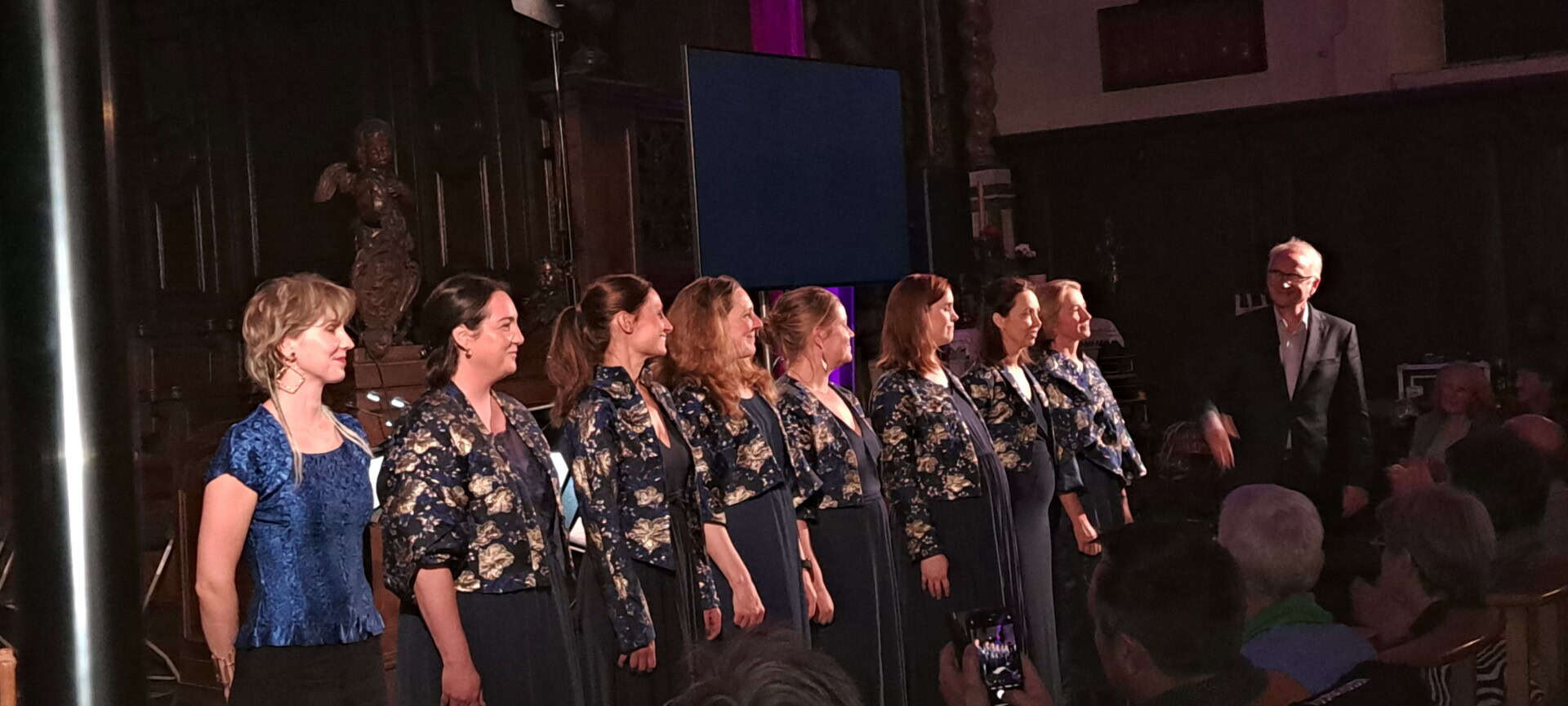
800 years of Bruges Begijnhof, enough years on the counter to celebrate. And that with all current residents and the small sisterhood that still exists - all women, that is - and with the choir ensemble Psallentes, also all women. Today, by the way, a bunch of "new-beguines" had gathered here to reflect on their future: what do we now still understand by the concept of "beguine"? Representatives of those still existing beguine communities from several countries pondered the contemporary interpretation of that beguine life: as a woman living in community, lovingly serving fellow human beings and doing so in complete freedom, with respect for one another but without monastic vows.
At the beginning of this celebration year, on 6 June, there was even royal interest in this Begijnhof, also UNESCO World Heritage, by the way. Queen Mathilde cut the ribbon of the celebration year and Psallentes was then allowed to sing 3 minutes for her. At the closing weekend, the begijnhof church is packed twice, each time for a concert of 70 minutes. Almost all songs from manuscripts of beguines that have been preserved in the archives of the Bruges Begijnhof, both psalms and occasional songs.
Conductor Hendrik Vanden Abeele: "Being called and they say: "In two years it will be 800 years Bruges Begijnhof. Can you do something about that? We have here in the library of the cloister, so the Beguine archives, a whole series of 16th 17th, 18th 19th-century sources, come have a look". That is now the wonder of artistic research and creation, I would dare say. That is actually always the most beautiful aspect of new projects for me. And then you start leafing through that and you recognize many of those things because it is often universal repertoire. But then suddenly something pops up that you have either never seen before or look at with new eyes and then as if by miracle, such creativity begins to develop. And yes, before I knew it, I was working on a project of 70 minutes."
Not just a cycle of 11 songs, but a whole concept with accompanying film full of sound and image, recorded in and around that Begijnhof and everything supported by a percussionist with a large hand drum. A wondrous combination. You saw a sister ring the church bell, tourists streaming in, but you could also perfectly empathize through that sound and image landscape in the peace of that exceptional place, with the blooming yellow Easter lilies and the rustling waving trees on that Hofplein. A sung story about life in the begijnhof, from sunrise to sunset. It was a sweet-sounding, mostly Gregorian concert with here and there a layer of polyphony on top, Latin texts, also easy to follow in Dutch via the carefully prepared program booklet. With also a couple of original old-Dutch songs, for example that beautiful love song by our Hadewijch and a funny little story about a beguine who loses her cat and finds it back thanks to a novena.
The Psallentes ("those who sing") - women brought all of that with dignity and refinement to heavenly sounds. You heard the experienced care and solidarity resound through it, essential concepts in beguine life. It sounded like an evocation of a long procession where the front of the procession does not sing the same as the back and then you naturally get a canon and then there actually arises a sort of polyphonic effect. The program was called "Sauvegarde", which is written in golden letters above the entrance gate of the Begijnhof. Hendrik Vanden Abeele: "It means protection, but it is more than the theme of this evening, it forms the beating heart of this project, it invites us to slow down and to pause on what protection and intimacy can mean, then and now."
As a ritual of music and mysticism, Psallentes brought this message across perfectly.