
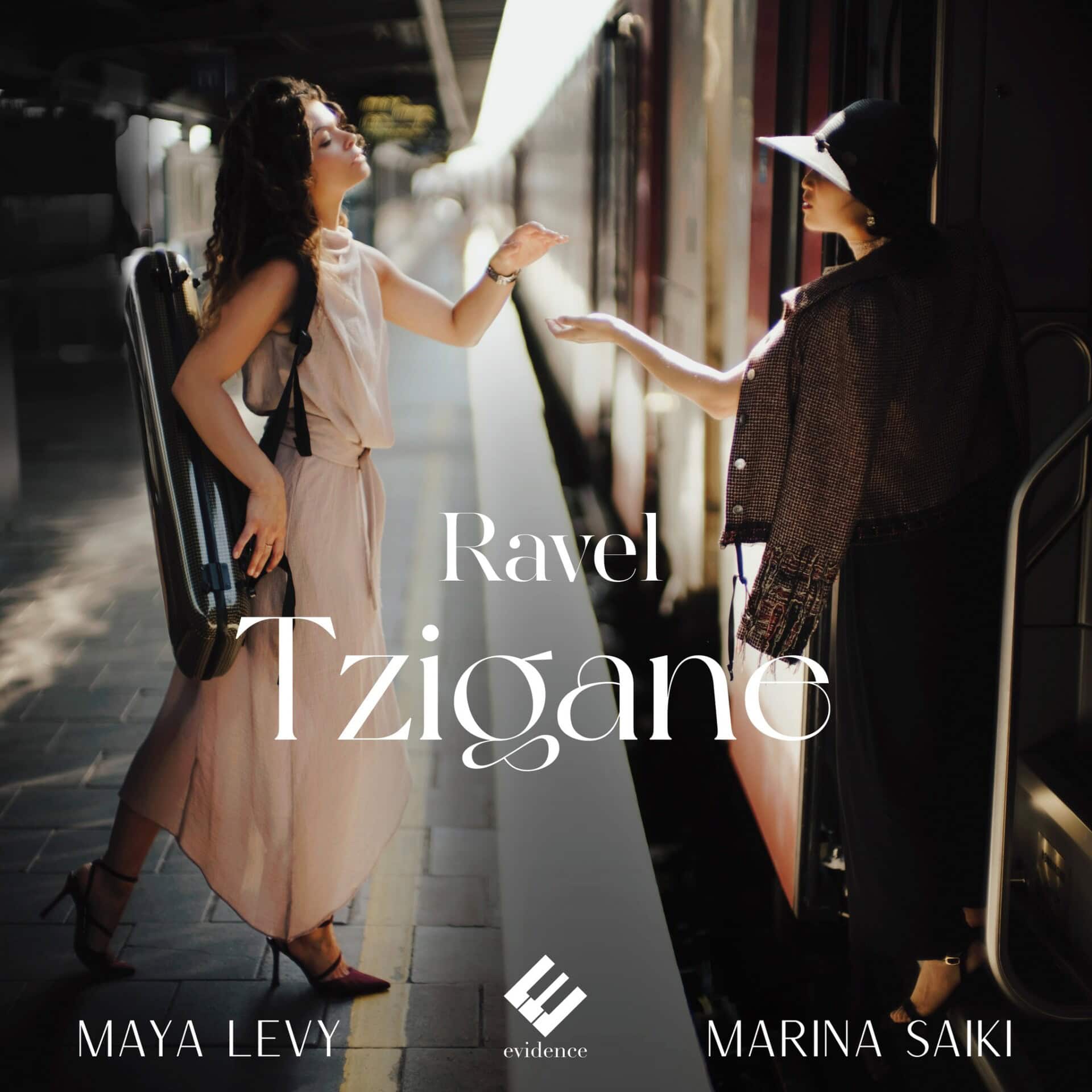
With their first collaborative single, Maya Levi and Marina Saiki make it clear that this duo did not come about by chance. Tzigane by Maurice Ravel is a work that relentlessly tests performers, both technically and musically. It demands effortless command of the instrument, a sharp ear for tone color, and above all an intense interplay in which there is no room for casualness. Precisely therein lies the strength of this recording: from the opening measures sounds a duo that understands, challenges and supports each other.
Maya Levi establishes herself here as a violinist with an impressive combination of technical authority and expressive freedom. The long opening solo, in which the violin alone carries the entire musical discourse, requires not only virtuosity, but also courage and imagination. Levi builds that arc of tension with natural conviction, her playing remaining fierce, lyrical and controlled at once. Her virtuosity is unmistakably present, but never becomes an end in itself; it stands entirely in service of Ravel's sonic world.
Marina Saiki is much more than an accompanist in this work. The piano part of Tzigane is exceptionally demanding and requires a pianist who effortlessly switches between power, precision and refined color nuances. Saiki masters that spectrum with great ease. Her playing is clear and rhythmically sharp when needed, but can equally be transparent and almost songlike. Together with the violin, she creates a sonic fabric that sometimes gives the impression of a much larger ensemble, without ever losing its clarity.
Ravel composed Tzigane in 1924, during a period when he was fully experiencing his fascination with virtuosity, timbre and sonic experiment. The work was originally written for violin and piano with luthéal, a rare instrument that expands the piano's sonic palette and adds an almost exotic resonance. Ravel was not seeking folkloristic illustration, but an extremely concentrated sonic fantasy in which violin and piano together evoke their own visionary world. That intention rings through particularly clearly in this recording.
Visually too, that world is convincingly supported. The visual material accompanying the single breathes the atmosphere of the twenties of the last century: stylish, slightly mysterious and suffused with artistic refinement. Music and image together form a coherent whole and reinforce the impression that this release is more than a casual recording, but the beginning of a thoughtful and ambitious trajectory.
In conversation with two brilliant artists
Following the release of this first single, we spoke with Maya Levi and Marina Saiki about their choice of Tzigane, their collaboration and their future plans.
For Maya, Tzigane was long not an obvious work to record. That changed the moment she was invited to play the piece as part of a tour with the original instrument for which Ravel had written it: the luthéal. That exceptional opportunity made an immediate impression. The realization that she could approach Ravel's original sonic world with this rare instrument led her to decide to capture this experience and make a lasting record of it.
Marina emphasizes how exceptional it was to actually be able to work with the luthéal, thanks to Festival de Wallonie. That instrument, today preserved in only a few specimens, opens a sonic world that perfectly aligns with Ravel's obsessive quest for timbre and color. For her, the choice of Tzigane was therefore obvious, precisely because this work is inseparably connected to that specific sonic ideal.
What artistically inspires them in this work, according to Maya, touches the core of Ravel's genius. He did not seek mere virtuosity or effect, but wanted violin and piano together to form a unique sonic landscape, almost orchestral in conception, in which every nuance carries meaning. Marina sees this single as the first chapter of a larger story. In 2026, an extended cd recording is planned with music from different parts of the world, in which that open perspective and that quest for sound will be further pursued.
About the future, Maya speaks in images. She refers to a mystical program around the great rivers of the world, in which water is central, but also the rock that gives the water its bed. That symbolism will take further shape in both concerts and on cd.
As for their collaboration, there is a striking unanimity and ease, both musically and humanly. That picture is confirmed by our own experience: a few months ago we heard and saw Maya Levi and Marina Saiki working together at BOZAR, where their interplay testified to rare intensity and a palpable, almost organic synergy. Two outspoken personalities who do not overshadow each other, but strengthen each other.
A powerful single as a promise of much more
This first single thus marks a solid and promising debut. The virtuosity of Maya Levi and Marina Saiki is beyond question, but above all the manner in which that virtuosity is deployed in service of sound, expression and imagination makes an impression. Tzigane serves here as a convincing starting point for a shared trajectory that clearly reaches far beyond a single recording.
The single is available via the usual streaming platforms and can be heard, among other places, via this link: https://aparte.lnk.to/RavelTzigane-MayaLevy-MarinaSaiki
That this is only the first track of an upcoming cd and concert series makes one eagerly anticipate what follows.