
Brussels is a magnet for many, very many things. Among them some of the least beautiful that shouldn't see the light of day, but fortunately also many cultural events that deserve to be seen by as many people as possible, whether in daylight or in the dimmed or undimmed light of a concert hall. The penultimate week of June is such a culture week that attracts Mozart lovers with the Midsummer Mozartiade.
THE annual crowd-pleaser is undoubtedly the Mozart opera that is programmed. This time the artistic leadership chose Mitridate, Rè di Ponto. It was Mozart's first opera, although before that the by then 14-year-old had already written three operas at age 12, namely Apollo et Hyacinthus, La Finta Semplice and Bastien und Bastienne. The teenager Wolfgang was as it were not untested, although this composition, a first real serious commission, proved to be a true trial.
Mozart did not have difficulties because of the composition itself and/or the libretto, but because of the whims of the singers, as director Eric Gobin and singers Pieter De Praetere and Dorine Mortelmans tell us just before the dress rehearsal on Wednesday evening, June 19. They do not hide their wonder and admiration for the young Mozart. How could such a young boy write such music? How could he perfectly translate such a mature world, in archaic language at that, into notes? How was he able to push the singers to the limits of their abilities? Actually, he went even further, took a leap beyond their demands. What difficulties would Mozart have encountered with melody, harmonization, orchestration or anything else? The misery he experienced while composing came from the pretentious singers, especially one of the tenors, who made enormous demands. Mozart had to write the roles very precisely according to their desires and abilities. He had to rewrite one role five times because the gentleman was not satisfied... Imagine that.
Would everything be in order for the audience? The singers had doubts about that, after all they were experienced, accustomed to adult composers who served the singers at their beck and call. What could such a pubescent boy accomplish, and even achieve some success? So they had their plan B in their pocket, the scores of composer Gasparini would be pulled out and sung in place of this young boy's work. Not at all. The audience in Milan, where the opera premiered, was delighted with joy – there were encores during the performance – and the applause would resound no fewer than 20 times, but unfortunately, not until the early 20th century. There were quite a few envious people in the opera world back then, and they succeeded in relegating the opera to oblivion despite its success.
It is, frankly admitted, moving how these three people, today in our cold times, speak with the greatest respect, more than 250 years after the creation of this work, about both the composition and the composer. It will lead to a performance that you won't soon forget...
Mitridate, re di Ponto by the 14-year-old Wolfgang Amadeus Mozart is what is called an opera seria, in three acts (KV 87 [74a]). The premiere took place at the Teatro Regio Ducale in Milan. The libretto is by Vittorio Amedeo Cigna-Santi, based on the drama 'Mithridate' by Jean Racine translated into Italian by Giuseppe Parini. It is a dramatic story full of envy, tyranny, loyalty, disloyalty, honor and dishonor with a mixed ending where happiness and unhappiness go hand in hand as it were and tyranny can be replaced by new hope.
Especially from the second act onwards, Mozart becomes more himself, as you can already know him from La Finta Semplice and Bastien und Bastienne and many other compositions. Due to the difficult collaboration with the pedantic singers, this work is still quite rooted in the baroque, although the later Mozart is already clearly present. You have to do it, as a beginning adolescent, to translate sometimes extremely heavily loaded emotions not only into coloraturas and runs, but especially into musically charged expression. He understood it all, took it as ordinary everyday things that he would 'simply jot down on paper'. That's when genius was already in full force.
The performance according to artistic director Eric Gobin
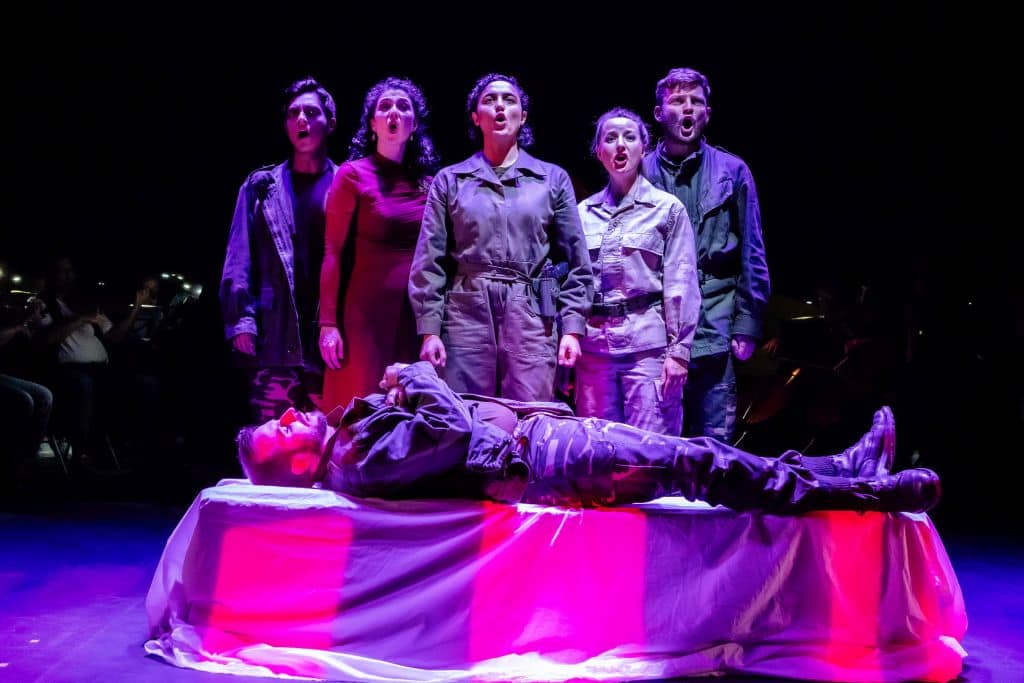
Since the series of 20 performances at the time of creation, Mitridate has never been performed again according to the composer's wishes. After all, he wrote three castrato roles and castrati no longer exist... Nowadays this evil is remedied by having the high roles sung by sopranos and the alto roles (sometimes) by countertenors. Eric Gobin found a suitable countertenor in the person of Pieter De Praetere (Farnace) and the sopranino – a man who can sing as a soprano – would be Dennis Orellana (Sifare). Only for Arbate did Gobin choose a mezzo-soprano, Sonia Sheridan Jaquelin. The other roles were filled with the appropriate voices: Mitridate by tenor Stefan Sbonnik, soprano Gianna Cañete Gallo portrayed Aspasia, Ismene was in the hands of soprano Dorine Mortelmans and tenor Mathis Van Cleynenbreugel took on the role of Marzio. Each one a particularly decent singer who, very text-conscious and score-faithful, performed the respective very demanding roles smoothly and sometimes very compellingly.
Sopranino Dennis Orellana
This still young singer (born in 2000 in Honduras) is a true rare discovery who has already conquered quite a few major stages in his short career. Bayreuth Baroque, La Scala in Milan, the Salzburger Festspiele: nothing small for someone his age. He sings with particular virtuosity, has a wide tessitura that reaches very high and the volume is astounding. He masters all registers as if nothing, from the softest pianissimo to a triple forte and all according to the strictest musical demands. He is his role, nothing more, certainly nothing less. A singer to look forward to and you can be sure that many will follow him, just as many once followed Alfred Deller, the 'first' countertenor. We simply had to get used to that, so be it, so it will also be with the sopraninos: getting used to it until it becomes the most normal thing that they perform roles once written for men, men who were castrated around their 12th for their beautiful boy's voice. Discover Dennis Orellana with us via this short fragment from the Bayreuth Baroque Festival 2023.
Since the story takes place on the coast of the peninsula we now know as Crimea, the link with today was quickly made. The scenography was therefore placed in a contemporary and minimalist setting. For a static opera with actually little action, there is not much to do with and you have to be very creative to still bring some life to the stage while the singers give one aria after another. 22 arias full of bravura and repetitions, that is quite something. Dramaturg Keith Tillotson took care of that.
The Orchestre Royal de Chambre de Wallonie supported the singers under the direction of Thibaut Lenaerts. An extra word for the translation of the archaic old Italian: Hannah Aelvoet signed for this. It should be said and written sometime. The audience nowadays finds it quite normal that a board hangs above the stage where the text appears digitally. Just imagine translating such a thing…
Those who want to know more about the annual Midsummer Mozartiade can find the link to the website below. Look forward with us to what will be on the program next year.