
Leipzig does it again! In 2019, the city already celebrated extensively the 200th birthday of Clara Schumann – which gave a boost to attention for female composers in general. Now no fewer than six museums are joining forces for the theme year 'Stark! Weibliche Lebenswelten in den Leipziger Musikmuseen'. The Bach-Museum is devoting attention in a fascinating way to no fewer than 33 women from the circle of the great master of the Baroque.
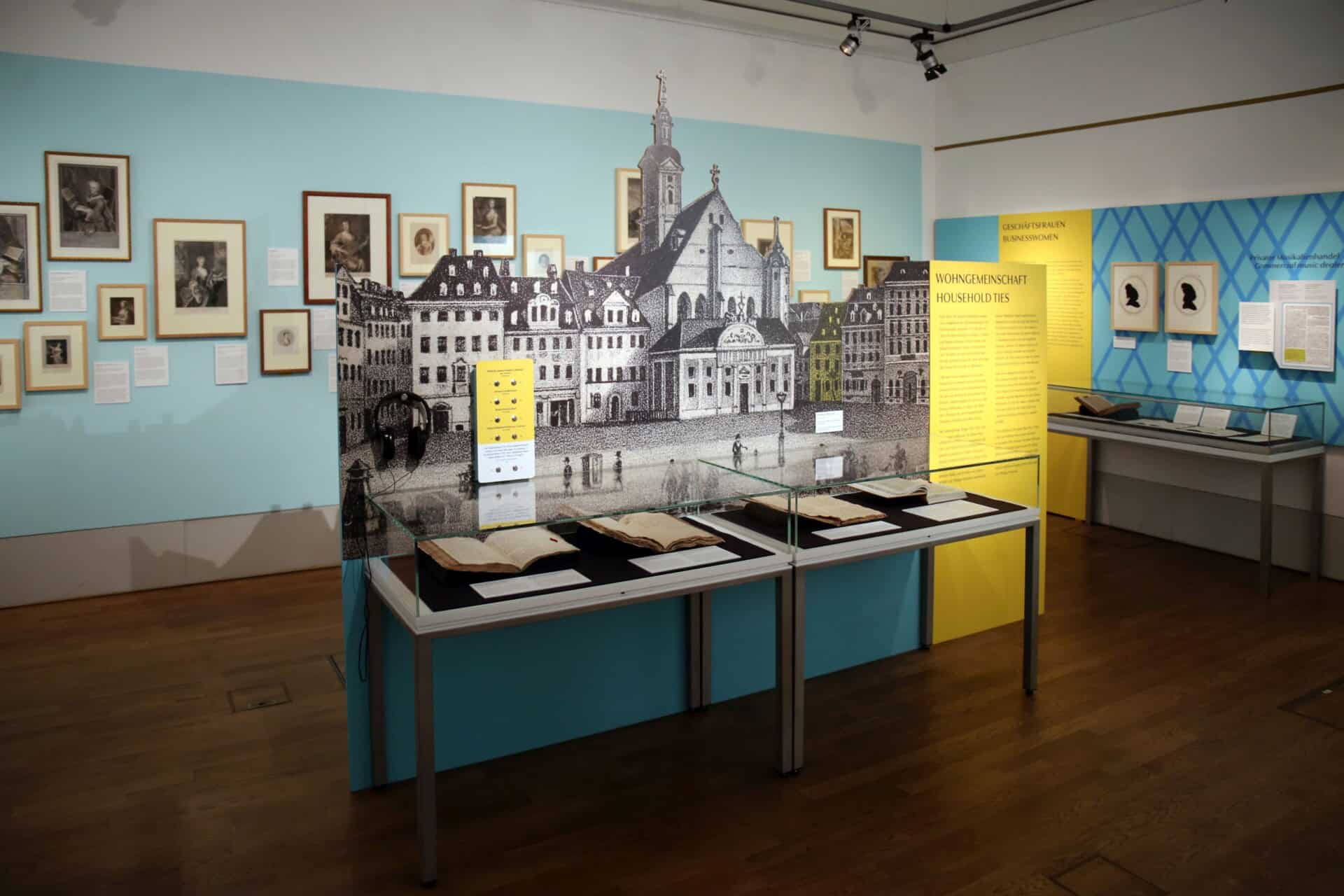
For more than 200 years, the widely extended Bach family determined the musical life of central Germany. But in music history, it was exclusively the men who were given a place. The small but fascinating thematic exhibition in the Bach-Museum now focuses for the first time on the women. Building on a study by musicologist Maria Hübner, the museum in the shadow of the Thomaskirche in Leipzig gives voice to no fewer than 33 women: Johann Sebastian's (step)mother, his two wives, (in-law) sisters, (in-law) daughters, granddaughters and so on. They are divided into four categories: family managers, singers, businesswomen and members of the residential community at Neukirchhof in Leipzig. In that building, Anna Magdalena moved in with a changing group of Bach women after the death of her husband, when they had to leave their residence at the Thomasschule.
Stories
You can take that 'giving voice' literally. Via headphones, the women briefly tell about their lives (in German and English). These are fictional narratives, based on limited source material. The fact that their lives are so sparsely documented has to do with the fact that they had no legal personhood. They appeared only in relation to male family members. Often there is nothing more available than baptism, marriage and death certificates to reconstruct their lives.
But however limited and fictional, the formula works and we do get a picture of these women and the time in which they lived. So we hear Elisabeth Bach (born Lämmerhirt, 1644-1694), the mother of Johann Sebastian (1685-1750), complain that in her death notice her own name was not even mentioned, only 'Johann Ambrosii Baachen Haußfraw'.
Even more painful was it for Anna Magdalena Bach (1701-1760), Johann Sebastian's second wife. In his in memoriam, Carl Philipp Emanuel (1714-1788) described his stepmother merely as the daughter of a court trumpeter, while she herself had been a highly qualified and much sought-after singer at the court of Köthen before her marriage. When the couple moved to Leipzig, that meant the end of her career. Leipzig had no court, and in the churches women were not allowed to sing solo. Yet Anna Magdalena, like her (step)daughters, remained musically active.
This is evident, among other things, from a preserved quote from Bach in which he praised the musicality of his family members. They could give a vocal and instrumental concert, he wrote to a friend, 'especially because my present wife sings a pure soprano and my eldest daughter also performs quite well'. That daughter was Catharina Dorothea (1708-1774) from his first marriage. She tells us how she dreamed of becoming a professional singer, but after the death of her mother Maria Barbara (also a born Bach, 1684-1720) became indispensable in the busy household with the many children that would follow.
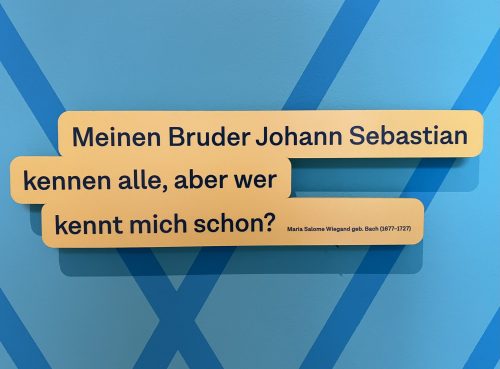
For Johann Sebastian's sister Maria Salome Wiegand (born Bach, 1677-1727), only marriage and a household were in store. Her cry of the heart, which immediately catches your eye when you enter the exhibition space, moves you: 'My brother Johann Sebastian is known to everyone, but who knows me?' Nobody knows if she too was highly gifted, and if she perhaps envied her brothers who were allowed to become musicians, you hear her sigh into the headphones.
Notenbüchlein and Art of Fugue
Anna Magdalena is one of the few Bach women, perhaps even the only one, who enjoys some recognition. This is of course due to the Notenbüchlein für Anna Magdalena Bach, relatively simple but charming piano pieces that her husband compiled for her and with which she taught her children piano – and which are still gladly played by beginning pianists. It is possible that this Büchlein also contains compositions by Anna Magdalena herself, as it is not ruled out that she too composed.
In that context, I was very curious whether the exhibition would go into the theory of musicologist Martin Jarvis, but I was also not surprised to hear not a word about it. At the time of his research, Jarvis was after all already persona non grata in the Bach Archive. Based on forensic research, he concluded almost 20 years ago that among other things, some of Bach's famous cello suites can be attributed to Anna Magdalena. Although the theory was hotly disputed and other academics hoped it would be quickly forgotten, I nevertheless paid attention to it in my book Vrouw aan de piano (p. 105-116) – I also explain there why. But I also felt I had to conclude that we 'will never know with certainty what the compositional qualities of Anna Magdalena were'.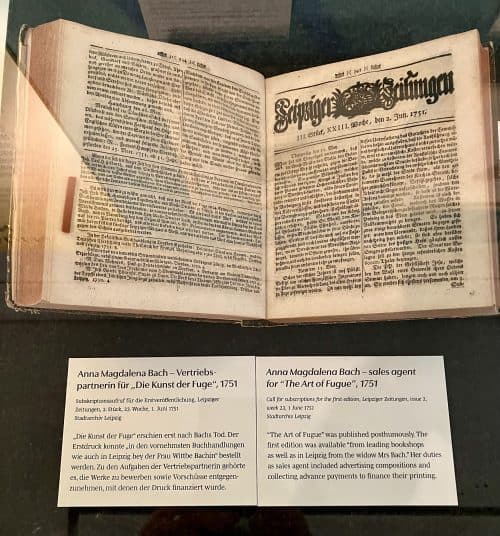
What people in Leipzig do agree on, however, is that she assisted her husband as a copyist and in other organizational matters. Furthermore, she ensured that among other things Die Kunst der Fuge was published. The printing preparations had already begun before Johann Sebastian's death, but for the widow, the distribution of his music also meant welcome income. Incidentally, she illuminated the manuscript with drawings of flowers. She was a great lover of flowers and of songbirds.
Legacy
Another Bach woman who secured the legacy of the composing family members is soprano Cecilia Bach (born Grassi, †1791). Before her marriage at the age of 40 to Johann Christian Bach (1735-1782), she celebrated successes in Venice and London. After his death, she ensured that the score of his opera Amadis de Gaule, which had premiered in Paris, was published. She also wrote a preface to it, which was apparently deleted in a reprint, possibly because it was too critical and/or inappropriate for a woman… Granddaughter Anna Carolina Philippina Bach (1747-1804) also ensured the distribution of the music of a Bach, in her case her father Carl Philipp Emanuel.
Convents and courts
Another granddaughter, Anna Philippina Friederica Colson (born Bach, 1755-1804), daughter of Johann Christoph Friedrich (1732-1795), enjoyed musical training, but played the harpsichord only in private circles. Unlike her brother, she was not considered for an appointment.
Yet we should not say that women never managed to build a career, the catalogue rightly notes. In women's convents or at a royal court, women at that time could make music in abundance. They not only played plucked instruments there, but also wind and string instruments and even organ. Think for example of Élisabeth-Claude Jacquet de la Guerre (1665-1729) and Barbara Strozzi (1619-1677). Or think of the Ospedale della Pietà in Venice, where Antonio Vivaldi was active. He composed no fewer than 31 violin concertos for his student Anna Maria dal Violin (1696-1782). Except… these women were systematically erased from music history.
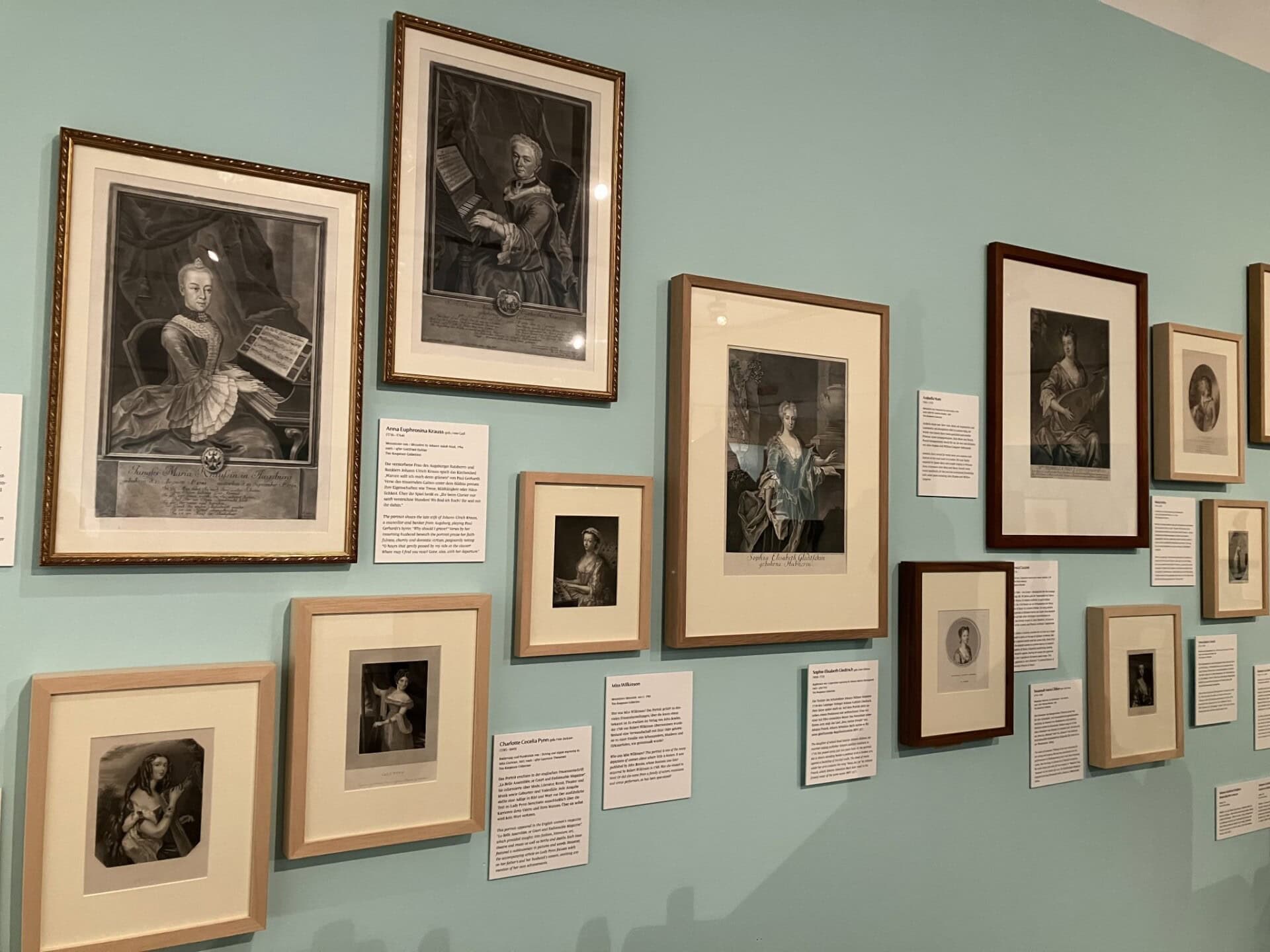
Of the 33 Bach women, hardly any or no portraits have been preserved – an oil painting of Anna Magdalena by Antonio Cristofori disappeared after 1790. Yet the exhibition is richly illustrated. The portraits of European female composers and musicians from the private archive of Ton Koopman, an annex to the Bach exhibition, also provide this. They give a multifaceted impression of the all-too-often overlooked but undeniable and indispensable contribution of women in the musical world.
The unknown beauty
Yet another woman whose role is only now being properly appreciated is Cécile Jeanrenaud (1817-1853). Although it remains unclear whether she was herself musically active – she would have been quite modest about her musical talent – she was an indispensable support for the man at her side: the composer, celebrated conductor and piano virtuoso Felix Mendelssohn-Bartholdy, who confessed in a letter to a friend that he was 'so utterly in love' with her. In biographies of Mendelssohn, we usually learn little about his wife, who gave birth to five children. Except that she was said to have been known for her beauty.
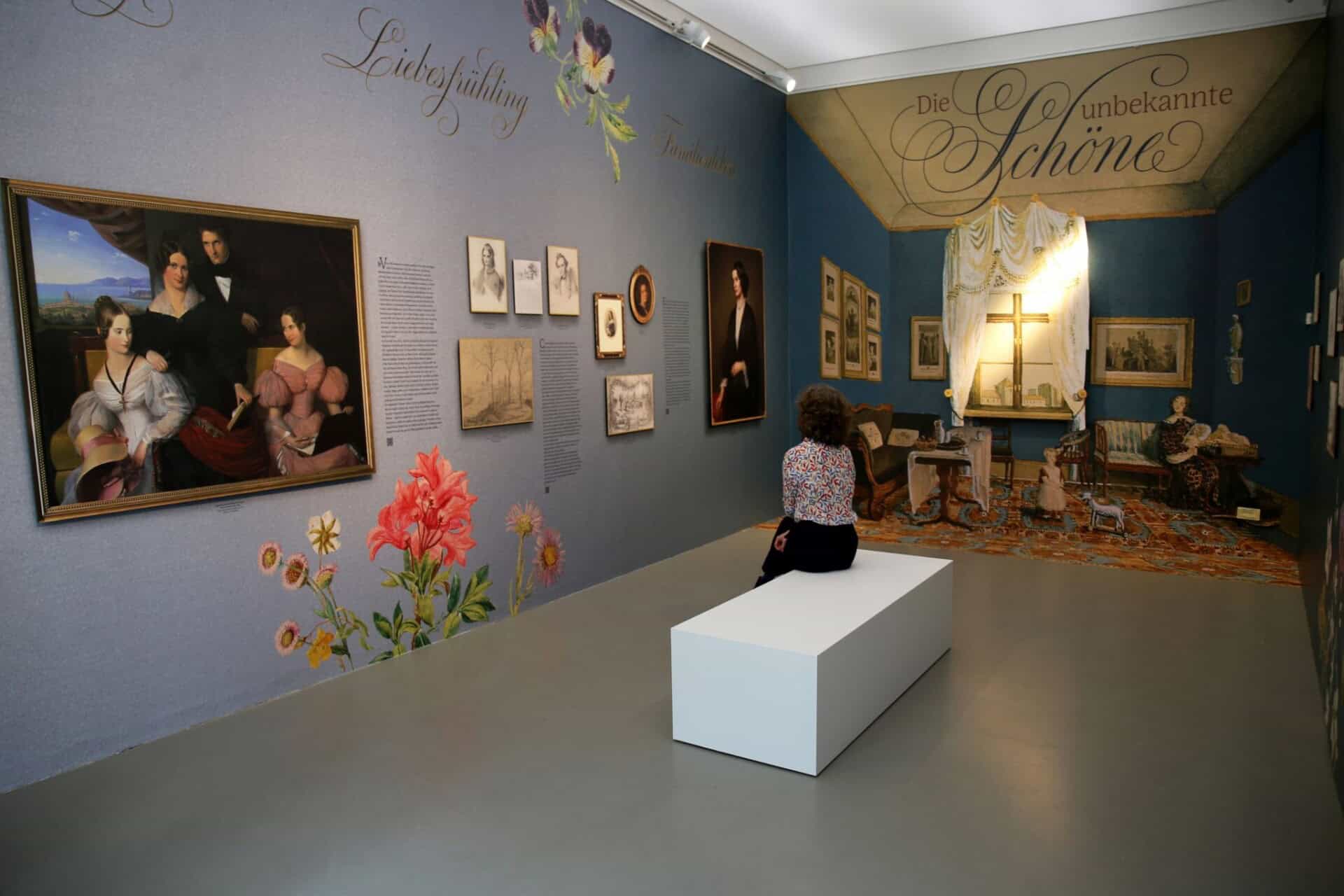
But the Mendelssohn-Haus – which has also been honouring Felix' sister Fanny in a beautiful way for some years – tries to look further and sees enough reasons to celebrate 'die unbekannte Schöne' in style. We actually get to see those flowers, because Cécile Jeanrenaud turns out to have been a great talent for drawing, as evidenced by her numerous watercolors of flowers. It's a pity, however, that only one copy was made of the collection and that the reproductions, with one exception, are not for sale. One wall of the small exhibition space is taken up by a reproduction of a work on which Felix and Cécile worked together. After Felix' death, Cécile arranged, among other things, the publication of a collection of songs that he dedicated to the singer Livia Frege.
Livia Frege
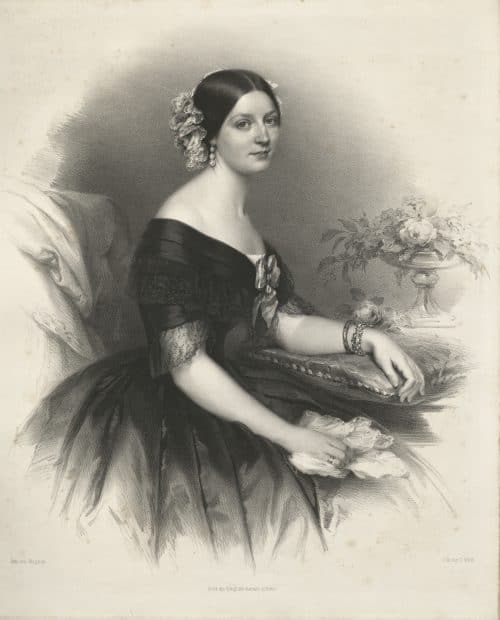 Livia Frege (1818-1891) now also receives permanent attention in a (digital) exhibition at the Stadtgeschichtliche Museum in the Alte Rathaus. At her debut at age 14 as a singer in the Gewandhaus, the Leipziger Tageblatt hailed this 'young talent of our city' that 'gives us the finest expectations'. Still as unmarried Livia Gerhardt, she also sang in the Musikalische Akademie founded by Clara Schumann. She married Woldemar Frege, scion of a wealthy merchant family to which the Fregehaus in the city centre still bears witness. Normally, marriage meant the end of musical women's professional careers, but Livia Frege continued to sing, though no longer in opera, but with songs and oratorios. She would also open a musical salon in their villa. Finally, the Schumann-Haus, the Grieg-Begegnungsstätte and the Musikinstrumentenmuseum are offering thematic guided tours and workshops this year. Leipzig is in any case a delightful city for music lovers. A Notenspur leads you from one memorable place to the next. Vaut le détour – Den Umweg wert!
__________________
- Consult here the full programme of Stark. Weibliche Lebenswelten in den Leipziger Musikmuseen.
- Die Stimmen der Frauen als der Bach-Familie, until 10 November 2024 in the Bach-Museum. All stories are recorded in the catalogue. More extensive portraits of the 33 Bach women can be found in the book by Maria Hübner, Frauen der Bach-Familie (Kampard, 2021, 288 p.).
- Die unbekannte Schöne - Cécile Mendelssohn Bartholdy, until 9 February 2025 in the Mendelssohn-Haus.
- Read more about musical Leipzig in the blog Met Clara in feestend Leipzig.
- This article also appeared at notities.vrouwaandepiano.be.