
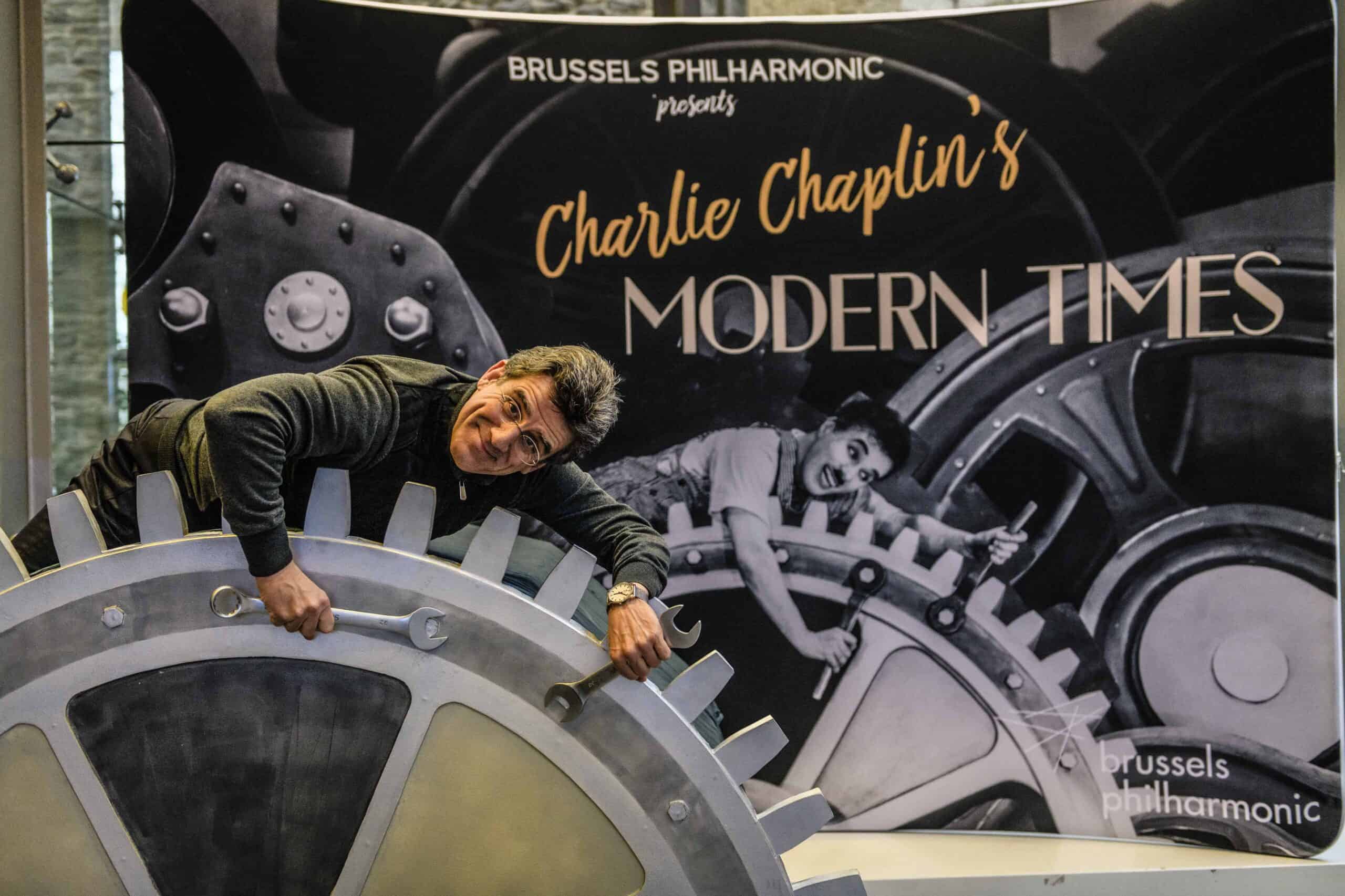
The Brussels Philharmonic under Dirk Brossé invites us to enjoy a 'silent' film as it was perhaps always intended in these hectic times? With high-quality music
Golden Label Symphonic nomination - First of all, upon arrival at Flagey we are immediately welcomed by an artist dressed somewhat as Charlie Chaplin playing accordion. There is also the amusing possibility of having a photo taken on the gear like on the film poster.
Thanks to modern technology, we can now listen to the music live during this film because the music has probably been filtered out (while other sounds remain) from the actual film and the orchestra is at work, except for the song towards the end where Chaplin himself sings. Separating sung text and accompanying music digitally is probably also an enormous task and he sings it himself in any case very well. The question arises whether a current recording cannot be made and preserved. Charlie Chaplin himself was disappointed in the recording quality and simplified the arrangement in such a way to keep everything clear.
What is historically somewhat amusing is that it all seems very new now to do this, but in the initial silent film period it was even customary to commission professional arrangers to make suitable compilations of published music to accompany films, then performed live by whatever instrumental combinations each cinema could afford.
The music itself is sometimes quite modern and shows enormous diversity in styles, but testifies mainly to good taste. Chaplin had a very clear idea and also didn't want to compete or anything like that, the music only serves the film and complements it charmingly. At times it is also quite virtuosic, the musicians are truly held to strict speed requirements. To what extent the music is entirely Chaplin's own is uncertain, he also collaborated with orchestrators, but the themes are original, he led the whole thing.
The orchestra and conductor make an enormous effort to bring these 87 minutes of music integrally and well together with the film, once slightly out of sync with the image I can absolutely understand and that remains as it is! It is an underestimated demanding work given the precision and subtlety of the interaction with the film. It will certainly be performed as well as possible tonight. Of course we must not forget that in the original context it was also created fragment by fragment in the studio.
The film is still topical, perhaps more so than ever and wonderfully symbolic/satirical, an image of a flock of sheep all walking in the same direction followed by an image with all sorts of factory workers is certainly not arbitrary. It probably seemed to Chaplin no natural way of life and he wants to urge people towards more individuality. In the film he sets a good, touching example by unconditionally helping a poor girl who steals food to survive with her family and preventing her from ending up in prison; in his own words; 'more than cleverness, we need kindness and gentleness'.
Nostalgia strikes me personally and certainly many others with me and now it is even better with this pure music and a generous arrangement for a very large orchestra. Several times I experience a teary moment thanks to the clear language of the music that the Brussels Philharmonic paints so beautifully in combination with the already so powerful images.
Smile
Chaplin took his freedom within the framework with the wonderfully beautiful theme that later became the song 'Smile'. As a kind of leitmotif, it is every time a little different while it remains so striking. It also makes the first violinist, who had to take on the melody, Otto Derolez, highly praiseworthy. This theme continued to inspire, first a song was made from it and later it was treated as a jazz standard which meant that figures like Michael Jackson and Frank Sinatra even sang it and others arranged it. Smile laughs while it weeps...
After the show there was still a charming burlesque in the hall with all sorts of imitations of Chaplin's work by the aforementioned artist and several other ladies entirely in the style of the time in which Modern Times was created, although I would like to note that the music was sometimes a bit loud, but this only contributed to the integrity of the event.
The total package was so complete, it could hardly have been better, fantastic reception, a fantastic concert (well, not an ordinary concert) and afterwards still plenty of spectacle. It was a grand evening and whoever gets the chance to see this I can only wholeheartedly recommend to go and encourage as many others as possible to come along, unfortunately the last performances are nearly sold out. This type of events in themselves (film+live music) is not necessarily unique, but it is in the minority, but the whole thing with the accompanying performances is absolutely unique.
Not to re-establish already established values per se, but because I find it such a fantastic initiative and hope to see more of it, I consciously nominate it for a Golden Label.
- WHAT: Brussels Philharmonic: Modern Times in Concert
- WHO: Dirk Brossé, Brussels Philharmonic
- WHERE & WHEN: Flageygebouw Brussels, 1 March 2018
- PHOTO: Brussels Philharmonic/Christophe Vander Eecken