
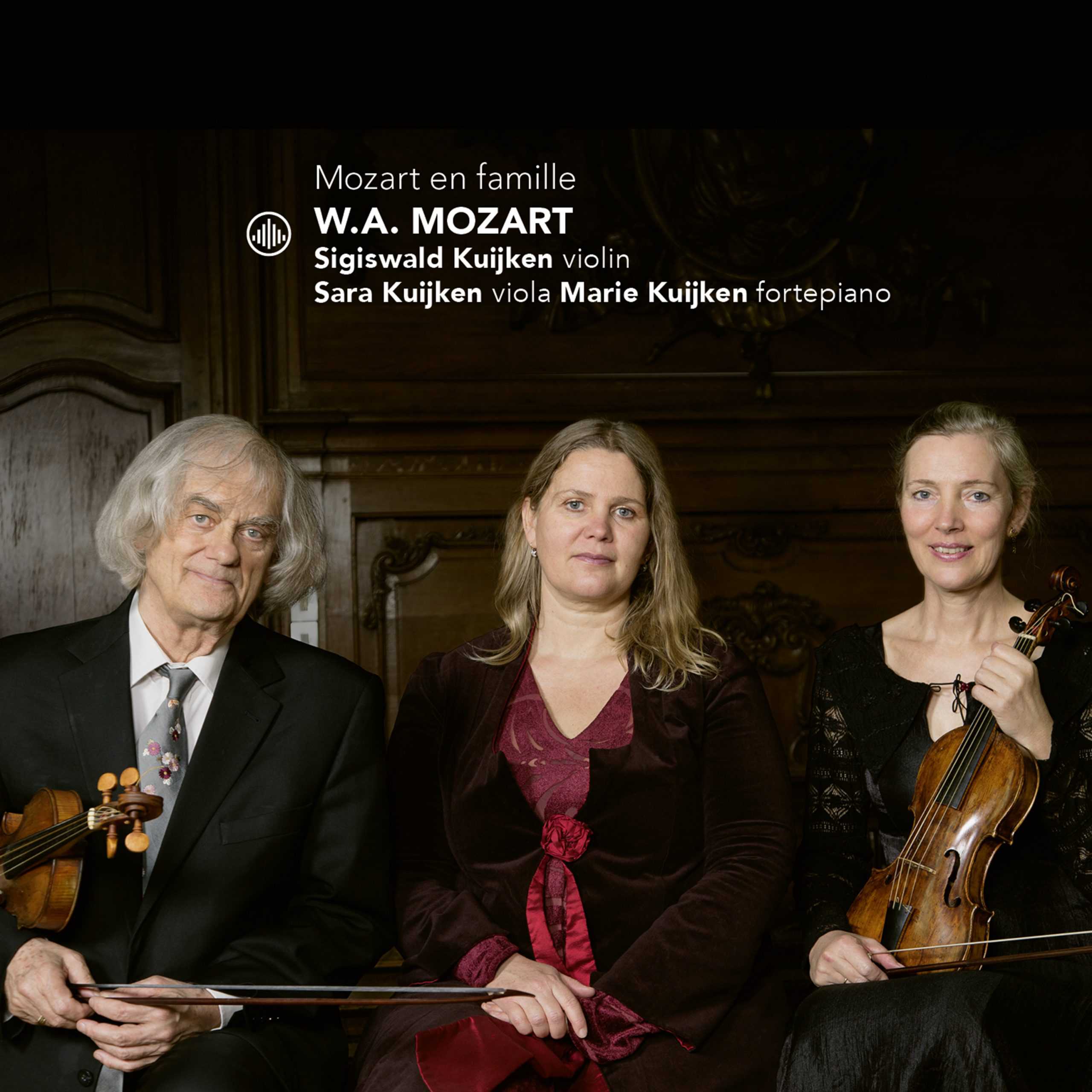
The choice of repertoire on the album Mozart "en famille" was determined by the combination of instruments played by the three Kuijken family members and has resulted in a varied programme.
The Sonata in C majeur (KV. 296), played by Sigiswald Kuijken (violin) and daughter Marie Kuijken (fortepiano), is nowadays called a violin sonata for convenience, but actually incorrectly. However, the description in the score is "für Klavier mit Begleitung einer Violine". This is to emphasize that the fortepiano takes the leading role here.
In the Duo in G majeur (KV. 423) the violin and viola are completely equal. Mozart, who was himself a violin virtuoso and also enjoyed playing the viola, used all the possibilities of both instruments. The individual characters of the violin and viola can be heard in the intense dialogue between the two instruments, on this album heard with Sigiswald Kuijken together with his other daughter Sara Kuijken (viola).
The Fantasie in d mineur for fortepiano (KV. 397) is a rare jewel in keyboard literature. The work is written in d minor, just like his string quartet (KV. 421), his Piano concerto (KV. 466), and of course the Requiem (KV. 626). Mozart uses this deep dark key to make his listener feel how fate is inevitably part of the unspeakable mystery of life and suffering, eternity and hopeful indestructibility.
The Kegelstatt Trio (KV. 498) was originally written for clarinet, viola and piano. According to tradition, Mozart wrote this work while relaxing at the bowling alley ("Kegelstatt") with friends. This recording presents the printed version of this work (with violin instead of clarinet), in which all three members of the Kuijken family can be heard.
Since 1998, Sigiswald has occasionally brought together members of 2 generations of Kuijken, his daughters Sara and Veronica and his brother Wieland, to perform string quartets from later periods (Debussy, Schumann, Beethoven, Schubert) - often in combination with songs by daughter Marie Kuijken (both pianist and soprano) and Veronica Kuijken on piano. Recordings of the two generations were made by Arcana and Challenge Records.
*If you make a purchase via the above link we receive a small fee. This allows us to continue providing you with reviews and articles. By buying something through our link, you support us in writing new articles. Products will never be more expensive for you if you use our links.