

Symfonieorkest Vlaanderen is a flexible orchestra that brings both classical and contemporary works with equal enthusiasm. Since the 2019-'20 season, Estonian Kristiina Poska has been the chief conductor. For this two-part concert with eight performances, she invited her compatriots from the Estonian Philharmonic Chamber Choir. Choral singing belongs to the cultural soul of Estonia. One in three inhabitants would sing in a choir. Singing is instilled in the population from childhood, so to speak. Thus, the country has held a song festival since 1869 that is listed on the UNESCO heritage list. It takes place every five years in Talinn and lasts two days. At the end of the festival, all choirs perform together. Then there are approximately 25,000 singers on the enormous stage. At the last festival in 2019, the audience numbered around 100,000 people.
The Estonian Philharmonic Chamber Choir is one of the country's showpieces. What is more, it ranks among the world's top choirs!
'Kreeks Notebook' Tõnu Kõrvits
Arvo Pärt is perhaps the most famous contemporary composer from Estonia with his minimalist style, but Estonia has several others, including the younger Tõnu Kõrvits, born in 1969. In 2007 he gained a strong reputation with his work 'Kreeks Notebook'. His 'Notebook' is inspired by a collection of Estonian folk hymns recorded by that other Estonian composer Cyrillus Kreek (1889-1962). An Estonian through and through. He continually pointed out the beauty of his own folk music. Forgotten music that is closely interwoven with the history of the country. The songs originated in Lutheran hymns from the 18th century and rune melodies from the Middle Ages. The choir, 25 voices strong, is accompanied exclusively by strings and minimally by percussion. The women wear a sober long taupe dress, the men a black suit. 'Kreeks Notebook' consists of eight parts, which form a contrasting whole, with meandering soundscapes full of melancholy, longing and subtle harmonic colours in an exceptionally beautiful performance by the Estonian Philharmonic Chamber Choir. There are songs exclusively for the women, for the men, ensemble singing, there is a solo part for a soprano, once sung a cappella in a wealth of voices that blends beautifully. The orchestration is supportive of the singing yet varied: the violins provide the light touch, the cellos and double bass provide a dark and sonorous sound. The final chord, from choir and orchestra, is overwhelming. The applause was commensurate. The extremely satisfied conductor, Kristtiina Poska, held the score aloft, as if to emphasize: all credit goes to the composer.
[caption id="attachment_52402" align="alignleft" width="200"]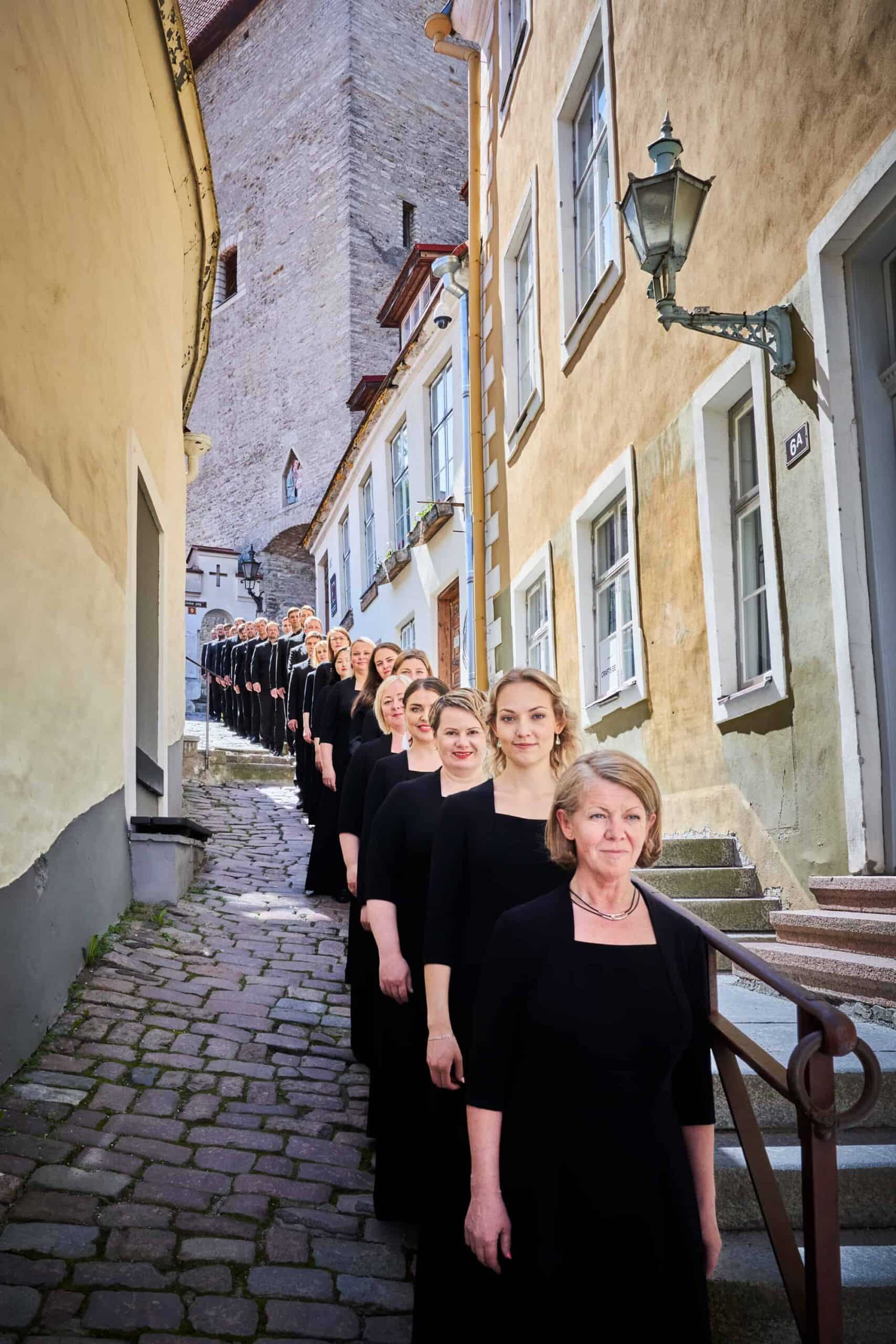 © Kaupo Kikkas[/caption]
'Requiem' W.A. Mozart KV626 (Süssmayr)
Death is something most people approach cautiously. When a loved one dies, there is emptiness. You miss their presence, their voice, their touch. Music is there to reconnect. A depth of understanding, sorrow but also hope. Mozart began in 1791 composing his Requiem on commission from Count Walzegg for the first anniversary of the death of his wife Anna, who died at the age of twenty. As an avid music lover, he wanted to have a requiem composition performed during a memorial service. Mozart died on December 5, 1791, before he could complete his composition. This masterpiece is considered a symbolic work that mythically connects the composer with his own death at the age of 35. Because it was a commissioned composition, the work was completed at the insistence of Mozart's widow Constanze, initially by Joseph Eybier but later in its entirety by Süsmayr, both friends and colleagues of Mozart.
How do you arrive at such a magnificent work? It is the end product of an entire world of experience. A sedimentation of kaleidoscopic seasons. The art of touching the silken surface of loss and grasping the weight of beauty in notes. It is not only about beauty but about resilience and durability. Music that holds memories, feelings and hope. The music belongs only to itself and washes away sorrow. Kristtiina Poska stands gracefully before orchestra and choir and conducts expressively and pointedly, anticipating the notes and emotional value. This Requiem is a masterpiece that still speaks and moves. The density of the work is breathtakingly beautiful, brought to life by an excellent choir and soloists supported by a superb Symfonieorkest Vlaanderen. Music as balm for the soul. The audience was silent for a moment after the final chord to recover from the power and intensity but then broke into prolonged applause. To be able to enjoy so much exceptional talent and beauty is something to be grateful for in this troubled world.