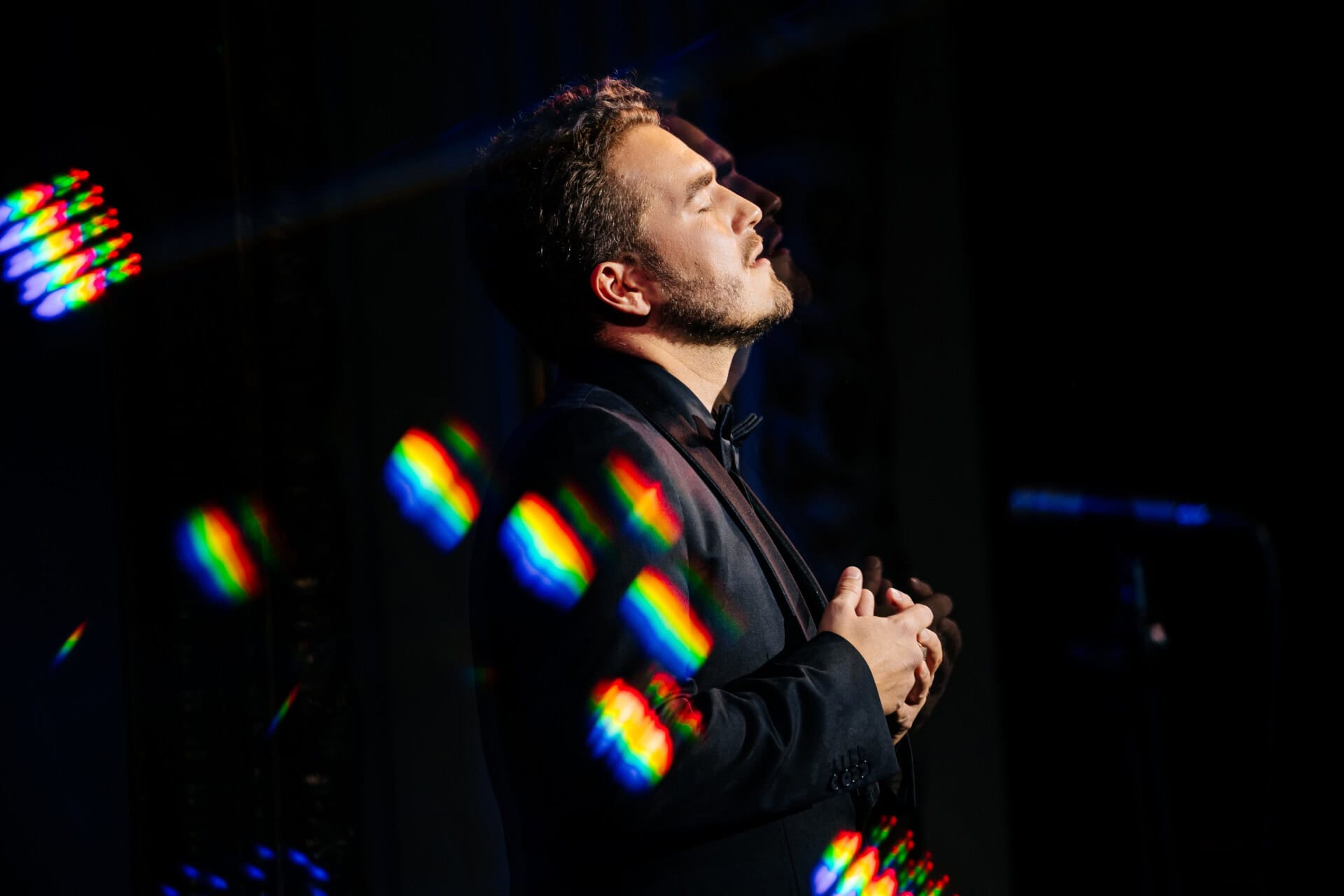
There are moments when music does not sound, but is born. A breath that slowly fills with words, a silence that suddenly speaks. That is where Klassiek Centraal begins its encounter following the Music Chapel Festival at Flagey with a voice like that of Oleg Volkov.
There are voices one hears, and voices one meets. Oleg Volkov belongs to the latter category: not a chance appearance, but a presence that slowly settles in the ear, like a conversation partner who not only sings, but also responds. His words breathe something of both the displaced and the homecoming, an echo of the polyphonies of the Russian south, a youth woven through with music and tradition, a spirit formed in the quiet laboratories of linguistics. Now, in Brussels, his voice becomes an instrument, a question, a horizon.
A calling that is chosen and chooses
His love of language and communication is no accident. With a master's degree in linguistics and translation, he has learned to listen to the layers behind words. "Everything begins with communication," he repeats. "In music, as in language, there is always a message that someone must receive. My task is to discover what my character carries, and to find the keys so that the audience can receive it." He himself describes this as a mysterious interplay: not only does he choose his path, but the environment also chooses him; the voice, the artwork, the audience, everything carries him to his natural place. Opera and concert, experiment and tradition: he inhabits them all, formerly a member of the "Jeune Ensemble" of the Opéra national du Rhin, now a voice that continues to unfold.
The singer as translator of the soul
What drives him always begins with language. "For me everything begins with communication." Correct pronunciation is merely the foundation; it is about grasping psychological layers, cultural nuances, emotional resonance. For Volkov, music is not scenery: it is a conversation with someone who may be seeking, may want comfort, may want nothing but clarity. "As an interpreter we don't really translate: we interpret." This is how he explains how his translation and interpretation practice forms the core of his artistic philosophy: music is exchange, a touching of the soul, not passive reproduction.
Every text – Hofmannsthal, Maeterlinck, Mahler – carries a breath that must be felt, not merely heard. Early on he experienced the power of music while working as an interpreter at the Sochi 2014 Olympic Games. "People encouraged me, as if they heard something I didn't yet know about myself," he tells us. "It's as if the audience sometimes chooses your path, calls you, invites you to sing, to 'light up stars' as Mayakovsky says."
Coming home at L'Opéra du Rhin
When he speaks about the "Jeune Ensemble" of the Opéra national du Rhin, his voice softens. "For me, the Opéra national du Rhin will always remain my alma mater." There he discovered freedom as a gift you never let go of again: the freedom to try, to fail, to explore. To push boundaries, vocally and dramatically; experiments alongside classical traditions.
"That place offered me much more than a workspace: it gave me friends, guides, life partners. I am especially grateful for the trust and support of Alain Perroux, Claude Cortese and Sandrine Abello. They are my people," he says. "Those who go their own way, create, share, and bring light into the lives of others." Tradition is not a mausoleum. Tradition breathes. The deep vocal tradition of South Russia, the polyphonies of Cossack culture: roots that carry him, breath that shapes him. "The vocal tradition is above all an oral tradition, passed directly from one singer to another," he explains. No writing, no doctrine, but listening. Not imitation, but feeling.
In Europe he adds new sound worlds, rhythms of speech, ways of silence. "Every culture has its own breath, its own tensions, its own language of colours and pain," he says. This mix makes his voice unique: an echo of the distant, woven with the near, a dialogue between past and present.
The Music Chapel: workshop of inner growth
In Waterloo, at the Music Chapel Queen Elisabeth, Volkov finds another form of homecoming: a workshop of inner growth, a place where you are not guided, but unveiled. "Here I meet people who inspire me deeply," he says, his eyes glinting at the names of José van Dam, Sophie Koch, Stéphane Degout, Olivier Reboul, Kira Parfeevets, Sophie Reynaud, Marie Dachary, Julie Deilbart, Lionel Bams, Thomas Hampson, Sabine Devieilhe.
"It is a place where you grow at your own pace, but never alone. No one says: 'Do it this way.' Rather: 'Understand why it must resonate within you.'" Guidance, stage experience, observation: they melt together into a circulation of trust. "It is an environment where trust circulates naturally – and in such a climate you surprise yourself by going further than you thought."
The three movements of a role
Approaching a new role is a ritual. First dissection: phonetics as microscope, rhythm as backbone. Then archaeology: centuries, customs, political contexts that shimmer beneath the score. Finally the living laboratory of rehearsal. "That is precisely where the real balance emerges between music, text and theater," he says. Here the ideas of conductor, director, composer, librettist and singer flow together into one breath. "Rehearsals are pure communication," he smiles. His technical philosophy is simple: "For the voice to be free, the body must be stable." Sleep, movement, breathing, nutrition, mental balance. "I use gravity as a support point. It is a constant, reliable force that never disappoints," he explains with a laugh. His discipline is not strict, but natural: a breath that resonates with the voice itself.
Mahler: where music is life
On December 6 he enters the universe of Mahler, a world that many do not step into in their entire lives. "What moves me in 'In diesem Wetter', as in all his music, is that beauty of a rare intensity. With Mahler, music does not imitate life — it is life. It is a moment where everything comes together: technique, emotion, text, breath," he says. He maintains the subtle balance between involvement and distance. "We will see each other on December 6 at Flagey," he smiles.
Returning as growing
"All the roles I have sung, I would gladly sing again." Repertoire is not a list, but a life cycle: return deepens, revival reveals new facets of the same mysterious being that is a character. "Returning to a role is like meeting old friends: familiar, but enriched by experience, voice development, personal growth," he says. Contemporary repertoire offers challenge and opportunity: "Some works continue to challenge me — and time is always too short to dive into everything."
The singer who reinvents the words
Oleg Volkov does not merely sing, he translates – not from language to language, but from person to person. His combination of intellect, emotion and physical control makes each performance a carefully considered, living interpretation. His creed stands immovably inscribed in him:
Singing is not repeating. Singing is discovering. Singing is reinventing the words at the moment they are born.
His ideal? To sing as if he were inventing the language itself on the spot — words that are born in that very moment. And so the breath of a voice returns to the silence of its origin, and one feels, in the spaces between the silences, that this voice has only just begun to speak.
Saturday December 6, 20:15, in "In diesem Wetter" from the "Kindertotenlieder" by Gustav Mahler (1860-1911) with Brussels Philharmonic conducted by Kazushi Ono. Also see https://klassiek-centraal.be/music-chapel-festival-2025-de-vier-elementen-in-klank-en-geest/