
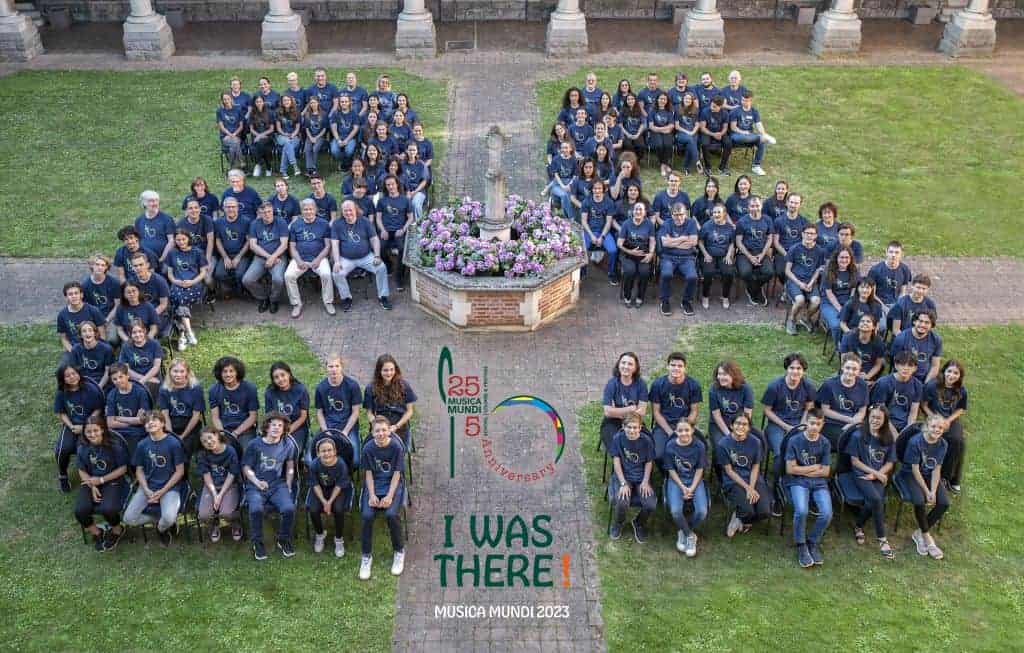
Who knows that somewhere in Waterloo, where once the ground was covered with the blood of soldiers, there stands an abandoned monastery that today houses a school for musical top talent? It began more than 25 years ago with the Musica Mundi Festival & Course at the lake of Genval. The initiative evolved into an enormous project that brings together highly gifted young people from all corners of the world to lay the strongest possible foundation for a professional musical career.
[caption id="attachment_51474" align="alignleft" width="500"]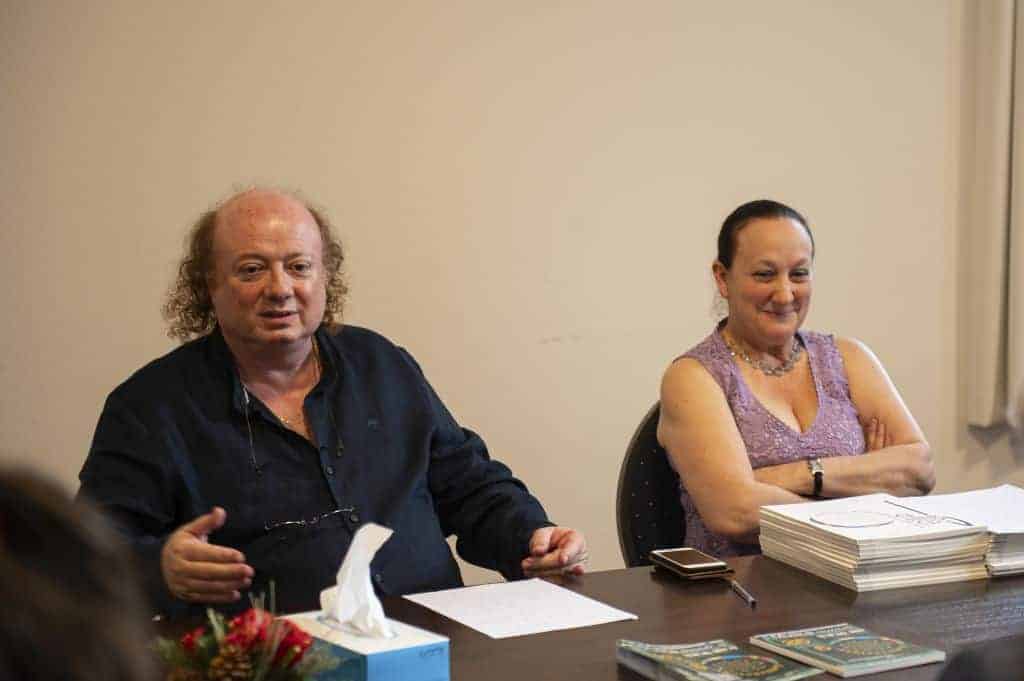 Leonid Kerbel and Hagit Hassid-Kerbel[/caption]
The driving forces behind the institute, which celebrated its 5th anniversary in 2023, are pedagogue and violinist Leonid Kerbel and his wife, pedagogue and pianist Hagit Hassid-Kerbel. Leonid had the privilege of receiving extensive training as a child prodigy in the former USSR. To this day, schools for highly gifted children exist in Russia. Children who, because of their talent, do not always fit into regular education, which sometimes leads them to completely lose their way as adults in a world where they could not develop their talent. Thanks to such a talent school, for whatever discipline, that becomes possible and it bears brilliant fruit. Education is tailored to the talent and maturity that a child can sometimes possess, far exceeding that of the ordinary adult, while still being a child who likes to play, who may and must be allowed to be a child, despite those particular gifts.
Such schools do not really exist in Europe. In Flanders, for example, there is a talent school for athletes that may work in a similar sense. There is the kunsthumaniora, but it is not equally adequate for those exceptional talents that are specifically in question here: classical musicians.
"De la Musique avant toute chose"
That evil was and is a thorn in the side of many. Two of those many were Leonid and his wife Hagit. Shortly after launching the festival in 1998, the musical couple saw the necessity of establishing such a school in Belgium, a country that can be seen as a sort of international centre. The courses connected to the Musica Mundi Festival lasted only two weeks – note that this was not the familiar format of Master Classes. These were very intense, but the work was never finished. Two weeks, it is something but in any case too little, too limited.
Leonid and Hagit Kerbel wanted to push through with their vision at all costs. How? Where? Who? Music would be the guiding principle, music above all and everything for music. General music education is sufficiently available, as are conservatories, but can one really get everything out of these rarely highly gifted children and young people within the existing structures? The question answers itself and the answer was: there is a need for an institute, a school where children can come, from wherever they come, to develop their talent as intensively as possible without neglecting necessary general education.
An ambitious project. If you have to start from scratch? Barely possible. The Kerbels started almost from zero, not entirely because they could boast of Leonid Kerbel's experience with what existed in the USSR on the one hand, and on the other hand he travelled around the world studying, comparing the teaching systems in various music schools and conservatories at multiple levels, extracting the weak and strong points and linking insights to them that would shape the total educational project. A rock-solid starting point on which an ever-evolving pedagogical idea was worked out and regularly adjusted where necessary.
Ten to eighteen-year-old top talents at Musica Mundi School
Not everyone has a chance; talent must be present and if innate talent is lacking but there is a strong will to succeed, then a young person can be admitted to the rather select group of students.
 Leonid Kerbel:
The Musica Mundi School is recognised as a Cambridge School. This means that students who complete the school can be admitted to any music conservatory or university in the world, since the Cambridge diploma is recognised worldwide. While in their general studies students are grouped by age group, in music studies they are not placed in a class by age category but in a class where students with a certain level sit together. So an 11-year-old can sit with a 17-year-old for music history or harmony. We want to guide students optimally in their musical and intellectual development, and the Cambridge system seemed best for our students. They often stand much further ahead than their peers in certain respects. Not only musically, but also in other intellectual areas.
We chose young people who have, in principle, completed primary school. You could roughly compare it to secondary education in terms of age, but not in terms of teaching method and content. We pay a lot of attention to finding the perfect balance between musical and general academic education. That is what it's all about. We train musicians at our school. Mind you, we don't want to train average musicians. The aim is to get the maximum and more out of young people through a very personally directed form of teaching. The intense music study and the associated general education is so strong that anyone who obtains their final diploma at Musica Mundi School will be accepted without problems at higher music institutions anywhere in the world.
Musically, we teach them not only to play their instrument like the best, we teach them to listen, we teach them to understand that they are performers of a creation that passes through them to the audience. Musicians who choose a soloist career are often too much of a soloist and don't always listen well to the accompaniment, whether it's a piano or a full symphony orchestra. That's why we emphasized chamber music from the beginning in the courses that are part of the Musica Mundi Festival. It is one whole, festival and courses. This collaboration is a core element in musical education alongside giving quite a few concerts for the public. This ranges from class concerts to concerts in the large halls of the country, for the unknown listener to well-known personalities. If you have learned to listen, you're already one step ahead to becoming a soloist.
Donate – Patronage
Hagit Hassid-Kerbel, who, besides teaching, takes care of the finances such as patronage and donations, tells us with passion and shining eyes that the school is doing everything it can to offer every suitable prospective student all the opportunities to take lessons, no matter how far from home, no matter how poor or rich the parents may be. Of the 48 students, only 5 have parents who can fully bear the actual registration cost. Others pay part of the high sum. The amount to be paid is calculated based on income according to tax returns.
This school year 2023-24 there is one foreign student whose only parent – the child is half-orphaned – has no income. Through scholarships and patronage, the costs are covered. That is remarkable: the child in question must not become a victim because there is no money in the house. Now it can flourish and is offered a future. Remarkable.
It touches the woman, her mother's heart speaks and also the heart of the artist who believes that every child with talent, that is highly gifted, must be given the necessary opportunities no matter what. For that, donors are needed. These can be large gifts, but also small ones, because many small things make a big one and so another talent can develop. Those who feel called to make a one-time or ongoing gift can contact Musica Mundi School, hagit@musicamundischool.org tel: +32 495 20 05 95.
WEBSITE: https://musicamundischool.org/