
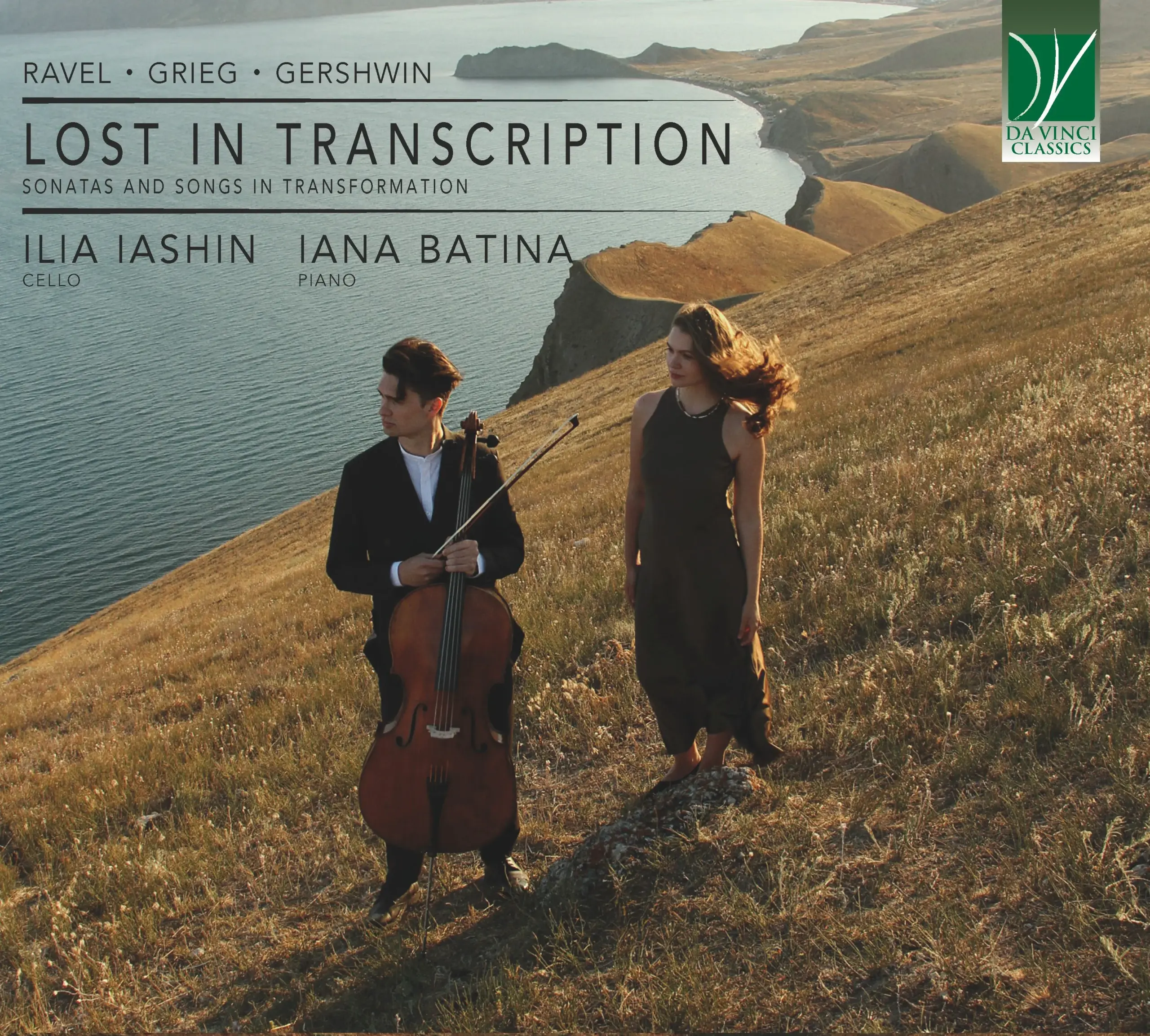
There are cd-titles that contradict themselves the moment one opens the cover. Lost in Transcription is one of them. Whoever takes the promise of loss seriously will, after a first listening, have to admit quite the opposite: nothing is lost here, something is rather found. Cellist Ilia Iashin and pianist Iana Batina, both trained in the demanding school of the Moscow Conservatory, venture into a programme that brings together three worlds – Ravel, Grieg and Gershwin – which at first glance seem to have little in common, but which have each entrusted their soul to the cello, an instrument whose considerable part of the repertoire has emerged from transcriptions. It is no coincidence that the history of classical music is also a history of transcriptions. Long before the gramophone brought the concert into the living room, arrangements were the natural way music travelled: from city to city, from salon to salon, from musician to musician. Only in the twentieth century did the idea grow that the score represents an inviolable original. This recording reminds us that a transcription is not necessarily a derivative, but equally a new way of reading and listening.
When the cello rediscovers a forgotten voice
The programme opens with the Sonate posthume by Maurice Ravel (1875-1937), a youthful work that for decades was regarded as a curiosity on the margins of Conservatoire life, and which only recently, thanks to a rediscovered autograph, revealed its true form: not a completed sonata, but the opening movement of a work that young Ravel abandoned, somewhere between the lessons of Fauré and the first outlines of a language that would soon become his own. In the cello arrangement, the piece loses nothing of that hesitant, searching beauty; on the contrary, the cello's middle register gives the lyrical main theme an introspection that the violin, with its tendency towards brilliance, less easily permits. Not the notes change essentially, but the perspective from which one hears them. More than that: after a few minutes it hardly seems conceivable that this work was originally conceived for violin. The cello appropriates Ravel's long breath and refined lyricism with such ease that the transcription nowhere feels like a compromise, but as a convincing alternative. This is not only the merit of Iashin as arranger, but equally of the exceptionally tight ensemble playing between him and Batina, which makes every impression of an arrangement disappear. Batina shines here precisely through her restraint: her piano playing supports, breathes and colours, without ever displacing the cello from its natural role. Where the score wavers between pupil and master, Iashin reveals that this wavering itself is already music. His tone remains remarkably natural: never overtly romantic, but always directed towards letting the melodic line speak. What was once regarded as an unfinished youthful work reveals itself here as a composition of moving beauty, a small musical discovery that deserves far more attention than it has received so far.
Even more closely interwoven is the thought in Kaddisch, the first of two Hebrew melodies with which Ravel – not out of devotion, but out of fascination with the age-old singing tradition of the synagogue – explores a language that is not his own yet becomes so. Italian musicologist Mario Bortolotto once called it a precious forgery of the nasal synagogue style; one could equally call it an act of listening respect. On the cello, the piece gains in weight what it loses in text: no more words carrying meaning, only the bare rise and fall of a voice that pleads without knowing to whom. Iashin lets his instrument sing not like a cello, but almost like a human voice. His warm, deeply felt tone approaches the cadence of a prayer so naturally that the absence of text is hardly experienced as a loss. On the contrary: precisely because the words disappear, the pure expressive power of Ravel's melody becomes all the more direct. Batina accompanies here with remarkable restraint: her piano playing breathes along, colours without ever diverting attention from the singing line. Once again, any awareness that one is listening to a transcription by Iashin's hand disappears. The performance possesses a rare ease, as if Kaddisch had always existed for cello and piano. It is precisely in such moments that Lost in Transcription completely turns its title upside down: what appears to be an arrangement reveals itself as a convincing new form of the same musical idea.
The hidden voice of the north
With the Violin Sonata No. 3 by Edvard Grieg (1843-1907), in a transcription by Ivan Skanavi, the programme shifts to the north, but the underlying question – what survives the crossing to another instrument? – remains the same. Grieg himself regarded this last of his three sonatas as the most international, and at the same time as the most pervaded by Norwegian earth, as if the folk song had by now become not a quotation for him, but a mother tongue. Iashin and Batina add a short cadenza to the middle section and make a modulation that is absent in the violin version – an intervention that does not hesitate to show itself as interpretation and which precisely thereby sounds more sincere than many impeccable but colourless readings of the original. It is also remarkable how the cello does not try to imitate the violin here. On the contrary: the dark tone reveals a melancholic undercurrent that in the original version sometimes hides behind the virtuosity. It is precisely in the broad cantabile phrases that how much kinship exists between Grieg's melodic imagination and the warm, human voice of the cello becomes evident.
Here too, the awareness that one is listening to a transcription soon disappears. The sonata unfolds with such ease that it sounds more like an original work composed for cello and piano than like an arrangement of a violin sonata. This ease rests first and foremost on Iashin's warm, honest cello tone, which seeks effect nowhere but convinces from beginning to end through its natural eloquence. His playing possesses a rare depth of feeling: the lyrical passages breathe freely, while the dramatic outbursts remain noble in tone and never lose their musical line. Batina is much more than an accompanist. Her playing seems to listen continually: every entry and every harmonic colouring emerges as a response to what the cello has just told. Clear in line, rich in subtle colour nuances and always ready to give Iashin space without herself retreating into the background, she forms with him not a relationship of soloist and accompanist, but a partnership of two equal musicians who seem to share one musical breath. Thus a sound world emerges in which cello and piano do not accompany each other, but continually inspire and support each other. It is precisely this natural unity that makes one forget that Grieg ever wrote this sonata for violin. One no longer hears a violin sonata in a new guise, but a work that in this performance sounds so natural as if it had always been intended for cello and piano.
The third voice of a shared memory
The finale, three numbers from Porgy and Bess by George Gershwin (1898-1937) jointly arranged by Iashin and Batina, is perhaps the most revealing choice of the album. Beneath the polished, almost opera-like line of Summertime, this performance harbors no self-evident showstopper, but rather an almost moment of stillness: a spiritual that does not cite itself literally, but breathes in every note, as if the melody is not sung but rises like a prayer from silence. In It ain't necessarily so, the attentive listener recognizes the contours of a synagogal blessing, but Iashin and Batina avoid any heaviness: with playful lightness, they allow the ambiguity of Gershwin's music to fully come alive. And in My man's gone now all of this culminates in a lament in which blues, spiritual, and opera-like aria do not compete with each other but embrace. It is not a traditional conclusion that bids the listener farewell with a final virtuosic gesture, but a final retrospect in which the different worlds of this recording come together once more and which, long after the final note, continues to resonate.
That Gershwin, son of Jewish immigrants, could weave these two memories – that of the synagogue and that of Catfish Row – into one body is in itself a small wonder; that this wonder now, via the cello, receives a third voice, is precisely what this recording owes its right to exist to. Here too it becomes clear once again that a successful transcription – not only on paper, but also in the hands of the performers – does not attempt to replace an original, but lays bare another truth of it.
Nothing is Lost
What connects these three, seemingly disparate worlds, is not the anecdote of the instrument changing hands, but the insight that a transcription need never be a loss – at most a shift in perspective. Iashin plays a French cello by Honoré Derazey from around 1850, an instrument with its own warm darkness, and Batina meets him with a piano playing that neither imposes itself nor disappears. Their interplay reveals a rare naturalness: phrasings seem not to be coordinated afterwards, but arise from one shared breath. Whoever calls this cd Lost in Transcription must have secretly known that the opposite would prove true: nothing here is lost. On the contrary: each work has found a new space along the way in which it can reveal itself anew. Perhaps that is ultimately the true meaning of a transcription: not that a work merely changes instrument, but that it is brought to speak anew from a new perspective.
Moreover, this is such a rare recording that does not end when the last note has sounded. It continues to resonate in memory, invites repeated listening and thereby continuously reveals new connections. For this reason alone, Lost in Transcription deserves a permanent place in the collection of every enthusiast who wishes to experience how a truly successful transcription does not replace a familiar work, but deepens it and brings it back to life.