
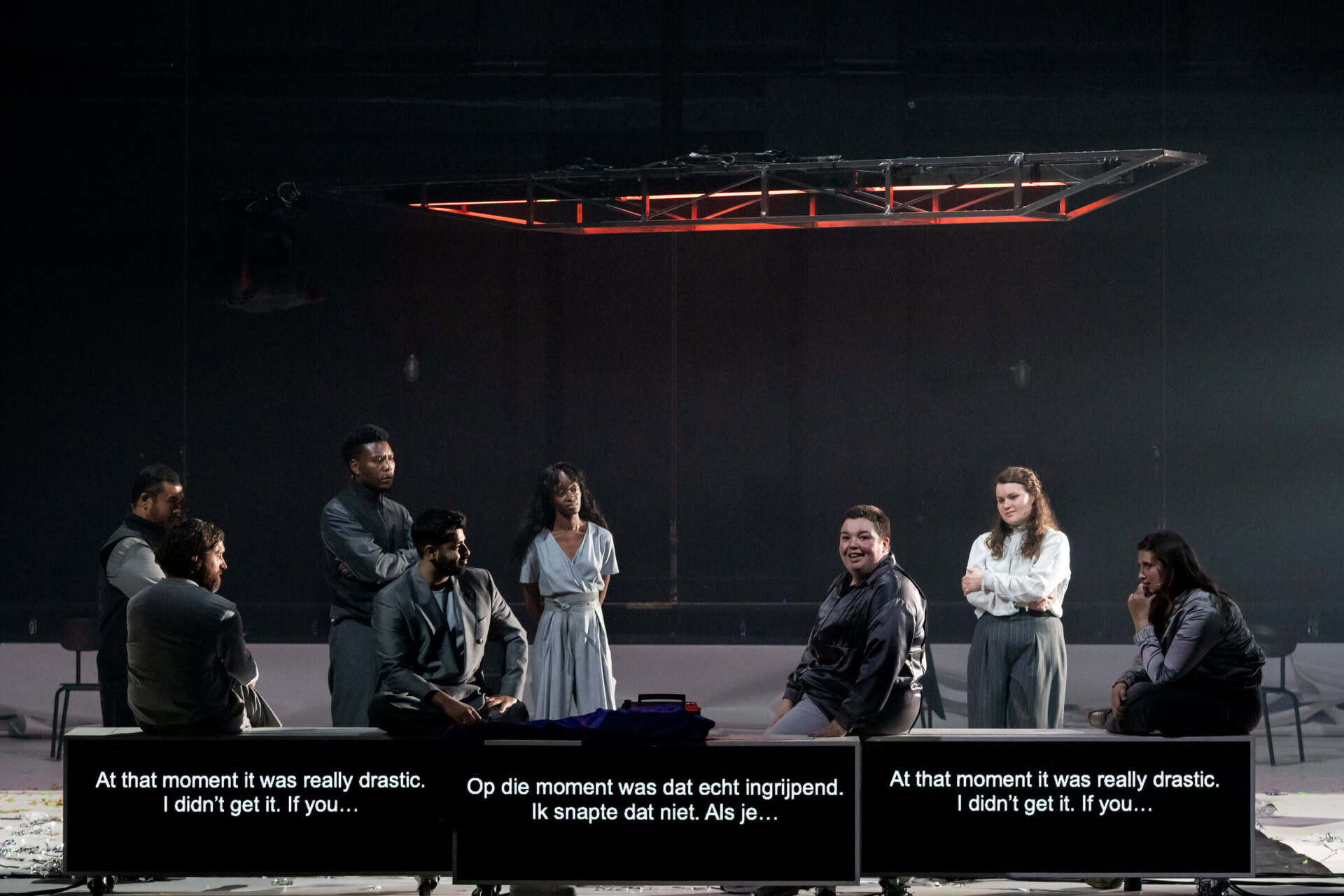
Dear Opera Ballet Vlaanderen, let me come straight to the point: please reprogram this work and commission the composer and librettist to write at least one and if possible more new operas. Because this 'procedure' is it. This is a new form of opera, strongly connected to the richness of the musicality of historical tonal operas.
The story 'Barzakh' (Arabic for the phase in Islam between death and resurrection on the Day of Judgment, somewhat like purgatory in Christianity): gripping, emotional throughout, thoroughly honest drawn from real life, no inventions, no fuss of any kind, no exaggerations, no minimizations, no romanticizing. Pure, genuinely human, dramatic to the core because yes, it concerns the prison system in this country. It could not be more current, scarcely a day goes by without something about it appearing in the press. Overcrowding, prisoners sleeping on 1.2 m² on the floor, insufficient staff, strikes, inadequate budget… It is quite something. It is so significant that it inspired people to make an opera about it, in close collaboration with former and current prisoners alike.
Is there no criticism then? Well, a little bit, which is immediately a tip for the librettist. Next time limit the dialogue and also be careful with the intelligibility of the spoken texts which were not always easy to follow. Let's say you could feel here that theatre people were at work who do not come from the broad classical music world. On the other hand, the achievement is all the more remarkable, especially in terms of content, musically impeccable, scenically representing the bleak hopelessness of prison life.
Text and composition convincing throughout
The prison system in our country has not had a good name for years. The Belgian state has strung together international condemnations like a failed string of pearls. Director Thomas Bellinck came into contact with prisoners as a theatre maker during his studies for a project and the impressions he gathered then have always haunted him somewhat. OBV's commission to write an opera immediately brought him to the world of crime. The collected operas throughout all music history are indeed one long story of betrayal, jealousy, murder, deceit and so on and everyone seems to find that 'normal'. Of course it is not real life, they are stories, but all those situations do occur in real life. There it is not an opera, there it is harsh reality. Guilty and innocent, justly and unjustly convicted: you find it all in prisons as well as prisoners who wait (too) long for their trial while in pre-trial detention. All this led Bellinck to develop a story about prison life. He wanted to involve prisoners themselves in it and here he succeeded wonderfully. The text is not only from his hand, but also from consciously anonymous, some by now ex-, detainees.
For the music he found the right man in the right place: the Iraqi-born autodidact living in Ghent and something of an all-round musician who had never heard opera before: Osama Abdulrasol. A musical genius, a musical wonder. What a powerful composition, tonal, harmonic, very bound to the text which is supported sometimes very intensely, then again remarkably subtly. Nothing is farfetched, studied over and again right to the end, on the contrary it is spontaneously created music, sometimes very gripping and moving with melodies that linger. How did he manage to achieve it? Read texts that are not immediately of a pleasant quality, become involved in the prison system to understand it as best as one can and convey it musically and emphasize it. This really demands more, let us look forward to his next opera or musically gripping spectacle that the future may have in store.
All this is presented in a simple set that references the historical set of Beethoven's Fidelio which comes up a couple of times. The four seasons follow one another and that is all there is to it. Nothing more, nothing less. They only provide respite during the walk, that is if there is no strike because then there is no walk, no visit.
[embed]https://youtu.be/M6sPv9iyclQ[/embed]
Actors: sometimes goosebumps
The acting itself could quite appeal to me. Marjan De Schutter who manages to identify herself incredibly with the woman whose situation she portrays. You could weep at how she portrays the role of the mother who is imprisoned. Another strong performance was that of Atta Nasser who is rather the simple criminal who perhaps knows no better or does not quite understand / realize what is going on, why there is so much violence within the walls, crooked organization and so on.
Sometimes a bit more difficult to understand, depending on the language (the actors perform their role in alternating four languages – Dutch, French, German and English) were Edith Saidanha and Jeroen Van der Ven although they managed to live very much in natural truth in their roles. Personally I would have chosen Dutch only, but given the international composition of the detainees and the sometimes poor or misunderstanding each other and intelligibility, the slightly difficult diction gave you even more truthful acting.
Singing 'in prison'…
Four actors and four singers. What voices! You would say that, if they hadn't existed, they were created especially for this opera. They became four discoveries for me – if you haven't reviewed opera for a few years you get to know new people – who convinced strongly in their interpretation itself, in musicality, in textual immersion and suffering individually and in the group, in confusion, in uncertainty, in not knowing what and when and where to. The names in a row: conscious soprano Katharina Dain, emphasizing bass-baritone Maurel Endong, sorrowful tenor Nattha Thammathi and moving mezzo-soprano Lotte Verstaen. All of this guided in very good order by a perfectly making music Symfonisch Orkest Opera Ballet Vlaanderen with at the head of it all conductor Zoe Zeniodi.
This opera belongs, as far as I'm concerned, already to the larger repertoire. Like all operas that remain eternal, it may also be so with this timeless opera, just like Fidelio where it is rightly referred to because the bond is there, is not and yet is… To conclude: hopefully politics learns from this and courage and determination grow to straighten out the skewed conditions in the Belgian prison system towards the norms and values of 2025 and no longer towards those of nearly two centuries ago.