
On January 15, the Antwerp Symphony Orchestra conducted by Jonathan Bloxham, with world-renowned French violist Antoine Tamestit as soloist, was a guest at De Bijloke in Ghent. A varied programme with works by Ida Moberg, Jozef Haydn, Bohuslav Martinů and Antonin Dvořák. Light, water, earth and fire.
They open with Sunrise from an orchestral suite by Finnish Romantic composer Ida Moberg. Light from the high North, rarely performed, a radiant prelude by a female composer. Haydn's thirty-ninth symphony is titled "tempesta di mare", a storm at sea. In the minor key of G, it is one of his first works influenced by the Sturm und Drang movement of the second half of the eighteenth century. The Antwerp Symphony plays beautifully accurate, but with smaller orchestras it often sounds more fierce, more stringent, with better balance between strings and winds. The water should as it were splash in your face during the storm, with a small boat on the rough sea. With ten first violins it sounds like a steamship that the storm has little grip on.
Masterful viola
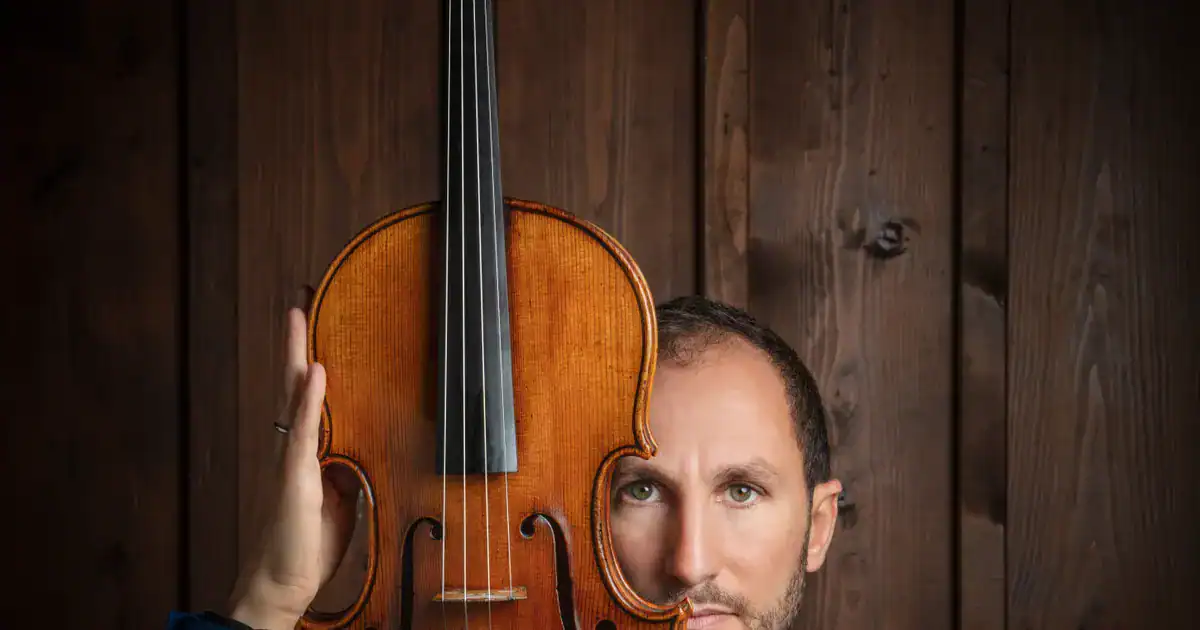
Less common than violin or cello, with less repertoire, the viola has freed itself in recent decades and conquered a rightful place among other solo instruments. Antoine Tamestit appears on the programme with his viola in front of his face. Radio Klara also devoted considerable attention to Tamestit during the week with several classics from the viola repertoire. Especially in the first half of the twentieth century, famous composers such as Bártok and Hindemith devoted more attention to the viola.
One of the most intriguing works for viola and orchestra is the Rapsodie concerto by Czech composer Bohuslav Martinů. Less well-known than his compatriot Leoš Janáček, he is rarely performed. Martinů's musical language is very personal and very distinctive. After only a few notes you hear that it is Martinů. Erratic, contrary, permeated with syncopation, often frenetic, compelling, then touching on lyrical moments, not strictly tonal and not atonal either. I often find it overwhelming, earthy music. Since I discovered Martinů some thirty years ago, he has held a special place in my listening life. Certainly this work of this evening, the masterful Rapsodie concerto for viola and orchestra.
Poplar wood
On his website, Antoine Tamestit tells about his instrument, indeed a Stradivarius from 1672 from the Swiss Habisreutinger Foundation. For the past fifteen years he has had it on loan, a great honour. Stradivarius built hundreds of violins and cellos, but only about a dozen violas. Tamestit also plays on the first viola that Stradivarius built. It sounds clichéd, but what richness and finesse, what sound projection! The back or back plate, Tamestit tells us, is incidentally not made of maple, as with violins, but of poplar, as with cellos. That resonates better, you hear it to the back seats of the concert hall.
Many listeners love the violin because of its singing high tone. The viola can also sound lyrical in the heights, but on viola you can do something that is barely possible on a violin. A viola can make you growl and rumble in the depths. The viola combines the richness of the violin and the cello.
Slavic fire
After the intermission comes Dvořák's seventh symphony. His best-known symphony is undoubtedly the Ninth, the New World Symphony. It is sometimes claimed that the Seventh is the best by the most famous Czech composer. Do you hear the melancholy of someone who has left his homeland, yet you feel the fiery Slavic soul. You also hear the symphonic construction that he so admired in Brahms. With Beethoven and Brahms you find yourself in an ideal world of energy and hope, with Dvořák I always hear nature, the Bohemian forest. The Antwerp Symphony Orchestra delivers a fine performance, although in the Bijloke concert hall acoustics are often lacking, which means that the brass instruments don't always come through well. It sometimes sounds a bit diffuse, it might help if the wind players sat a bit higher at the back.
There is a nice anecdote attached to Dvořák's Seventh. During the first tour of the Israel Philharmonic Orchestra in 1961 with conductor Zubin Mehta, the lights went out in the third movement. What happened? Everyone just kept playing and Mehta continued conducting in the dark … When the lights came back on, there was thunderous applause. Perhaps a tip for the technicians at De Bijloke?