
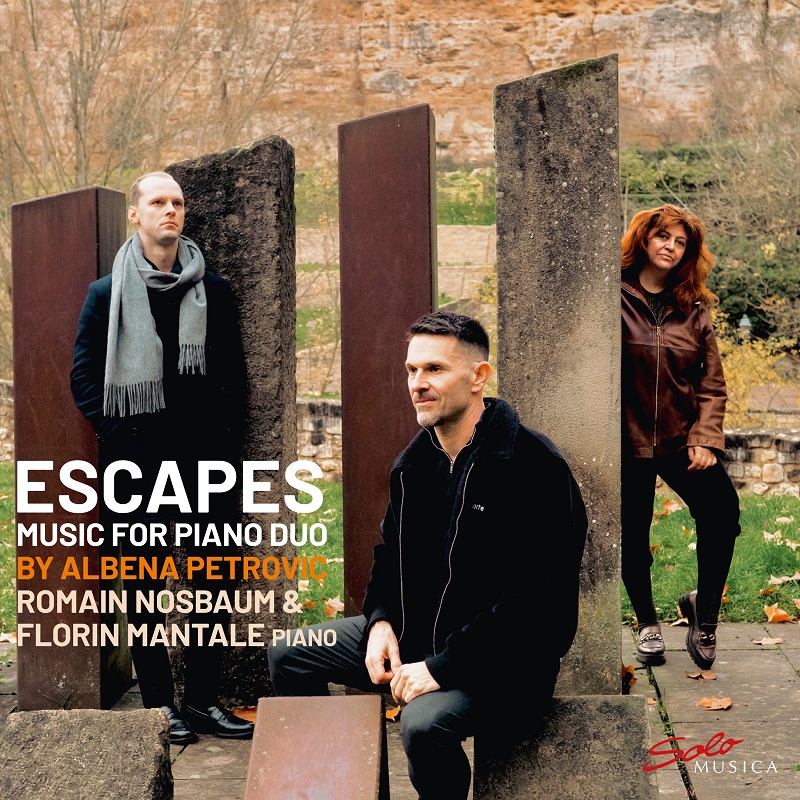
Escapes, the new album by Bulgarian-Luxembourgish composer Albena Petrovic (°1965), gradually unfolds. With a concerto, four miniatures, La fenêtre invisible and two exotic dances, the programme appears as a loose collection, but whoever dismisses the title too quickly as a programmatic indication does the album a disservice: this is not light salon music for four hands, but a richly layered universe in which escape is not flight behaviour, but a way to explore another reality.
I discovered Petrovic's music a few years ago through Bridges of Love, on which pianist Plamena Mangova devotes herself to her piano works. That cd whetted my appetite; Escapes fulfils that promise effortlessly and adds a series of compelling works to that picture.
Petrovic, born in Sofia and resident in Luxembourg since 1996, presents that thought herself as the red thread of the album. The break with the East European system in the nineties brought not only a geographical distance from her birthplace, but also – as she describes it – the loss of the self-evident grip of a cultural identity. In her own words, the fragments of her memories feel "more like fiction than my real life". That alienation, that awareness that the self must constantly reinvent itself, runs like a red thread through the works on this cd. The music supports this reading convincingly: not as consoling music, but as an attempt to enter another reality, that of dream, fantasy and the dark beautiful.
The Concerto for Two Pianos – originally written in 2019 for piano and orchestra and reworked for two pianos after the pandemic silence when the planned premiere was postponed – opens the album from a consistently executed sonic starting point. Petrovic builds her harmonies from tense sonorities that continually grate, without ever becoming harsh or aggressive. Especially in the opening pages, a tension emerges that does not resolve, but gradually develops its own logic, without the composer losing sight of the beauty of sound.
Those who then listen to Sand of Oblivion and La fenêtre invisible discover Petrovic's most characteristic signature: the piano as an expanded percussion instrument. Tibetan sound bowls, tambourines, glissandi over the strings and palms striking against the instrument's casing give the sound image a dark, tangible presence. Musicologist Iliya Gramatikov described this approach as "expansive reductivism" – with a limited arsenal of interventions, without extensive instrumentation or complex harmonic language, Petrovic manages to build a remarkably rich and layered sonic palette. In La fenêtre invisible, originally written for piano and harp, there is a harmonic ambiguity and play with silence that evoke Debussy, but filtered through a pronounced introspective sensibility and without simply imitating Debussy's impressionistic sonic world.
The title cycle Escapes – four miniatures that gradually evolve from one hand to four hands, supplemented with two sound bowls and two tambourines – forms the heart of the album. In the final section, the pianists must operate keyboard and percussion simultaneously. It yields a clever piece of musical choreography that never gives the impression of being mere effect-seeking. To conclude, two of the five Exotic Dances op. 264 are heard, a mature counterpart to Petrovic's youthful work for young pianists. Their playful character provides a welcome respite after so much introspection. After the rich darkness that preceded it, that lightness sounds almost like liberation, although these dances resonate less long than the more layered works that carry the album.
For this repertoire, Romain Nosbaum and Florin Mantale prove to be a convincing duo. Nosbaum, a pianist with a sensitive, romantically schooled touch, previously recorded Petrovic's complete piano works for GEGA New and thus knows her musical language from within. Mantale, trained by Naum Grubert at the Amsterdam Conservatory and renowned for his luminous, inwardly expressive playing, has been forming a piano duo with Nosbaum since 2025. They make music as if this were not their first, but their tenth joint recording: in the Concerto, both voices effortlessly switch from leading to accompanying roles, and in the percussive passages of the title cycle, attacks of sound bowl and key align so tightly that the rhythmic framework never detaches from the melodic line. They seek out the percussive fragility of Petrovic's sonic world without losing sight of the lyrical undercurrent.
The recording, made in the Salle de Musique de Chambre of the Philharmonie Luxembourg, places both pianos clearly next to each other in the stereo image, with the sound bowls resonating above the soundscape with tangible presence.
Escapes is not an album for fleeting consumption. It asks for a listener willing to immerse themselves in Petrovic's sonic world, but rewards that attention richly. The music ultimately convinces not because it illustrates a story, but because it possesses its own logic and eloquence: sometimes recalcitrant, often enchanting and always with its own, recognizable voice. Nosbaum and Mantale lend that world an obvious conviction and make Escapes not a flight from reality, but an invitation to hear it differently: an escape that, in sound, ultimately proves to be an arrival.