
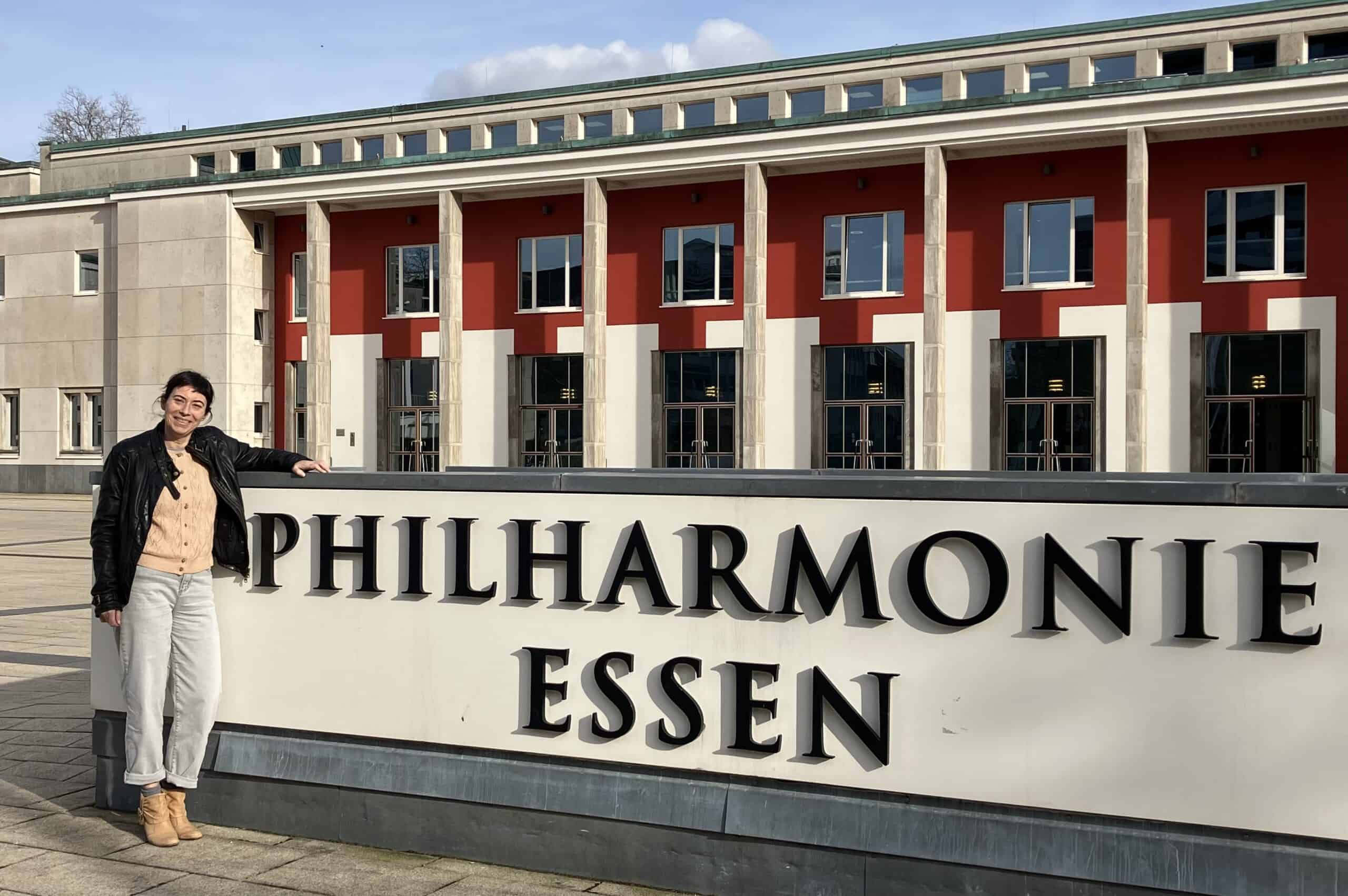
The Komponistinnenfestival her:voice in the German city Essen, which took place for the third time last week, is not only attractive for its concerts featuring rediscovered works. The lectures and debates are also more than worthwhile. And on the sidelines of the festival, we even ran into an 'old acquaintance' from Antwerp at the Essener Philharmoniker. The perfect moment for a comparison between ten years ago and now, and between Flanders and Germany: is there now more interest in female composers?
Chloë Herteleer (foto) was responsible for years for the programming of classical concerts at deSingel in Antwerp. I interviewed her back then for my book Vrouw aan de piano. Almost ten years later, I wanted to ask the current Leiterin Programmplanung at Theater und Philharmonie Essen (TuP) how she now views the place of female composers in the music landscape and whether she experiences a difference between Flanders and Germany.
Concert organizers, she explained to me back then at deSingel, are dependent on what the major, highly sought-after names and orchestras themselves offer. 'Musicians travel around with two to three programs per season. At best, you can choose from those. They themselves will not easily offer unknown work, because they know that halls play it safe. Programmers put together concerts with work that the audience already knows', she told me. And: 'The audience wants recognition and repetition. People who are curious form an absolute minority.' (Vrouw aan de piano, p. 247-248)
Budget cuts
At a table in a coffee bar across from her new workplace, she quickly dashes my hope that there has been any improvement in the meantime. Yet when we look at the audience and the programmator*innen (the elegant way of writing in German to refer to both men and women – in spoken language you can even hear a subtle pause before *innen).
'Those programmator*innen still play it safe, or even more than before', Chloë Herteleer now states. This has everything to do with budget cuts due to the spirit of the times. 'In many places in Germany, less is being invested in culture because the standard of living has fallen. More needs to be invested in healthcare, infrastructure and defense. And even where budgets for culture are still good – thanks also to the business community, which in Germany still sponsors remarkably well – people rarely do anything extravagant with it anymore because they fear the public won't follow. Ticket sales revenues are becoming increasingly important and that leads to halls programming less adventurously.'
'Here and there there are still some bright spots, such as the Emilie Mayer Festival by the Akademie für Alte Musik, last autumn in Berlin. Or our own Komponistinnenfestival her:voice, which took place for the first time three years ago. But I wonder if such events will have a chance in the coming years. I even suspect that there is currently more appetite for initiative to be found in Flanders, the Netherlands or the United Kingdom.'
Pro bono
With individual musicians, on the other hand, she does experience more openness and willingness in comparison with ten years ago to explore less familiar paths and thus to seek out female composers. 'But for the reasons mentioned, they have difficulty selling their proposals to the halls. So they organize small-scale, local concerts or festivals themselves with friendly musicians who are often willing to participate pro bono. Then they have more freedom in their choice of program, even though they don't earn anything from it.'
We can also see this interest among musicians in unknown work from the cd recordings of recent years, I note. Hardly a week goes by that another album doesn't come out with 'forgotten' or lesser-known work by female composers. But Chloë also somewhat tempers my enthusiasm about this. 'Cd recordings or streaming don't bring in much for the musicians. The major record labels only offer opportunities to musicians who have many followers on social media. I read an interview with someone from Deutsche Grammophon who openly admitted this.'
In line
They are exceptions for whom the marketing machine still turns, such as someone like Olafur Arnalds or the sisters and brothers from the English musical family Kanneh-Mason. As for recordings of composers, the German cellist Raphaela Gromes can consider herself lucky to have a record contract.
She opened the Komponistinnenfestival with a cello concerto by Maria Herz (1878-1950), a work she learned about thanks to the grandson of the completely forgotten composer. Last year she was also the first to record it for her double cd Fortissima, which also features a wonderful cello concerto by Marie Jaëll (1846-1925). She also published a book under the title Fortissima together with musicologist Susanne Wosnitzka. It is about Verdrängte Komponistinnen und wie sie meinen Blick auf die Welt verändern, as the subtitle reads. Three years earlier, she released the equally highly praised double cd Femmes with no fewer than 33 works by women. During the intermission and after the concert at the Philharmonie in Essen, people stood in line for it. Her supply of books and cds brought along proved far too small.
In brackets
Between brackets: in terms of design, Gromes' book shows many similarities with Vrouw aan de piano (2018). Just as I reported on my voyage of discovery as an (amateur) pianist, she does so as a professional cellist. Both of us marveled that we had never heard about female composers earlier in our education and wanted to correct that injustice in a way accessible to a broad audience.
When people asked me whether a translation of my book was planned, I responded that there probably wouldn't be much interest for it in Germany (or France or the UK) because they are already much further advanced in research and many monographs about female composers have already appeared there. However, now that I see how well Gromes is doing with a similar book – 'Von der Nummer 1 der Klassik Charts' is emblazoned on the cover – I'm beginning to doubt that…
Not sold out
There was certainly interest from the audience present. However, it could also be noted that the (admittedly quite large) Alfried Krupp Saal of the Philharmonie was by no means sold out. It also surprised festival director Merle Fahrholz, as she told me, because at earlier concerts Gromes had drawn more people. 'It might be due to the programme then. In any case, it is much more difficult to gauge public interest than before corona. People also book much later (an observation that is also heard in Flanders, btw). But that applies equally to, say, Mozart. Programming becomes much more difficult as a result. But it does offer opportunities. Because if even the classics no longer appeal, then perhaps there is more willingness to offer unknown names.'
Fritjof-Saga
For the lesser-known Fritjof-Saga at the Aalto-Theater, the house was at least well filled. This opera by Swedish composer Elfrida Andrée (1841-1921) on a libretto by Nobel Prize winner Selma Lagerlöf (1858-1940) had its scenic Uraufführung more than 120 years after its creation in Essen and also garnered positive press reviews. What is particularly and quite unique about this opera about vikings is that the creative duo behind it focuses on the perspective of the female main characters. Excellent direction also from Anika Rutkofsky. Looking forward to the announced cd release of this riveting performance.
Networking moment
What surprised me, on the other hand, was that apart from the speakers, very few people turned up this year for the admittedly very interesting and even free symposium of the Komponistinnenfestival. Nevertheless, Fahrholz was very pleased. 'We succeed with our festival in making forgotten composers and works known. Although we are not a museum. We always check what a work can still mean in our time. Besides, this festival is an important networking moment for the academics working on the theme – ideas are exchanged back and forth. For the fringe programme we collaborate with the University of Vienna. We also reach young people: students from the University of Zurich have researched the life and work of Maria Herz and presented it with an exhibition and a Gesprächskonzert. For the performance of the second symphony of Elfrida Andrée (1841-1921), we received, just as two years ago for the opera Fausto by Louise Bertin (1805-1877), sponsorship from the Palazzetto Bru Zane in Venice. And the Fritjof-Saga is also supported by the Swedish embassy.'
Those collaborations and financial support for her festival the director has well organized, and immediately for four years. This also guarantees the fourth edition, from 4 to 7 March 2027. But after that, in the summer of 2027, Merle Fahrholz's contract with the Aalto-Theater will not be renewed.
Education
The question of why female composers, in any case, despite increasing research and growing interest, remain an exception on the Bühne, was also raised during a debate at the symposium. 'Ignorance', answered Mary Ellen Kitchens without hesitation. That is why she works with the Archiv Frau & Musik on educational projects. This AFM in Frankfurt am Main is not only the world's largest archive with scores, recordings and literature about female composers, musicians and conductors from the 9th to the 21st century. According to Kitchens, it also contributes to adapting curricula – 'but that takes time' – and, for example, ensured that works by women were naturally included in a new music anthology for beginning pianists. As a conductor, Kitchens also notes that Gesprächskonzerte work very well. These are concerts where stories are told about the works being heard. Something for which the concert series Poèmes d'amour by the Triotique ensemble with myself as narrator has indeed received much acclaim.
Repertoire
Once a work is rediscovered, it remains a challenge to get it into the repertoire. According to Merle Fahrholz, sponsors are still relatively easy to find for Uraufführungen. 'Because they can make a splash with that – which, by the way, also applies to unknown work by men. They like it even better when there is no recording of it yet.' Mary Ellen Kitchens also notes that with musicians, second performances are less sought after. When they are looking for works by female composers at the Archive, they explicitly ask for something that has never been performed before.
Baby concerts
Back to Chloë Herteleer for a moment, because education also came up in our conversation the day before the festival, and not by chance. She watched with dismay as the programming of chamber music, among other things, was scaled back at deSingel, leaving a loyal audience out in the cold. 'Everything is being done now to attract young people, but they don't have the time or financial means to attend concerts. While you should cherish and serve that core audience, who do have time and money, and then of course try to involve young people in that. The key to that is education. Around Emilie Mayer (1812-1883), for example, I would have liked to organize a Discovery Day (a whole day with lectures and concerts around one composer). But that educational program has also been stopped in Antwerpen.'
'Here in Germany, that education is really very good', she thinks. 'There are projects for schools. Or concerts where children get a separate introduction before the interval, after which they attend the second part of the concert in the hall. There are even baby concerts!'
Finally, Chloë Herteleer pointed out the unprecedented increase in the number of female conductors. Just about all orchestras are actively searching for women on the podium, to such an extent that the pendulum may be swinging too far. And although according to Chloë it is not proven that female conductors attract extra audiences, it was a pleasure to see the Turkish-Italian conductor Nil Vendetti at work in the concert with Raphaela Gromes. Her enthusiasm was contagious and uplifting, not only for the audience but reportedly also for the orchestra.
• The Fritjof-Saga can still be seen on April 9 at the Aalto-Theater in Essen.
• This review also appeared on the blog notities.vrouwaandepiano.be.