
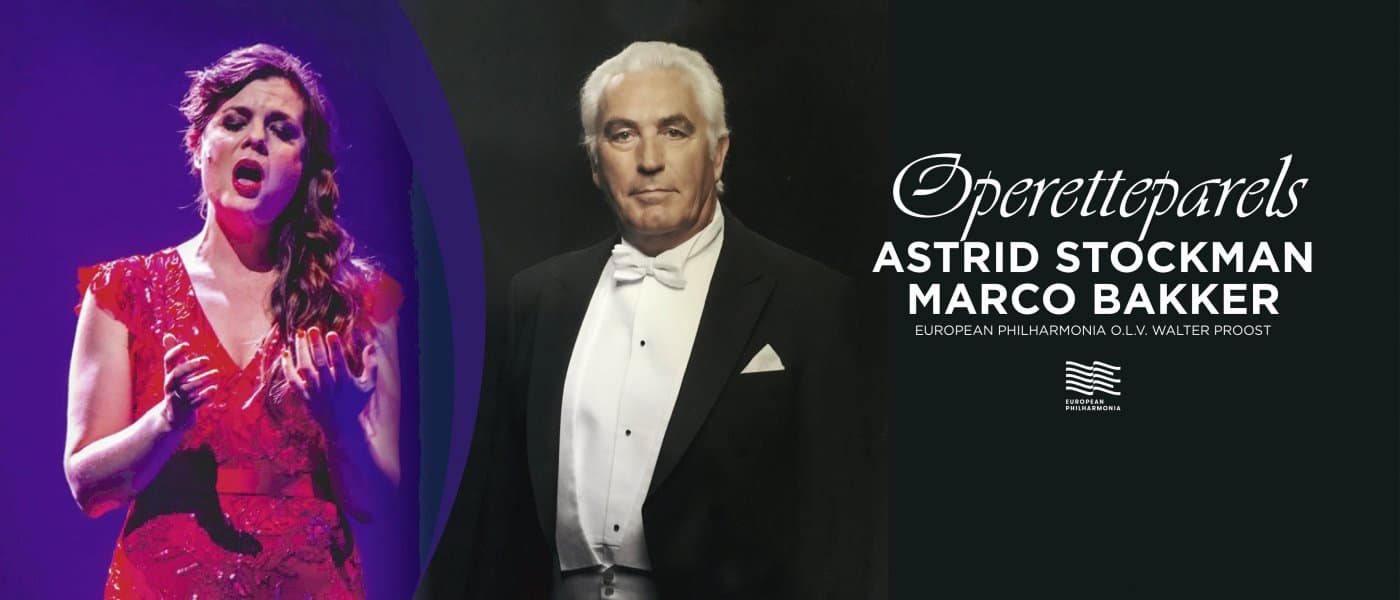
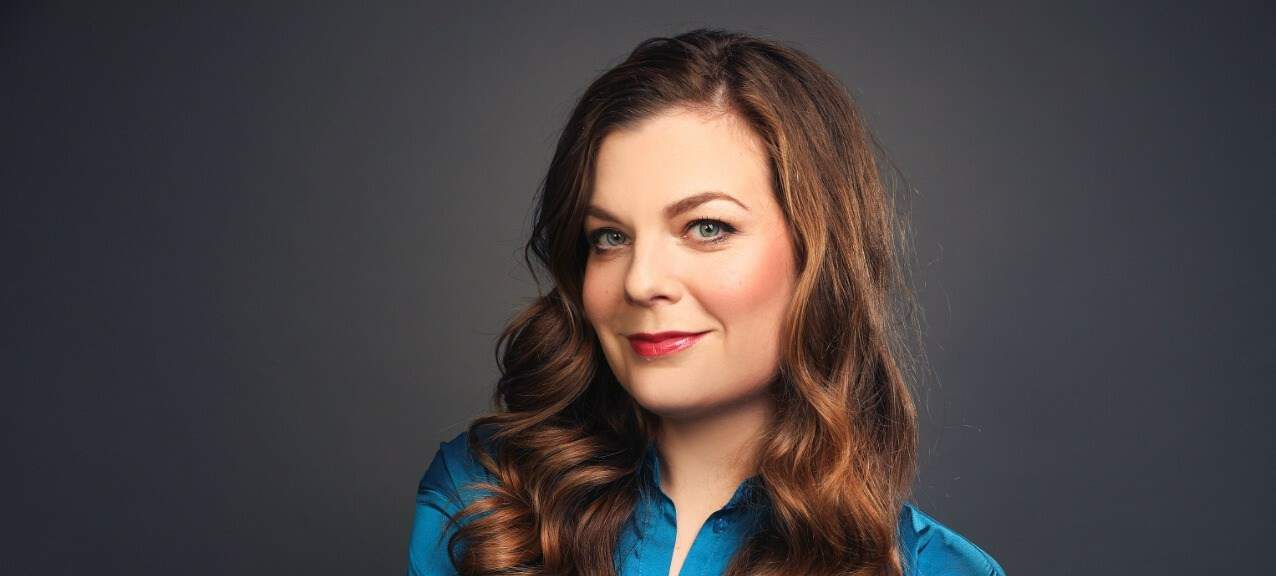
The new cultural year is still young. Astrid Stockmans' schedule is already quite full. It promises to be a generous year. A gratifying experience after the entire cultural life was paralyzed by corona for a couple of years. Her career has already taken her around the world. With her classical vocal training, this lady doesn't let herself be put in a box. She loves artistic encounters across disciplines. Like a chameleon, she dives from one character into another. Alongside the classical repertoire, she also enjoys the lighter repertoire and other side ventures. Think of her noted participation in 'De Slimste Mens' and as the instrumental sidekick of Karl Vannieuwkerke in the well-known cycling talk show 'Vive le vélo'.
Soon she will be on stage with éminence grise, Marco Bakker. They are creating a unique collaboration with melodic melodies that have fallen somewhat into oblivion. They sing solos and duets about longing, extravagances and boost the vibrations. Subtle pearls that in a waterfall of sounds capture the refined atmosphere of that era. We had a pleasant chat with this charming and driven performer.
-A collaboration with Marco Bakker, a name with resonance. How did your paths cross?
That was actually arranged through Walter Proost's orchestra. He organized a competition a few years ago in the spirit of New Tenuto, which I participated in. Since then, we have collaborated several times. He actually linked us together and put us on the bill. I'm not sure what to expect, but I'm looking forward to it.
-Is a rehearsal period set aside for this or is it based on self-study and your craftsmanship?
It will be a run-through on the day itself. More and more is being done this way. That's the reality. It counts on your competencies. This concert was actually already planned in 2020, but was always postponed to another date because of covid. Now it's finally happening. It's really about giving your all on the spot.
-Marco Bakker has been a welcomed performer on the stage for decades. The man has now reached a blessed age (born in 1938). Despite his age, still lively and fresh?!
He is a man with métier. I recently heard him sing in a tv program. He still has a beautiful vocal quality. Singers, generally speaking, can continue longer than women. I'm always amazed that despite the passing years, the quality of their voice remains virtually constant. There's also enormous technique behind it.
-A charming man, a womanizer, the perfect person to sing the spicy operetta repertoire!
It's always pleasant to look at a handsome man or woman. The repertoire indeed matches his generation. The beautiful tone and timbre of his voice, of course, makes it pleasant to sing duets.
-The heyday of operetta music can be situated between 1850 and 1950.
The golden days are indeed situated in that period. An older audience will enjoy and savour it. I have also focused on that segment in recent years. Seniors in care homes who are no longer very mobile and can no longer participate in cultural activities. Thus completely left out. That audience spans different generations. When you put together a program for them, operetta melodies are certainly included. For that audience, it's a perfect fit.
-Operetta has completely gone out of fashion, musical has taken its place.
I wouldn't dare claim that the musical repertoire is so well known to a broad audience. In my generation too, there are quite a few young people who know nothing of blockbusters like 'Les Misérables'. When I sing, for example, the 'Viljalied' from the operetta 'Die lustige Witwe' by Franz Léhar, everyone in the care home knows it. During a New Year's concert, waltzes are traditionally played extensively and operetta repertoire is also eagerly drawn from. The audience enjoys it.
-A program full of operetta pearls, does that present you with a challenge?
It certainly does. In the sense that: I grew up in a family that had nothing to do with culture. I had to learn everything in my studies. I do miss the tradition behind it a bit. I find that a challenge. That shortcoming has also made me greedy. I love classical music. Currently, I'm at a crossroads. Other genres are presenting themselves. I haven't done pure classical genre and opera for some time. Experimental things, cross-overs with other disciplines and genres really appeal to me. Also the confrontation with an audience that is not familiar with those things or at least not with a live performance. Operetta is situated somewhere in between as well.
-Helping people overcome a threshold?
Yes, exactly. That's why I enjoy doing it. In the similarities and differences we find each other.
-Operetta is a fervent and emotional soundscape. Who compiled the program?
Orchestra conductor Walter Proost. There are a few solo works for Marco and me and of course the beautiful duets. The repertoire of Léhar features extensively and then a couple of pieces I knew less well like 'Spiel mir das Lied von Glück und Treu' from 'Die Ungarische Hochzeit' by Nico Dostal. Operetta doesn't really have a large back catalogue.
-Quite a few earworms probably pass by.
Yes, you may never have heard an aria before, but after hearing it a couple of times that melody nestles in your head and you can't get it out anymore.
-It will be a succession of passionate moments. A musical trip that leads through the celestial vaults of happiness and euphoria to the dark catacombs of betrayal and heartache.
Operetta is well known for its often spicy romance full of sighs and longing. To mention the 'Viljalied' once more. It is a simple story but what it tells is so extraordinary: a man who is in love with a beautiful forest creature that disappears the moment he wants to kiss her! It gives the song a certain pathos. It is a fairy tale, but you have to be able to present it credibly.
-You must convince not only as a singer, but also as an actress.
That's right. You have to find the right tone to touch the strings of the audience. I find it somewhat difficult with the overall expectation of something like that. It has to look like that or be brought in that tradition! If I have to get into a mold that doesn't fit me one hundred percent, I'd rather withdraw. I like to search for an empathy that fits my temperament. Then it can be that I exaggerate something or act it smaller. I have to be able to live through it. Music, however you turn and twist it, is essentially a reflection of life.
-Do you have a particular ritual before you take the stage?
Not really, and partly yes. The time you need to get dressed, do your hair and makeup, that is actually my ritual. My way of finding peace. The transition from the hectic everyday life to the intimate stage.
-You told me: these are busy times. Are you active at home and abroad?
Before covid, my work was quite a lot abroad. There were concrete plans to work in Asia and Greece, but covid thwarted all that. Those performances were postponed a couple of times, but due to difficult travel conditions they were eventually cancelled. That is a shame. You absolutely have no insight into the long term and start to play it safe because the virus is still not completely defeated. Since covid, I've focused mainly on the home front. I don't work with a manager and arrange everything myself. That's also because of covid.
-Then you must have a large network?
My network, how should I put it, is becoming increasingly specific. In that sense, I have good connections in experimental music theatre such as Transparant, Walpurgis and Lot in Gent, but also the Cultural Centers. I got a call yesterday from a programmer at a CC asking if I could step in for an ensemble that couldn't perform. I've successfully performed for the footlights a couple of times already. That's how a bond of trust grows. Sometimes you have to play it close to the vest. What I'm also counting on is the business world. What music brings to a lecture adds value. That message is taken along.
-A quote from Samuel Beckett: "Quand on est dans la merde jusqu'au cou, il ne reste plus qu'à chanter"
Very well observed, because singing is not only fun but also has a therapeutic impact.
-Are there performers who inspire you, who you look up to?
Many, and especially Belgian ones. We have a very talented generation. I often perform with Liesbeth Devos. Follow the still very young Emma Posman. Someone who belongs to the world top in the opera circuit. Then Tineke Van Ingelgem who stands on the other side of the spectrum, who is very experienced and very solid, and all those who navigate in between. They compete on a global scale. I get enormous pleasure in seeing them go. We have enormous talent in this country.
-Captivating an audience with your voice, how does that feel?
That is a privilege, I think. I am also very happy when people leave a concert with a smile on their faces.
-Energized?
A softening occurs. I hope that people can let everything go for a moment. It is a gift I have been given, a present, a conduit. I remain very humble in that and try to do every concert as well as possible with all the flaws and qualities that I have.
-Is there a musical work that enjoys your absolute preference?
Ouch, I can't put a single name to that. That goes very broad for me from Vera Lynn to Gershwin, Beethoven, Louis Neefs… Many stories circulate around certain musical works. For 'Vive le vélo' I had to keep bringing numbers that were relevant to current events. I thus adapted the song 'Yellow' by the British band Coldplay for piano. During the covid period, we could only reach an audience through streaming. At one point, a panic reaction overwhelmed me: "I will never be able to play/sing live for an audience again." Inside I was revolting. I then decided to always include that song in my programs.
The audience enjoys it too. Each individual gives it their own interpretation. I sang it, for example, at the funeral of a little boy. He had a very rare metabolic disease. The parents connected that song to their child. Many people come up to me after a concert with their specific story around that number. That makes it very universal. For me it's not about the quality of the composition, but that it touches people individually. I also sang it on Mercy Ships, an initiative that converts ships into modern hospitals and sails to Sri Lanka, among other places, to perform life-saving operations there. That's why I love singing it so much. It's not about me at all, but about the humane message that the song conveys. It's not about the technicality and the high level but simply about the experience and emotion. That's what I find so beautiful about music.

-You are a beautiful, young, emancipated young woman who has been able to develop and unfold her talents. In Afghanistan, girls and women are denied all opportunities. How does that affect you?
That troubles me deeply. From my upbringing, I was given a lot of chance and opportunities. My parents supported me in my dreams and expectations. For a long time I thought about taking engineering studies. Both my brothers did that. At the very last minute I decided to study music because I felt that other choice would gather dust after some time. I often cursed during my music studies, because it wasn't always easy. For me it's extremely important that what you see on the outside also matches what's on the inside.
-A coming together of heart, gut and reason?
I have a very strong longing for authenticity. Then you can also handle a lot in life. It doesn't bother me if people have comments. As a budding musician it's very often difficult. Building a career doesn't all roll smoothly. You can't comfortably make a living from it one, two, three. There are systems you run into as an artist: the status, a lot of controls, the paternalistic… My dad often called me asking: "Are you still happy with your choice?" Wholeheartedly: "YES!" even though at certain moments it rolled completely. Now I've reached a point where all the effort and hard work have been doubly and triply worth it.
-What does the near future look like?
In October the focus is mainly on Stokman and Vos. We just performed a series with the support of the Koninklijke Bouwewijn Stichting. That was fantastic! We initially started that project in 2016 with the aim of performing in care homes. In reality we end up mainly in Cultural Centers for active senior planning or family planning. The intention was and still is to explore the boundary between music and therapeutic effect. There's always someone in the audience who has a beautiful voice and sings along resoundingly. We then invite that person on stage to sing along with us. That gives a wonderful boost to their self-worth. You see them grow and shine. It's a mutual pleasure. There's still a lot in the pipeline but I can't say much about that yet.
See you at the Casino in Oostende, Astrid.
WHAT: OPERETTEPARELS
With Astrid Stockman [soprano] and Marco Bakker [baritone], European Philharmonia conducted by Walter Proost
WHEN: Sun 4 December 2022 at 15:00
WHERE: Kursaal Oostende