
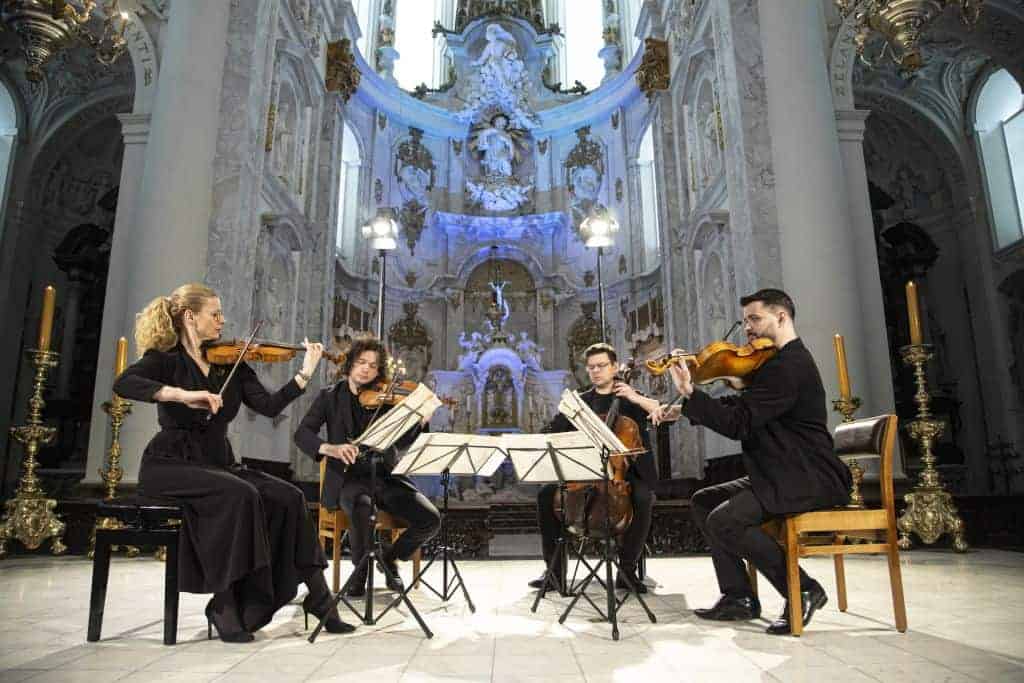
The Festival takes Europe as its starting point for this edition, with a focus on Central Europe and a special interest in the musical scene of Czechia. One of the reasons for this is the celebration of 200 years of Bedřich Smetana.
This composer was born in 1824. His operas and particularly the symphonic poem 'Má Vlast - My Homeland', with the section titled The Moldau, are world-renowned, but his chamber music, songs and choral music also deserve wider recognition. For this aspect, there is intensive collaboration with Czech Dreams and with the Czech partner festival Concentus Moraviae.
Jelle Dierickx, artistic director of the Festival van Vlaanderen Mechelen, has extensive knowledge of the musical landscape, from composers to performers. He also has an eye for exceptional talent. He contacted compatriots of Smetana, Leoš Janáček and Josef Suk, who feel deeply connected to the work of these composers. Not just anybody. The Pavel Haas Quartet, named after the Czech composer Pavel Haas, born in Brno in 1899 and murdered in 1944 in the German extermination camp Auschwitz during the Holocaust, makes an appearance.
The quartet consists of three gentlemen and one lady: Veronika Jarůsková and Marek Zwiebel, violin; Šimon Truszka, viola and Peter Jarůšek, cello. Four top musicians with a unique dynamic that inspires each other. Their life's work is to pass on classical works in pursuit of beauty and the sublime in an imaginative visual and auditory flow. They delve into scores, dive into the sea of notes, engage in dialogue with each other and when the chemistry works, time seems to stand still. The repertoire choices also show that they are at home in multiple fields. The Czech soul resonates through the three composers, but the listeners will also notice their mutual differences.
BBC Music Magazine ranked the Pavel Haas Quartet among the ten greatest string quartets of all time and rightly so. They are visiting Mechelen for the first time with a programme entirely devoted to their homeland Czechia. At the centre is Bedřich Smetana's First String Quartet. Like Beethoven, Smetana had to deal with deafness. It was given the subtitle 'From My Life'.
The programme booklet addresses the question of whether a composition should be interpreted emotionally or purely technically? The truth probably lies somewhere in between. The three composers anchored their feelings in their composition in different ways: the love for their country, a woman, a lost sense. There is no lack of intensity. In three different compositions, the quartet manages to build a mesmerizing tension.
Bedřich Smetana's 'String Quartet No. 1' is described as an autobiographical work depicting the tinnitus he suffered during his deafness. Thus, in the finale, long sustained tones can be heard, representing the whistling sounds that announced his deafness. The composer, who had been deaf for two years by 1876, called it "a meditation on my life and the catastrophe of complete deafness." A composition with a wide range from soft, tender sonorous sounds to stormy and tormented ones. The notes tremble and vibrate. With hearing gone, vibrations are an alternative. It reveals the human in his vulnerability.
In Leoš Janáček's 'String Quartet No. 2 – Intimate Letters', the composer illustrated the intangible and fascinating game of love in musical love letters. A spicy detail: the 74-year-old Janáček describes his love for Kamila, nearly forty years his junior. This results in a bubbling musical fountain that seduces, beckons and flames from beginning to end with rapid alternation of tones on various strings. With technical difficulties for the first soloist featuring fast, complicated and sometimes stratospheric high tessitura. Veronika Jarůsková commands her instrument flawlessly. Radiates grace when playing. There are also beautiful passages for viola and cello. The quartet makes the work entirely their own. Fortunately, because if there were only one standardized interpretation of each work, musical life would be deadly dull. They bring a raw clarity and heartfelt depth to the work with tempi, intensity, phrasing, and feeling that move the audience. An instinctive, almost biological necessity of making music.
Josef Suk's 'Meditation on the Czech Chorale Saint Wenceslas'. Knowledge of the world changes constantly, partly under the influence of the spirit of the times and political reality. Now only the musicality of this work appeals to us. Suk was inspired by his composition in 1914 by the old sacred Bohemian Saint Wenceslas hymn. The message of this hymn – a plea for the welfare of the Czech people, directed to their patron saint – was immediately understood by the public. This composition was at the time a form of wordless resistance. Behind the innocuous-sounding title and calm melody lies a strong statement. The style and interpretation of the Pavel Haas Quartet speaks directly to the heart. Musicians who make an impression. Apart from being powerful, their approach is also subtle, nuanced, personal and technically virtuoso.
This versatile and multi-layered concert with instrumentalists perfectly attuned to each other in the beautiful, atmospherically lit Sint-Pieter-en-Paulus baroque church was a treat for the eyes and ears and received enthusiastic, prolonged and appreciative applause.
- WHAT: Festival van Vlaanderen LUNALIA from April 18 to May 5
- WHO: Pavel Haas Quartet - Veronika Jarůsková and Marek Zwiebel, violin - Šimon Truszka, viola - Peter Jarůšek, cello.
- PROGRAMME: Bedřich Smetana, Leoš Janáček, Josef Suk
- WHERE & WHEN: Thursday April 25, 2024, Sint-Pieter-en-Pauluskerk, Mechelen
- PHOTOS: © Iris Teunissen