
What a splendid plan by De Nationale Opera to program Die Walküre under the direction of Pierre Audi once more. Pierre Audi took his leave from De Nationale Opera as artistic director in September 2018 after thirty years, and it would now absolutely be the very last time that this favorite part of the Ring is to be seen in this justly legendary staging. An opportunity not to be missed!
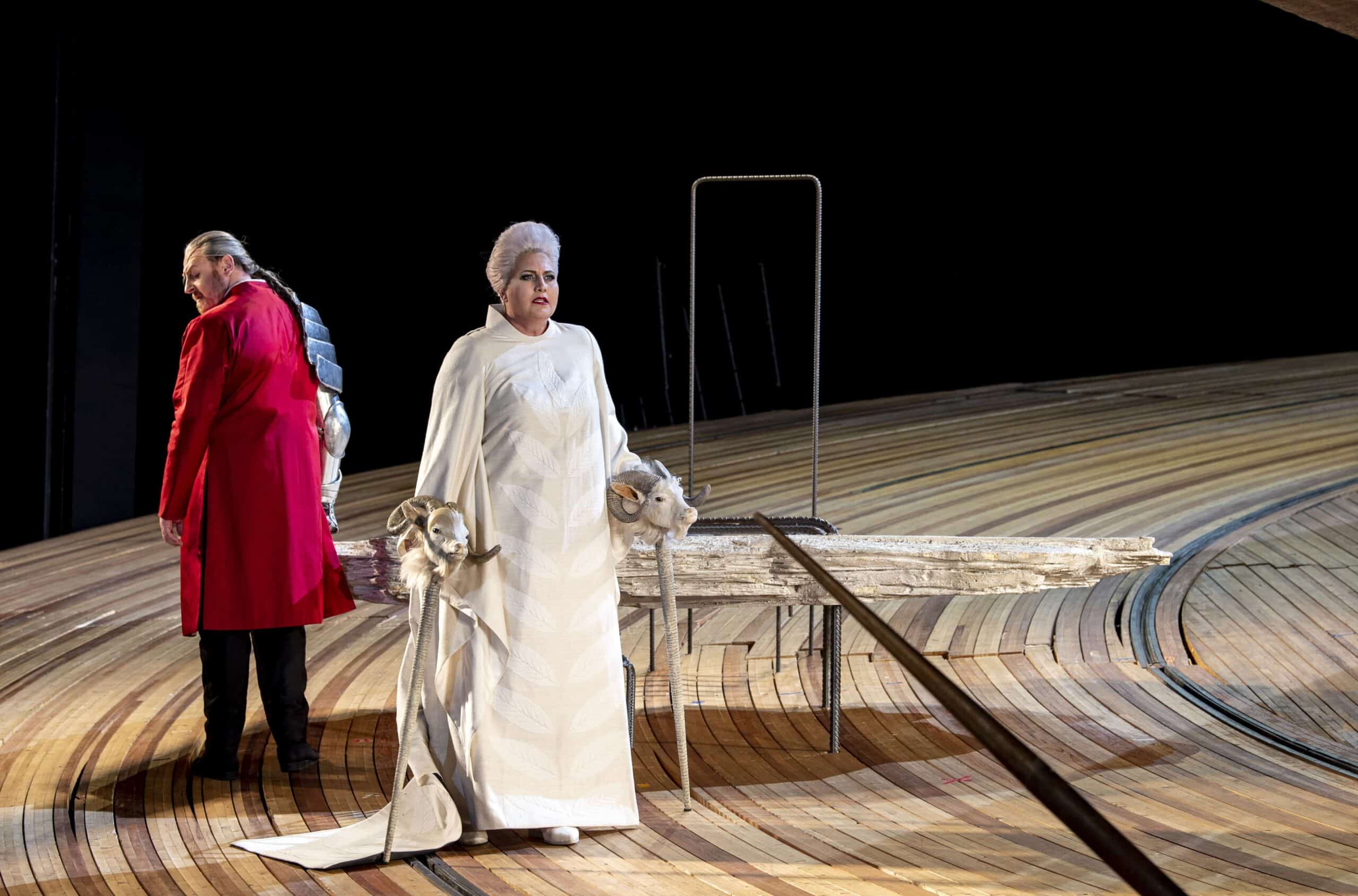
For his production of Der Ring des Nibelungen, which was presented as a complete cycle in 1999, Pierre Audi collaborated with George Tsypin on the set design. It is an unforgettable concept, consisting of an enormous circular ring of strips of bare wood. In the joints of the rings, fire can burst out spectacularly, like a sea of flames at the beginning of the second act, for example. But that is the only spectacle in the production. In the wooden construction is an armpit-shaped cutout that provides space for the orchestra. So it is not in the orchestra pit, but visibly forms part of the set. Let us also point out immediately that the unity between what is depicted in the scenes ideally coincides with the sounded music. Could we call it an aspect of Wagner's Gesamtkunst? Apart from that striking scene form, the set is pure simplicity. Here too, a parallel can be drawn with the simple but so powerful eloquence in the character direction. Hunding's hut is a barracks standing at a certain angle – only four walls and a roof – which disappears after the first act. Essential is of course the ash tree trunk. It is nothing more than a pointed wooden plank, in which the sword is embedded that Siegmund pulls out. Sober but clear. Another attribute in the set that is continuously present but only noticeable where needed is Wotan's spear.
Carefully thought-out character direction
It is simply delightful to see an opera without far-fetched extra gadgets or time-juggling. The clothing cleverly and eloquently becomes part of the characterization of the characters. Wotan looks like a mythological god: stately with a beautiful red cloak, partially armored hand and arm and obligatory eye patch. Fricka is aloof and chic in white and arrives with two walking sticks with ram's heads as a sign of her obstinate narrow-mindedness. Siegmund walks in rags, while Sieglinde wears a simple gray dress. Hunding wears a macho black leather jacket, which immediately gives him a brutal appearance. The Valkyries are dressed in black asymmetrically hemmed dresses that look beautiful. They wear a black helmet and especially a striking but beautiful pair of shiny metal wings, which they move as a fitting illusion of rapid movement in their task of collecting fallen heroes. Moreover, the back-and-forth flapping wings create a beautiful play of light.
From scene to scene, the character direction is so carefully thought out and at the same time so simple that every emotion, every confrontation becomes a gripping element in a whole that captivates from beginning to end. The sincere and spontaneous way in which Siegmund and Sieglinde meet at the beginning immediately conveys that something is about to happen between these two. Immediately the music with the wonderfully lyrical cello sounds makes the affection between the two heard. The hard and relentless bearing of Hunding and the decisiveness of Fricka, who gradually makes Wotan give in to her demand: these are each scenes that clearly tell the story in depth and clarity. The absolute highlight is of course the beautiful duet in which Wotan says farewell to his favorite daughter Brünnhilde, whom he punishes because she protected Siegmund against his command. That scene alone makes this opera my favorite part of the Ring, together with that beautiful aria of Siegmund (Winterstürme wichen dem Wonnemond) and the love scene between Siegmund and Sieglinde in the second act.
Never obtrusive, always recognizable
The singers that De Nationale Opera has cast for this final revival contribute to a pure homage to director Pierre Audi. Each singer performs his part with convincing commitment and great vocal artistry. Both the deep bass of Stephen Milling as Hunding, who accentuates his rough character and uncouth behavior towards Sieglinde, and the beautiful lyrical and nuanced voice of Eva-Maria Westbroek as a moving Sieglinde: each singer contributes to a successful whole. Iain Paterson is an impressive Wotan, who is authoritative but also dares to show his doubting side. Right at the end he sounds slightly weary, but how well that fits the broken father figure he is at that moment. Martina Serafin sings Brünnhilde with a robust soprano and an equally heroic interpretation. And all the while she also gives the sensitive side of the character every opportunity, as support for the loving couple and as a punished daughter. Simply delightful!
Marc Albrecht guides the Nederlands Philharmonisch Orkest through the score in a flawless and transparent manner. Each passage is supported by the orchestra with the right nuance – here and there also announcing. Leading motifs come out fine and clear without being unduly magnified: Wotan's motif, for example, or that of Alberich in the second act where he is mentioned. Never obtrusive, but always recognizable and precisely played. English horn, oboe and bassoon, horn and tuba play their passages skillfully. The strings are sweeping. Albrecht doses overwhelming sounds as well as refinement equally well.
A long performance, but when you leave the hall at the end, you have the feeling that there could be a third intermission for another piece … It says enough about how brilliantly the production is executed. It confirms that the theater is right when it states that thanks to Audi's groundbreaking work De Nationale Opera ranks among the most leading opera houses internationally.
- WHAT: Richard Wagner (1813-1883) || Die Walküre
- DIRECTION: Pierre Audi
- VOICES: Michael König, Stephen Milling, Iain Paterson, Eva-Maria Westbroek, Martina Serafin, Okka von der Dammerau
- ORCHESTRA: Nederlands Philharmonisch Orkest conducted by Marc Albrecht
- WHERE: De Nationale Opera, Amsterdam
- WHEN: Saturday 16 November 2019 (premiere) – performances running until 8 December 2019
- PHOTOS: © Ruth Walz