
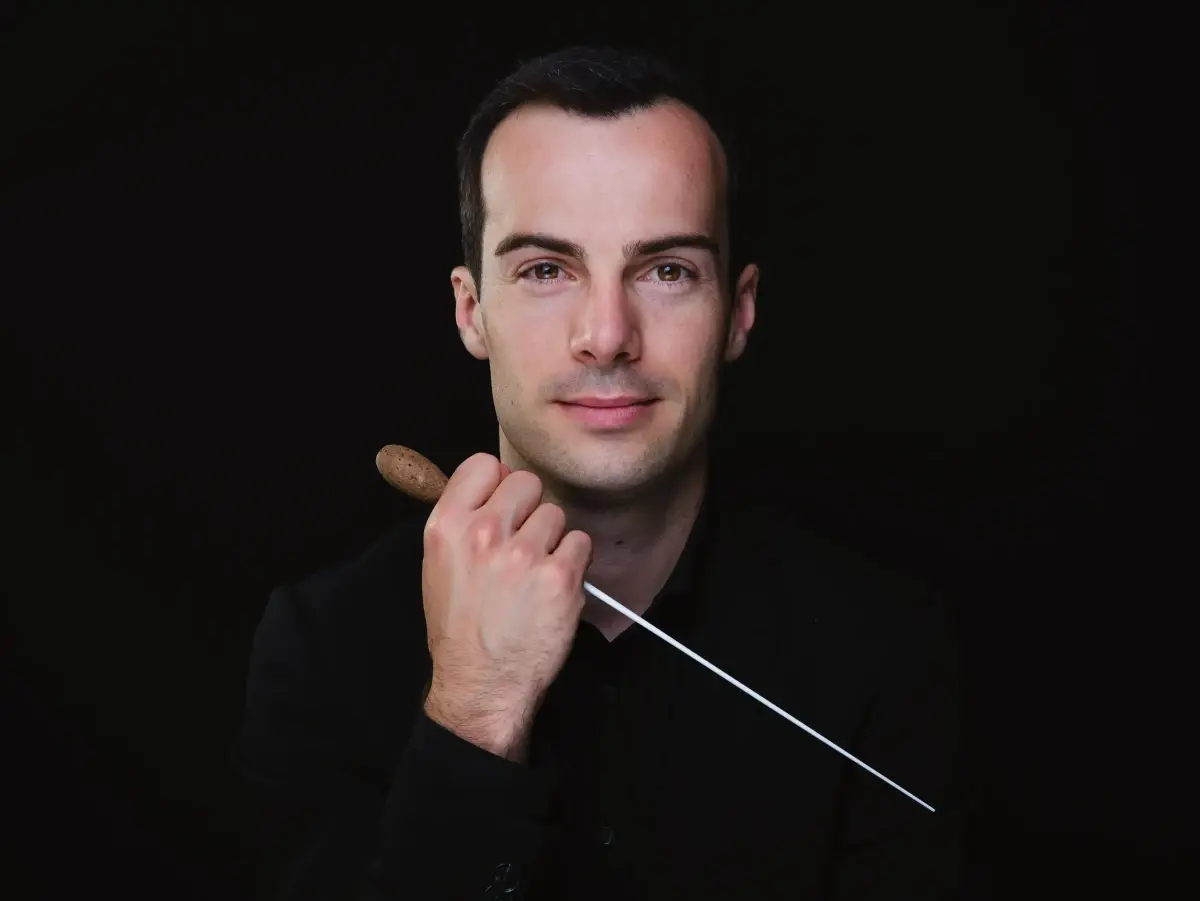
Five years ago, the idea to establish a national youth orchestra was born in Luxembourg, an initiative that has since grown into the Orchestre National des Jeunes du Luxembourg. The ensemble brings together young Luxembourg musicians with talent from various European countries, offering them the chance to explore the great orchestral repertoire at a high level. The day after the concert at Young Euro Classic, Werner De Smet spoke with co-founder Pit Brosius about the orchestra's origins and development, its international composition, and future plans.
From absence to growth
The idea for the orchestra arose from a gap that Brosius and his fellow musicians had long felt. They had regularly organized summer project orchestras in Luxembourg, but at the same time noticed that their country lacked its own national youth orchestra structure such as existed in many other European countries. When they themselves went abroad to study and learned about this system firsthand, it became clear that Luxembourg also needed such a structure: a place where young musicians could gain experience, discover repertoire, and above all learn to make music together. "We founded the orchestra with a wonderful team," Brosius says. "There was always this frustration that Luxembourg didn't have a national youth orchestra." Based on this realization, they established contacts with the Luxembourg Ministry of Culture, and the project was gradually developed from there.
The initiators may not have anticipated how quickly the development would progress. What began five years ago as a small-scale chamber orchestra has since grown into a full symphonic youth orchestra, with collaboration from renowned soloists playing an important role from the beginning. Brosius points to, among others, violinist Alina Baeva, who lives in Luxembourg and participated in a project even before the official founding of the orchestra. It was precisely that experience that made clear how valuable it can be when young musicians not only work with their age peers, but can also learn directly from artists who have already built an international career. "That was an inspiration for us," says Brosius, because "great soloists can pass on their experience to young people and often a workshop or masterclass emerges from it too." The orchestra wants to deliberately maintain that interaction.
Luxembourg as a starting point
Although the Orchestre National des Jeunes du Luxembourg clearly starts from Luxembourg, its composition at the same time reflects the international character of the country. Young Luxembourgers receive priority when their level permits, but it would be impossible to assemble a full symphonic orchestra exclusively with Luxembourg musicians. Selection occurs through an annual application procedure in which candidates can apply with video recordings, and interest appears to be substantial: for the current season, the orchestra received more than a thousand applications.
In a sense, the ensemble is also a European youth orchestra, though Luxembourg remains the starting point. The orchestra comprises approximately twenty-five different nationalities. "If someone, for example, lives in Warsaw and wants to apply with us, that's basically possible," Brosius explains. For him, it's not so much about internationalization in itself, but about the possibility of allowing Luxembourg young people to work at a level that would not be achievable with the local population alone. At the same time, that international composition creates precisely the kind of exchange that is so valuable for young musicians. Brosius tries to preserve a connection to the local region. "The more local, the better," he says, though he certainly doesn't exclude candidates from other parts of the world when they artistically fit within the whole.
That international outlook also manifests itself in contacts with other youth orchestras abroad. Contacts with foreign orchestras, among others in the Netherlands, have opened new possibilities in recent years and ultimately also contributed to the invitation to Young Euro Classic in Berlin. The fact that this invitation coincided with the orchestra's fifth anniversary was not planned, but felt to the initiators like the fulfillment of their original five-year plan.
Young people and the great repertoire
When putting together programs, Brosius has one goal at the forefront: young musicians should have the chance to discover the great orchestral repertoire before encountering it later in their professional careers, for example during an audition or in a professional orchestra. At the same time, he wants to avoid programming consisting exclusively of well-known works. Alongside the great repertoire, he therefore regularly seeks music that is less familiar or challenges young musicians in different ways. During the concert in Berlin, this idea was evident in a commissioned work by young Luxembourg composer Hy-Khang Dang, but also in the choice of Stravinsky's Circus Polka, a work that doesn't immediately belong to the classical standard repertoire.
According to Brosius, this combination is important because a youth orchestra should be not only a place where young instrumentalists learn how to technically perform an orchestral work. It must also be an environment in which curiosity is stimulated and in which musicians discover that the orchestral repertoire is much broader than the works they most frequently encounter during their training or at auditions. Exposure to different styles and periods, but also to new music, contributes to broader musical development.
The magic of Young Euro Classic
Brosius speaks about Young Euro Classic with particular enthusiasm. For him, the festival is unique because it offers young orchestras from different countries not only the opportunity to present themselves to an international audience, but also brings them together within an environment where music is naturally shared across borders. "I think this is one of the most beautiful festivals that exist," he says. "Really, something like this should be everywhere." According to him, it is especially the combination of the high level of the participating ensembles and the energy that young musicians bring that makes the festival's atmosphere special.
What he especially hopes the audience takes away after a concert by the Luxembourg orchestra is not so much one specific musical memory, but a renewed curiosity about classical music. He speaks of "hunger" and "fire", of the need to continually rediscover emotions and keep searching. It is precisely the young audience that Young Euro Classic attracts that plays an important role in this. According to him, the energy that comes from the stage can directly transfer to the hall, bringing the distance between young performers and listeners closer.
Building further
The next five years will be devoted primarily to further developing what was accomplished in the first five years. Brosius wants to work with his team to thoroughly review the plans again, but one element is already fixed: the international activities and tours must be further developed. During the current tour, the orchestra performed three concerts in three different countries for the first time, an expansion that requires much organizationally, but according to Brosius is particularly valuable artistically.
According to him, it is precisely during such tours that it becomes clear how quickly young musicians can grow as an ensemble. At each new concert they become freer and more open, because they gain increasing confidence in each other and in what they can achieve together on stage. That process is difficult to fully capture in words, but that is exactly where Brosius sees the essence of the youth orchestra. The rehearsals, the travels, the meetings and the intensive preparation are necessary, but ultimately all of that only gains meaning when the musicians stand together before an audience.
"The magic only happens at the concerts," says Brosius. Perhaps that is the best summary of what he and his team have built in Luxembourg over the past five years.