
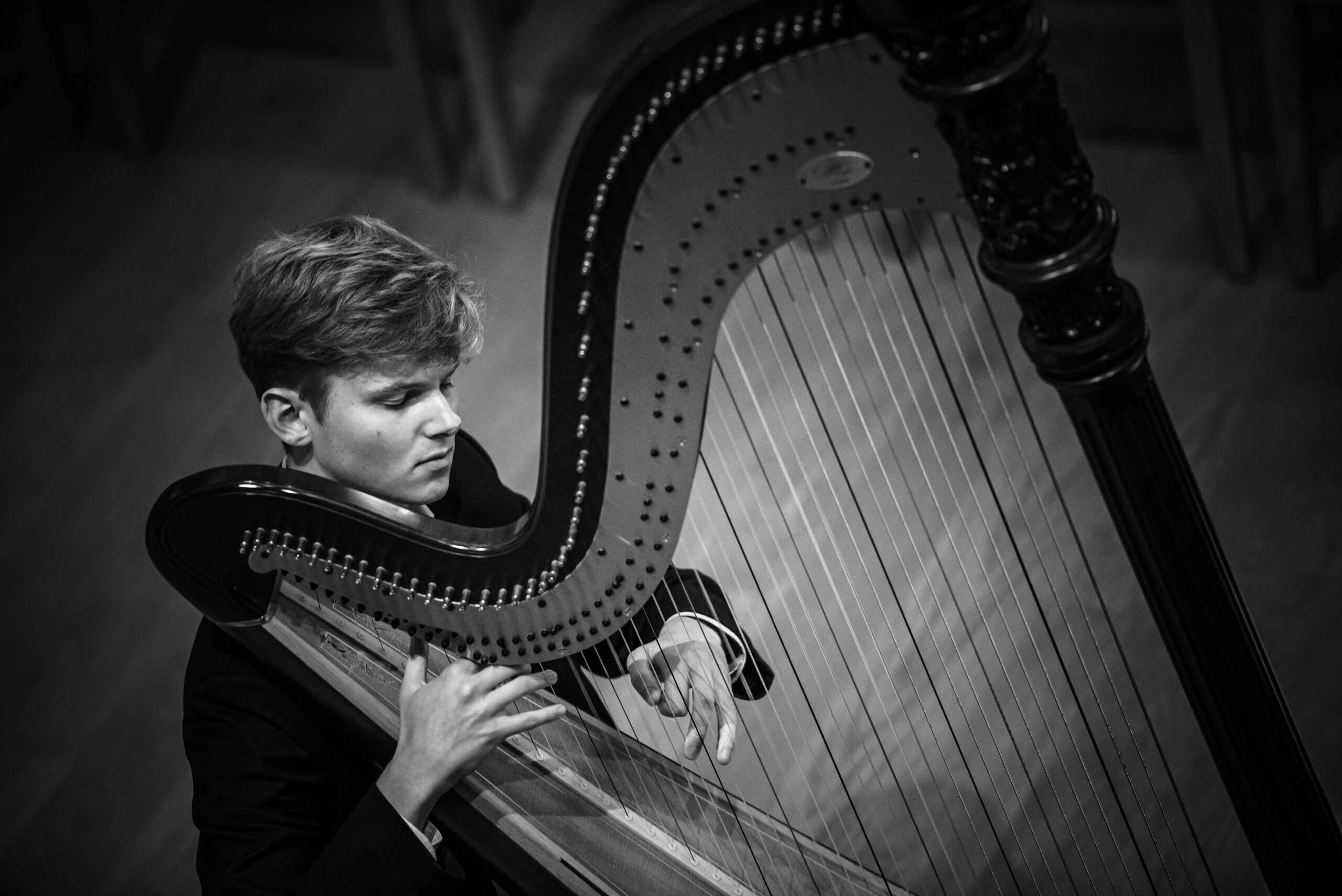
With Rhapsodos, harpist Joost Willemze presents an album that aims to be more than a recital. The cd, which is released on 13 March, is conceived as a personal artistic portrait: a programme in which repertoire that shaped him comes together with new compositions specially written for him. The result is a musical journey in which sound, imagination and story continuously touch each other. In conversation with Werner De Smet for Klassiek Centraal, Willemze talks about his musical roots, his fascination with language and mythology, and about the harp as an instrument that can carry stories.
When the harp found him
The beginning of Willemze's musical path is almost anecdotally simple, yet at the same time a twist of fate. At age six, he visited the open day of the music school in Woerden with his mother. On the stairs, his eye immediately fell on the harp room: "There was a small troubadour harp there, with just over twenty strings. When I heard the glissandi, that had something magical about it. Actually, the choice was made immediately. I sometimes think: 'What if I hadn't come across the harp that particular day? It seems like a stroke of fate that I became a harpist.'"
Years later, he experienced a concrete moment in which he felt like a rhapsode for the first time: during a performance of Grandjany's Rhapsodie in a palazzo in Rome, he was completely transported: "It was only about the music. I functioned as a kind of medium. Afterwards, I was emotional. Then you notice that music can transcend everything. You truly feel like a servant of a greater story."
This feeling of total surrender returns again and again in how he interprets music and in how he compiled Rhapsodos as an album: he constantly seeks the connection between individual pieces and an overarching narrative.
Between old and new
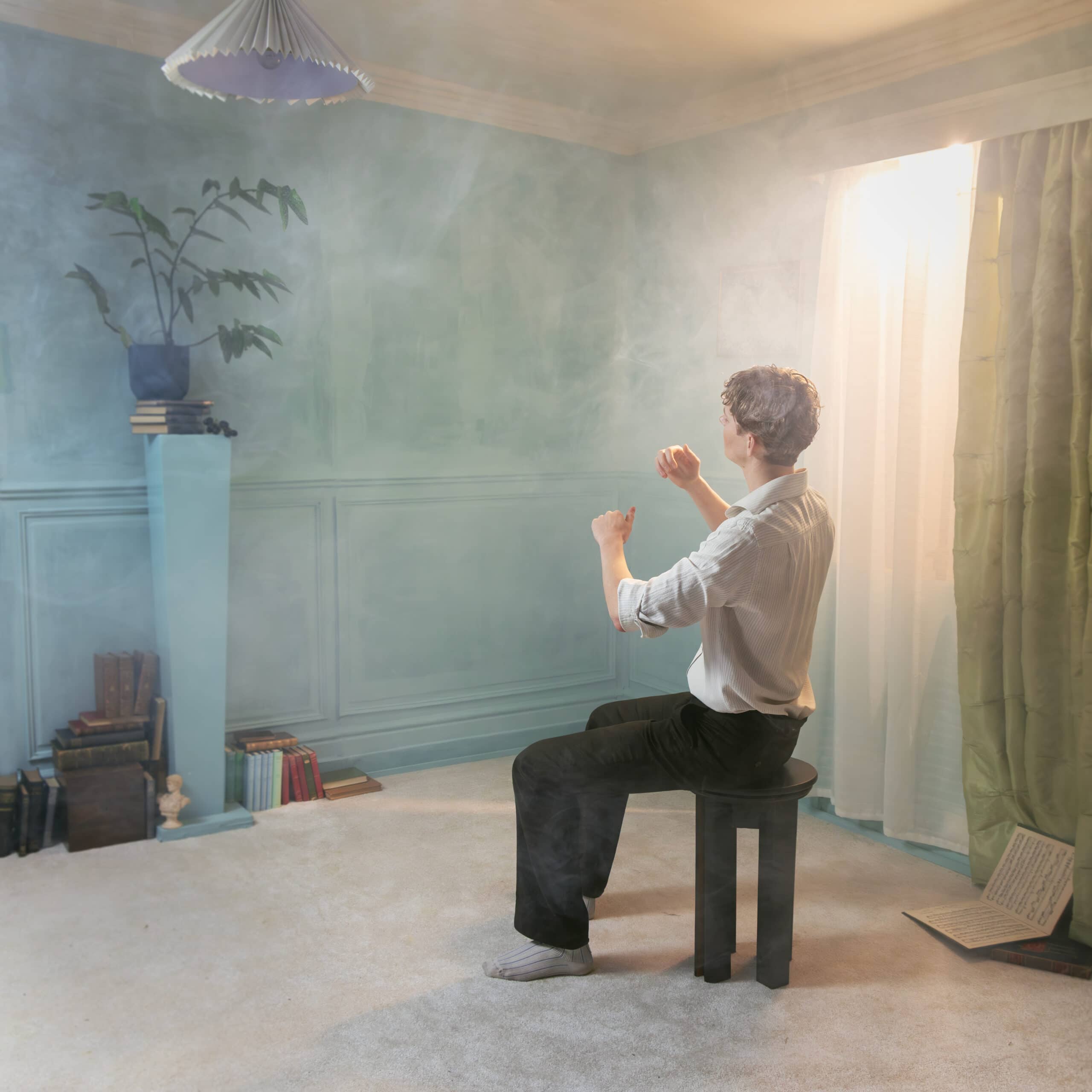 Willemze calls himself a musical eclecticist, inspired by philosophers from antiquity who combined ideas from different traditions: "That's how I see my own music practice: I play what moves me, regardless of style, period or genre, and seek my own colour palette," he explains. "I have an aversion to dogmatism and too much black-and-white thinking anyway. It is precisely nice to find a unique combination of colour nuances for yourself."
His concert programmes are often structured around an overarching idea that connects different works: "For me, making music is also a form of storytelling. Some emotions are difficult to put into words. Music begins where words end." During a programme about Orpheus, he told the story himself in his own words, and some of the pieces from that concert are also on the album.
Roots and inspiration
Willemze grew up in a musical environment. His brother and sisters already had music lessons and on Sunday afternoons, Bach or Händel often sounded at home. The church also played an important role. "We went to the Petruskerk in Woerden every Sunday. As a child, I already heard the majestic sounds of the organ there. Above that organ stands a large statue of King David with his harp. Perhaps an interest was unconsciously awakened there."
Religion and spirituality have deeply shaped his artistic vision. Years later, he sees religion eclectically: he can find peace in churches in Rome or in Buddhist or Taoist temples, while he has little use for rules and dogmas: "There are certain universal truths and ideas in most religions that touch the core of being human. For me as a musician, the pursuit of the higher and the beautiful feels like an important task. Sometimes I notice that music can transcend everything; those are wonderful experiences. As Dostoevsky wrote: 'Beauty will save the world.'"
Besides music and religion, a broad cultural curiosity also played a role. Willemze studied classical languages and Russian and travelled a lot, often also for his music: "Ancient texts teach you that there is rarely one definitive version. You work with variants, context and interpretation. I recognize that in music. There is no neutral performance there either. Tempo, phrasing and tone colour determine how a piece is understood. Classical languages have mainly taught me to be more precise: not just playing intuitively, but being able to explain why I choose a particular direction."
Willemze experiences music as a form of language, with sentence structure, accents, commas, questions and exclamations. "A musical phrase can land or remain open. On the harp, that is very tangible." At the same time, he warns against too strict systemic thinking. "Sound and colour are equally important. Music ultimately remains a sensory experience." He sees parallels between classical antiquity and his music practice: structure (logos) and charge (ethos) form the core together: "For me, logos is the bow and the structure, ethos is character and charge. I always try to connect those two: clarity in form and something that touches people."
The rhapsode as inspiration
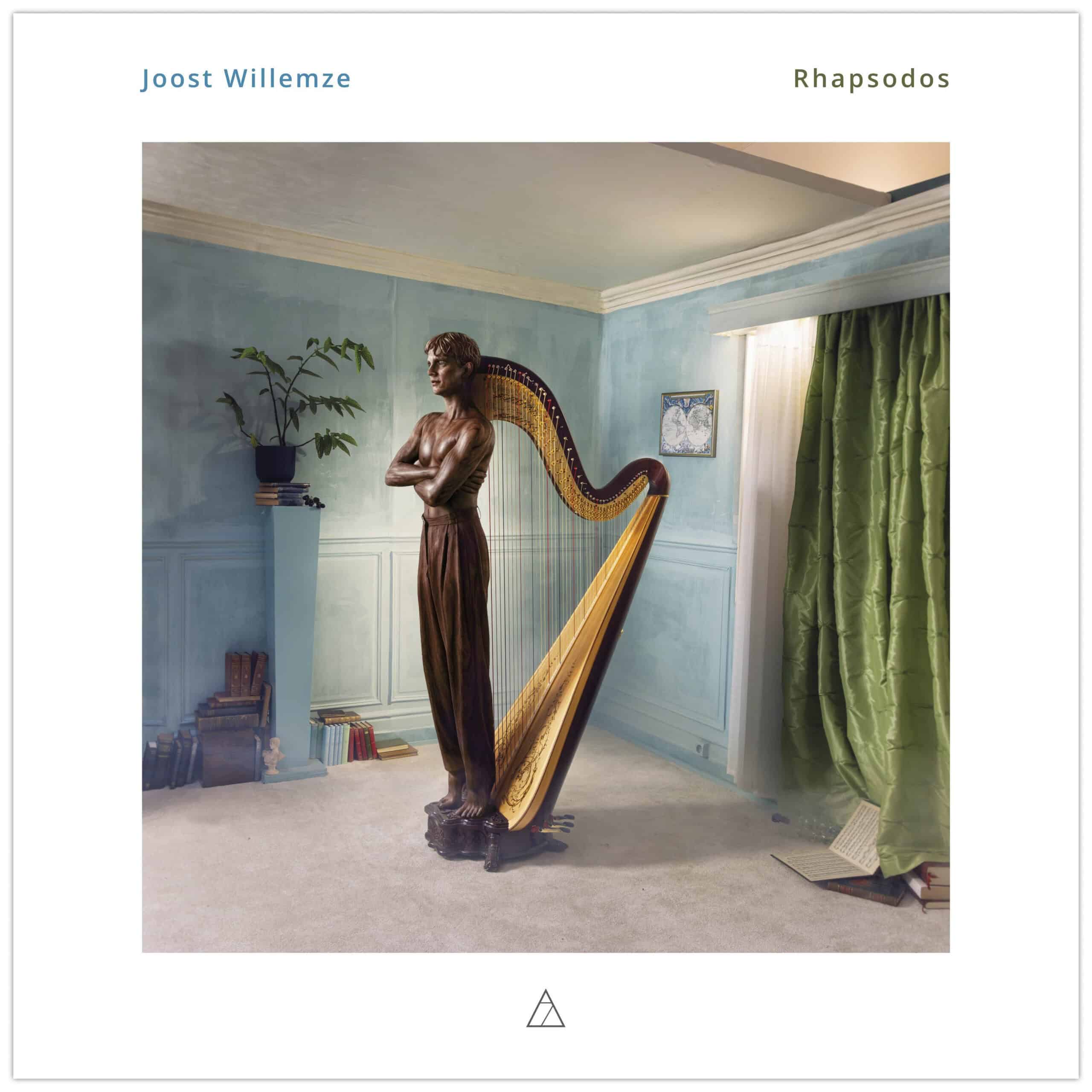 The title Rhapsodos refers to the itinerant storytellers of ancient Greece, who wove together and performed existing narratives. Willemze recognizes himself in this image: "I am first and foremost a performer. But I feel connected to the idea of the rhapsode. Not because I literally retell a story, but because I give meaning to the performance. I try to make a coherent arc from loose pieces, with contrast, timing and character, so that the music can speak as a story."
He sees the harp as an instrument that balances between the ancient and the contemporary: in new works you hear mythical images interwoven with modern timbres, sometimes even with electronics, as in Event Horizon. New repertoire on the album has been specially written for him by various composers, including Lemereis, Micháns and Tafreshi & Shayesteh.
Although the album consists of separate works, he sees it primarily as one continuous line of thought. According to Willemze, it is an artistic portrait: pieces that have shaped him alongside new works written for him, together they form one arc. At the same time, it is a menu of what the harp can do: lyrical sound fields, rhythmic passages, theatrical effects, subtle colour shifts and electronics. Patient listening contributes to a deeper experience, a kind of catharsis, as the ancient Greeks described it: intense emotions lead to inner purification and clarity.
According to Willemze, the interpretation of these works requires responsibility: "Technique is the foundation, but only so that it can become invisible. In Micháns the underworld must be palpable, in Lizotte Exosphère sounds lighter, and with Chertok little scenes remain playful. That freedom also means that the same work can sound very different when played by different harpists, as long as the main line and atmosphere are right." As with classical texts, there is rarely one definitive interpretation. Ambiguity and personal choices, such as the length of a silence or how a cadence is concluded, leave room for individual meaning.
Teaching as a mirror
Willemze experiences teaching as a way to stay sharp and discover new perspectives. He gives students a solid technical foundation, but encourages them to develop their own vision: "When a student gets stuck, I have to analyze exactly what's happening. This often leads me to new insights myself. Students also bring new interpretations and repertoire. One of my most repeated pieces of advice sounds simple, but is effective: study slowly. If something stands solid at a slow tempo, you can build up the speed later without it collapsing. I say that to students – but actually also repeatedly to myself." In a sense, he thus passes on the rhapsodic tradition: giving meaning to music, building tension, making choices that allow a piece to speak.
He emphasizes that Rhapsodos is structured as a continuous dramaturgy: individual tracks can be listened to separately, but you only hear the full coherence from beginning to end. In this way, the album invites attentive listening: "I understand that people often listen fragmentarily, but the order of the album is deliberate, with contrasts and tension that builds and recedes. My invitation to the listener is: try it once from A to Z, and then choose your own route."
Willemze sees classical music as an oasis of calm and reflection in a culture of speed. He also draws a parallel with classical languages: both are often marginalized, but both offer timeless insights into human emotions and behavior. Patient listening is connected to a deeper purpose: experiencing catharsis, as the ancient Greeks described it: "During tragedy you experience intense emotions that ultimately lead to a form of inner purification. I recognize that in music too. Problems don't disappear, but more space and clarity can emerge."
What you take with you
What does Willemze hope listeners take away after listening to Rhapsodos?
"That music can carry stories and that the harp can do much more than you ever imagined. The incredibly powerful narrative power of music and the unprecedented possibilities of the instrument are boundless for me."
Through the combination of tradition and innovation, intellect and emotion, rhythm and timbre, Rhapsodos offers a rich, personal and compelling portrait of a harpist who sees music as language, as story and as an instrument of catharsis. An album that you not only hear, but feel, experience and take with you on a journey through sound and meaning.
More info: https://joostwillemze.com/rhapsodos