
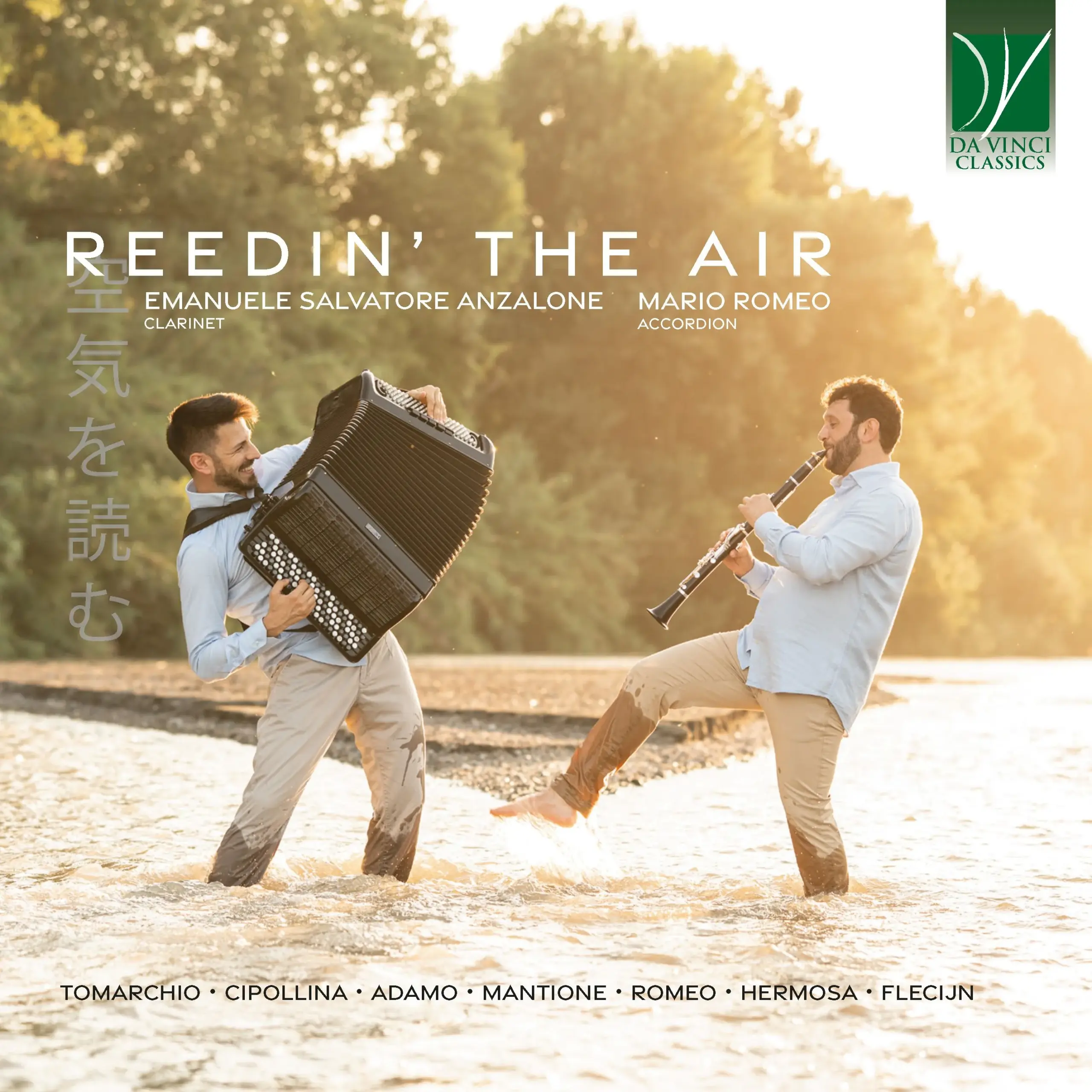
The combination of clarinet and accordion has never achieved the status of, for example, the violin sonata in chamber music, and that is no accident. Both instruments carry a dual identity: the clarinet has balanced between salon and folk festival ever since Mozart, the accordion between musette and concert hall, and whoever combines them must either smooth out that ambiguity or actively cultivate it. Yet it is precisely this liminal position that makes both instruments attractive to composers seeking a sound world in which the popular and the refined do not exclude each other, but can actually reinforce one another. Reedin' the Air, the new release on Da Vinci Classics featuring clarinetist Emanuele Salvatore Anzalone and accordionist Mario Romeo – together known as Duo RomAnce – resolutely chooses this approach and makes that ambiguity the starting point of the entire program. This is no coincidence: the first seven compositions on this CD were written especially for the duo and dedicated to them. The album thus documents not only new repertoire for a remarkable instrumental combination, but also a close collaboration between composers and performers.
The opening triptych by Alberto Tomarchio (b. 1962) sets the tone without detours. Al Moulin Rouge is theatre in sound, with a cabaret curtain that is almost audibly drawn open, though the piece sometimes remains somewhat trapped in its own theatrical gesture: the playful character of the music receives in performance precisely the lightness of touch it needs. It is, however, especially Il Cubo di Rubik that shows how inventively this composer handles rhythm and color. What on paper seems an intractable play with meter and motion here acquires a natural fluidity: the music continually surprises but never loses its dancing character. Romeo gives the accordion a solid foundation, while Anzalone unfolds his lines above with great lightness and agility. The result is not a musical puzzle, but a playful dialogue in which both instruments continuously challenge and complement each other.
With Roberto Cipollina (b. 1994), the register shifts from the playful to the narrative, and there immediately lies one of the plate's most difficult balancing acts. Lu re d'amuri wants to evoke a Sicilian fairytale without illustrating it, which means that the music must function through allusion rather than program. This largely succeeds: the recurring motifs are given enough space to become familiar before they are disrupted again, and the duo manages to convey the alternation between the tragic and the ironic – those two inseparable poles of Sicilian narrative art – without caricature.
Shapes 898 by Francesca Adamo (b. 1987) is a brief but intriguing miniature in which an asteroid, named after Hildegard von Bingen, forms the starting point for an encounter between twelfth-century mysticism and a contemporary sound world. Not a monumental gesture, but a concentrated sonic thought in which silence and suggestion become as important as motion. The piece therefore demands not so much time, but rather a different way of listening: it lingers as a question, not as an answer.
It is, however, Gernika, 26/4/1937 by Gorka Hermosa (b. 1976) that forms the moral and musical center of gravity of the album, and deserves not to be passed over too quickly. The piece directly alludes to the bombardment during the Spanish Civil War and to Picasso's painting that followed roughly a month later – two artworks, two media, one rage. Where Picasso's canvas freezes destruction in a monumental image of horror, Hermosa chooses the time dimension of music: not a depiction of violence, but a sound trail of memory and resistance. That Hermosa wrote it as a seventeen-year-old, in scarcely a week, and restricted it to diminished fourths and sevenths, is in itself a curiosity; what ultimately gives the piece its force is that this limitation never sounds like poverty, but as discipline. The duo opts for a remarkably sober reading: Anzalone's almost vibrato-less clarinet and Romeo's restrained accordion playing avoid any trace of effect-seeking. One gesture too many, one dynamic lurch toward the sentimental, and the piece would have drowned in pathos. Precisely that danger is avoided here.
Not everything on the album reaches that level. Tarantella plenaria by Carmelo Mantione (b. 1980), with its three contrapuntically interwoven themes, is technically skillful but occasionally misses exactly that touch of shamelessness that a tarantella needs to avoid sounding like a learned exercise; the irony resides mainly in the title and less in the music itself. Mario Romeo's own Ruit hora, in which the accordion sets up a gliding, harmonically ambiguous sound landscape above which the clarinet dreams, is a different kind of problem: the piece is atmospheric and convincing in sound, but in proportion to its limited material somewhat long-winded – a matter of form, not of content.
Eddy Flecijn's (b. 1962) closing Suite, written for the interludes of Marie NDiaye's theatrical piece Hilda, brings yet another kind of caveat. The emotional variety of the sequence – hope, betrayal, rage, remorse – comes largely to its rights, but the dramaturgical coherence that the suite undoubtedly had in the theater is less immediately palpable for those who hear the piece only as concert music. This is not a shortcoming of the performance, rather an inevitable loss when theatrical music loses its original context; it does explain why the CD ultimately ends with a series of strong impressions rather than with a fully resolved musical statement.
Technically, this repertoire is far from frivolous: the continual alternation between rhythmic precision, lyrical freedom, and color change demands of both musicians an exceptional sense of timing and phrasing, and that control is continuously evident. But ultimately, it is not technical perfection that carries the day here, but rather the naturalness with which Duo RomAnce brings new repertoire to life. Alongside an absolute highlight like Gernika stand pieces that reach less far, and precisely because of this, Reedin' the Air feels like an honest portrait of what is being written today for clarinet and accordion: with peaks, caveats, and everything in between – not as a selection of polished miniatures.
Above all, what lingers is the naturalness with which Duo RomAnce approaches this music. Anzalone and Romeo do not treat clarinet and accordion as opposing forces that must be reconciled with each other, but as two voices that have found each other. The fact that the first seven works were written especially for them and dedicated to them says much: this duo does not merely perform new repertoire, but has also actively contributed to its creation. They play with infectious commitment and show that contemporary music can be just as playful, warm, and communicative as the classical repertoire. Perhaps that is the greatest merit of this edition: it pretends to prove nothing, but does precisely that through the naturalness with which this music sounds here. Whoever listens to Reedin' the Air hears not a curious instrumental combination, but music that sounds so natural that you wonder why this repertoire is still played so little.