
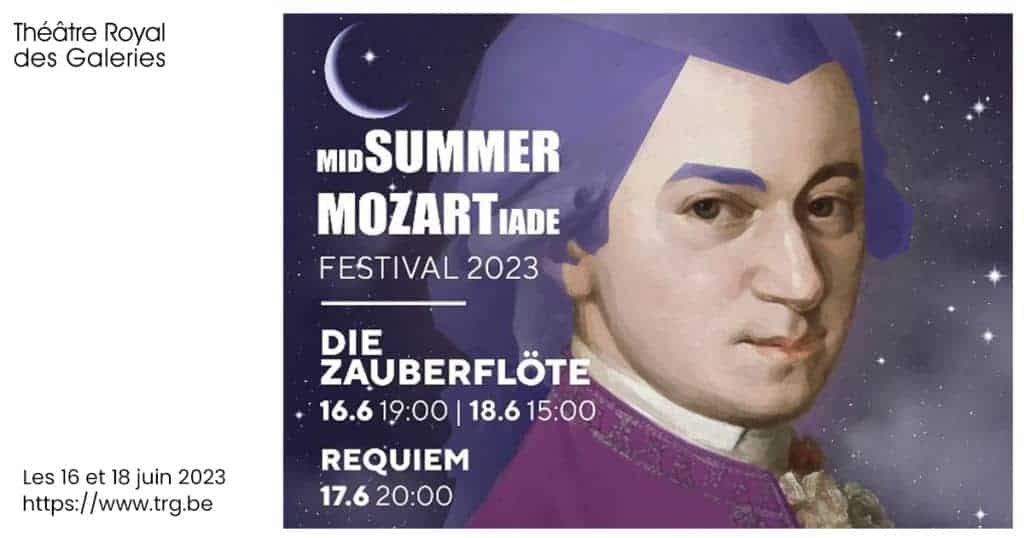
Mozart resonating in the Royal Gallery in Brussels, close to the Grand Place. That in itself is more than tempting to be there. A whole series of artistic elements, history, legends and stories coming together in the heart of Europe. A Europe in conflict, let us hope that Mozart's Requiem may not be a prediction of the downfall of present-day Europe. Hope can then be regained from the positive ending of Die Zauberflöte, the opera with music by Wolfgang Amadeus Mozart and text by Emanuel Schikaneder.
Is the story of this most famous and most popular opera of all time really so positive? It is full of duality and there is confusion in the background. Why is the initially good Queen of the Night, who does everything to save her abducted daughter, suddenly the evil, hateful woman who disowns her child? Where is the turning point, where is the logic? Do we find it in Mozart's Requiem? Suppose this is the farewell music of the husband of the wronged queen, what then? Let us, dear readers, think about it. We are curious about what your idea is about it. You can let us know via redactie@klassiek-centraal.be .
REQUIEM
CaVeMa, the organization behind the renowned Chœur de Chambre de Namur and the Millenium Orchestra, put their shoulders to the wheel for the seventh Mozartiade in Brussels with effective far-reaching musical support. The audience in the cozy hall of the royal gallery was treated to arrangements of Mozart's Requiem, his Mauerische Trauermusik, the Marcia from Die Zauberflöte and the Ave Verum Corpus. The Trauermusik was purely instrumental for an ensemble of six strings and organ positive, as was the Marcia. The Requiem and the Ave Verum likewise, but with a small soloistic double choir of two singers per voice (soprano, alto, tenor, bass).
The small room has rather poor acoustics. Ideal for theater, the spoken word, disadvantageous for music that carries less and does not blend sufficiently. On the other hand, I must tell you that I was even more impressed than at all other performances of the Requiem because, partly due to this dry acoustics, but also due to the small ensemble, the genius of this composition of compositions became even clearer. There are hardly any words to describe the unprecedented mastery of this composition that is so much more than 'a composition' that grabs everyone by the throat.
The period instruments were somewhat affected by the warm weather, but generally speaking it was listening to a very good performance, balanced, musically strong, reverent, voices in great harmony which is not always so obvious with soloists singing in a choir.
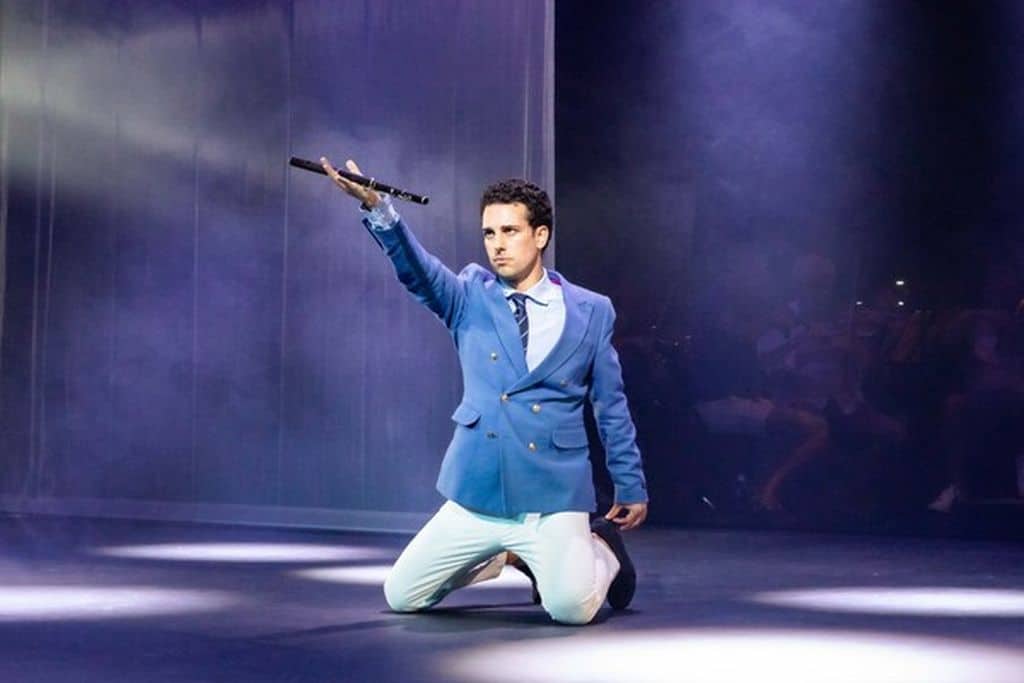
DIE ZAUBERFLÖTE
How does the organization manage to bring top quality with limited means that presents a complete picture that could count on full applause in every opera house in the world for the general public.
Once again the orchestra is on stage behind a hazy curtain. It has been tested and fully approved by everyone at the previous six operas that the organization programmed in the past editions. Conductor Gabriel Hollander led the Orchestre Royal de Chambre de Wallonie without pretensions, without pedantry and additions or other interventions in Mozart's score. We love musicians who have all respect for the brilliant work that cannot be improved by anyone. Together with the singers and a modest staging where humor and seriousness alternate, the conductor sweeps everyone along in the unusual story.
Some voices deserve our special attention. There was the young Portuguese tenor João Terleira who put on a fine, serious, faithful Tamino in a wonderful interpretation with a very sensitive approach. Princely.
French soprano Morgane Heyse delivered a Queen of the Night who had you in her power at her first appearance. What a convincing presence! And then the purity of the colorature, the power of the voice, the very clear intelligibility of the text. First class!
And then Papageno… Yes, of course, Papageno always knows how to win the hearts of the audience and yes, of course it is a role that every baritone wants to sing and play. It is something different than just being serious. Does Papageno not ask for seriousness? The simple boy who feels abandoned and then chooses to end his life, is that not deep seriousness? It is composed with immense musical strength and it is rarely sung profoundly enough. Here you should get goose bumps and be moved to tears. A tip for the world voice of Australian baritone Damien Pass. How many times I heard this opera, I do not know, but what I do know, and I weigh my words carefully, is that this Damien Pass is one of the very best Papagenos you can imagine. Very creamy voice, deliciously acting, enormous musical and technical control.
Shadie Torbey as a bass is not yet full and ripe enough for the demanding deep impressive bass of Sarastro. Particularly clever was Monostatos, performed by tenor Mathis Van Cleynenbreugel. The three ladies who also played the three boys were at their best, as was the girl of "achtzehn Jahr und zwei Minuten" Papagena, the Ghent fine soprano Marion Bauwens.
The audience enjoyed themselves. There were many open doors after the arias and the prolonged applause provided a fresh breeze in the warm hall, applause that concluded another successful Mozartiade. We look forward to next year!
CAST
Tamino: João Terleira
Pamina: Gianna Cañete Gallo
Queen of the Night: Morgane Heyse
Sarastro: Shadi Torbey
Papageno: Damien Pass
First Lady: Pauline Lebbe
Second Lady: Sonia Jacquelin
Third Lady: Aina Callaert
Monostatos: Mathis Van Cleynenbreugel
Papagena: Marion Bauwens
First Priest: Kenny Ferreira
Second Priest: Tom Van Bogaert
Ensemble Emma Barton-Smith, France Colaux, Juliette Doummar, Hendrik Mispelon, Pierre Romainville, Christophe Bornet, Erwin Muller
With the Koninklijk Kamerorkest van Wallonië
Creative Team
Musical direction: Gabriel Hollander
Direction: Eric Gobin
Costumes: Gaël Bros
Lighting: Félicien Van Kriekinge
Rehearsal pianists: Lionel Bams, Noemi Biro