
Last year the Salzburger Pfingst-Festspiele were cancelled. With the experience gained during the summer festival that could take place in a reduced form in 2020, this year there was again a Whitsun festival: four days of enjoying a well-filled, varied programme.
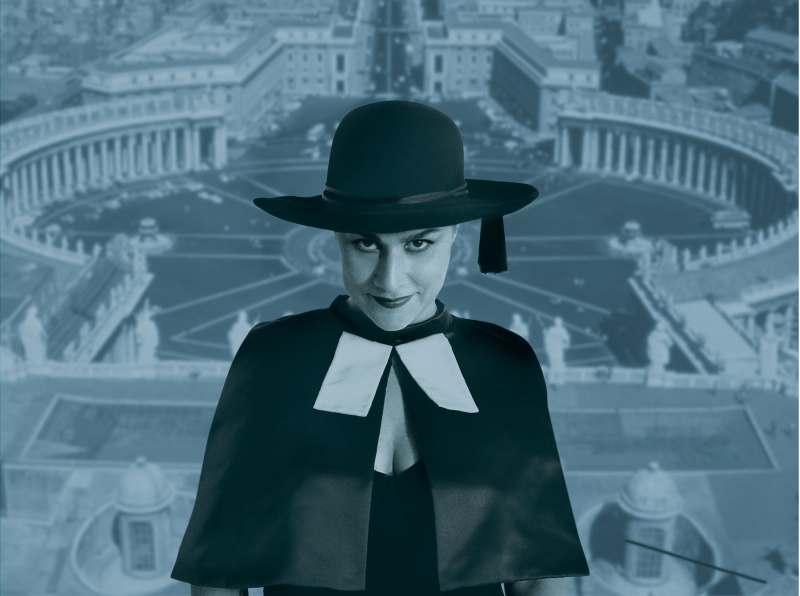
As the theme for the tenth festival under her artistic direction, Cecilia Bartoli chose "Roma Eterna" a tribute to her birthplace. It was four well-filled days with seven performances and concerts in the various theaters of the Mozart city and the projection of several films that illustrated the diversity of Rome such as "La dolce vita" (Fellini) and "Accatone" (Pasolini). The originally planned gala dinner, offered by a three-star chef, fell victim to corona, however.
"Il trionfo del tempo e del disinganno" (the triumph of time and disillusionment), an oratorio by Händel in two parts from 1707 opened the festival. It is Händel's very first oratorio for which he chose a libretto from Cardinal Benedetto Pamphilj: a discussion of four allegorical figures. Piacere (pleasure) urges Bellezza (beauty) to lead a life of carefree abandon and distraction while Tempo (time) and Disinganno (disillusionment) warn her. If Bellezza wants to escape the ravages of Time, she must ensure she secures a place in heaven where Time no longer has any influence.
In his staging, Robert Carsen made this contrast between the two worlds clear by relocating them to our time and society with the typical beauty pageants, disco, alcohol and drugs that slowly give way to that other world (set and costumes Gideon Davey). The final image of the production shows us a "purified" Bellezza who walks across an empty stage in a simple white dress towards a white light in the distance and "carries her new heart to God".
It is the young French soprano Mélissa Petit who performs this Bellezza and expresses her various emotions in the many arias allotted to her. She does this with a fresh and supple voice and an admirable virtuosity. She will certainly gain in authority in the five performances of "Il trionfo del tempo e del disinganno" this summer at the Salzburg Festival.
Authority certainly does not lack Cecilia Bartoli in the role of Piacere, the devilish spirit in a red pantsuit who manipulates Bellezza (her agent?) but who provides us with her performance of "Lascia la spina, cogli la rosa" the vocal and interpretative highlight of the evening! Lawrence Zazzo (Disinganno) and Charles Workman (Tempo) received less prominent turns and profiles in Carsen's concept but also deliver beautiful vocal performances and integrate well into the ensemble.
In the orchestra pit sits "Les Musiciens du Prince – Monaco", the baroque orchestra founded in 2016 at the initiative of Cecilia Bartoli and which has in a sense become "her" orchestra and now accompanies her almost always. Under the direction of Gianluca Capuano, they bring Händel's score to life, deliver beautiful detail work, pay attention to nuances and keep the audience spellbound.
Naturally the Musiciens du Prince – Monaco are also of service – not in the orchestra pit but on stage for the concert performance of Mozart's "La Clemenza di Tito". At the back of the stage of the "Haus für Mozart" the Bachchor waits its turn and Davide Pozzi (continuo Hammerklavier) and Robin Michael (continuo violoncello) follow the dramatic development attentively.
It was apparently the first time that Cecilia Bartoli performed the role of Sesto in a more or less scenic version and for soprano Anna Prohaska it was her debut as Vitellia. That may not be the most suitable role for her slender, clear soprano voice and for performing the temperament and demands of the vengeful princess. Cecilia Bartoli, on the other hand, gave us a moving and convincing Sesto: beautifully sung as we are accustomed to from her. Charles Workman's Tito had royal bearing, warm humanity and virtuosic coloraturas. Mélissa Petit (Servilia) and Lea Desandre (Annio) formed a charming young couple and Peter Kalman gave Publio his sonorous bass. Gianluca Capuano chose a fairly robust approach.
Brexit and Corona were the spoilers that caused the concert "Dixit Dominus" with compositions by Arcangelo Corelli, Georg Friedrich Händel and Domenico Mazzocchi to be performed by the English Baroque Soloists and the Monteverdi Choir under the direction of John Eliot Gardiner to be cancelled. No panic. Fortunately Cecilia Bartoli still had a programme in reserve. Under the title "What passion cannot music raise" she presented, with the help of her orchestra, fragments from cantatas, oratorios and operas that prove the most varied emotions that music can evoke.
Much Händel but also pages by Porpora, Hasse, Telemann and Vivaldi. Bartoli and the orchestra alternate and whenever Cecilia takes the floor, she appears in an adapted (historical) costume for the character she brings to life. The audience enjoys it (so do I!) and participates in the changing moods. As a cherry on top, Bartoli and some orchestra members begin to outdo each other in virtuosity. Much to the great delight of the audience who can't get enough of it. It's a feast!
Les Musiciens du Prince-Monaco was not the only orchestra to perform in this edition of the Whitsun Festival. The Artaserse ensemble brought a performance of Scarlatti's oratorio "Cain, overo il primo omicidio" with Philippe Jaroussky. The Orchestra del Maggio Musicale Fiorentina, conducted by Zubin Mehta, took to the stage of the Grosses Festspielhaus for "Poema Sinfonico" a concert with compositions by Respighi and Mendelssohn and a concert performance of Puccini's "Tosca".
Corona also interfered with the planned programme there. Not with the "Poema Sinfonico" concert featuring the "Italienische" symphony and Mendelssohn's violin concerto and Respighi's "Pini di Roma". Zubin Mehta, who recently celebrated his 85th birthday, makes his way to the conductor's desk with small cautious steps. But once seated, he is clearly the master. However, the audience's ovations are primarily for Maxim Vengerov and his compelling, virtuosic interpretation of the violin concerto.
For the concert performance of Puccini's "Tosca", an opera set in this "Roma eterna" which was the theme of this edition of the Whitsun Festival, corona once again caused problems and the replacement of two singers: not Anja Harteros but Anna Netrebko as Tosca and not Bryn Terfel but Luca Salsi as Scarpia. Unfortunate, unfortunate, but it could have been worse!
Unchanged: Cecilia Bartoli as the young shepherd boy heard at the beginning of the third act but who usually does not appear on stage. It was in this small role that the ten-year-old Cecilia Bartoli once made her debut at the Rome Opera! Now she walked past the orchestra, spread across the wide stage of the Grosses Festspielhaus, with a projection of Castel Sant'Angelo in the background, the place where the final act takes place. There was not much room to act and the executed Cavaradossi even had to sit next to the conductor for a moment awaiting the end of the opera.
The singers moved freely and maneuvered skillfully and knew how to convince the audience through their commitment and compelling performances. Anna Netrebko performed Tosca with her ample, expressive soprano, empathy, vulnerability and dramatic commitment and… two magnificent dresses! Jonas Kaufmann gave Cavaradossi distinction and profile and managed to give his ample tenor Italian sunshine. Luca Salsi's Scarpia had authority and allure and a precious expressive baritone. The various smaller roles were solidly cast and Zubin Mehta led his phalanxes with a sure hand in an excellent dramatic build-up. The audience held its breath and jubilated.
The production of "Il trionfo del tempo e del disinganno" is on the programme of the major Salzburg summer festival on 4, 8, 12, 14 August.
The theme of the Whitsun Festival 2022 will be announced in the summer.
- WHAT: Whitsun Festival Salzburg (Salzburger Pfingst-Festspiele)
- WHERE & WHEN: Salzburg, 21 – 24 May 2021
- PHOTOS: Cecilia Bartoli © Decca / Ferdinando Scianna; Il trionfo del Tempo e del Disinganno © SF / Monika Rittershaus; Tosca, La clemenza di Tito, Les Musiciens du Prince-Monaco & Poema sinfonico: © SF / Marco Borrelli
- WEBSITE: Salzburger Festspiele