
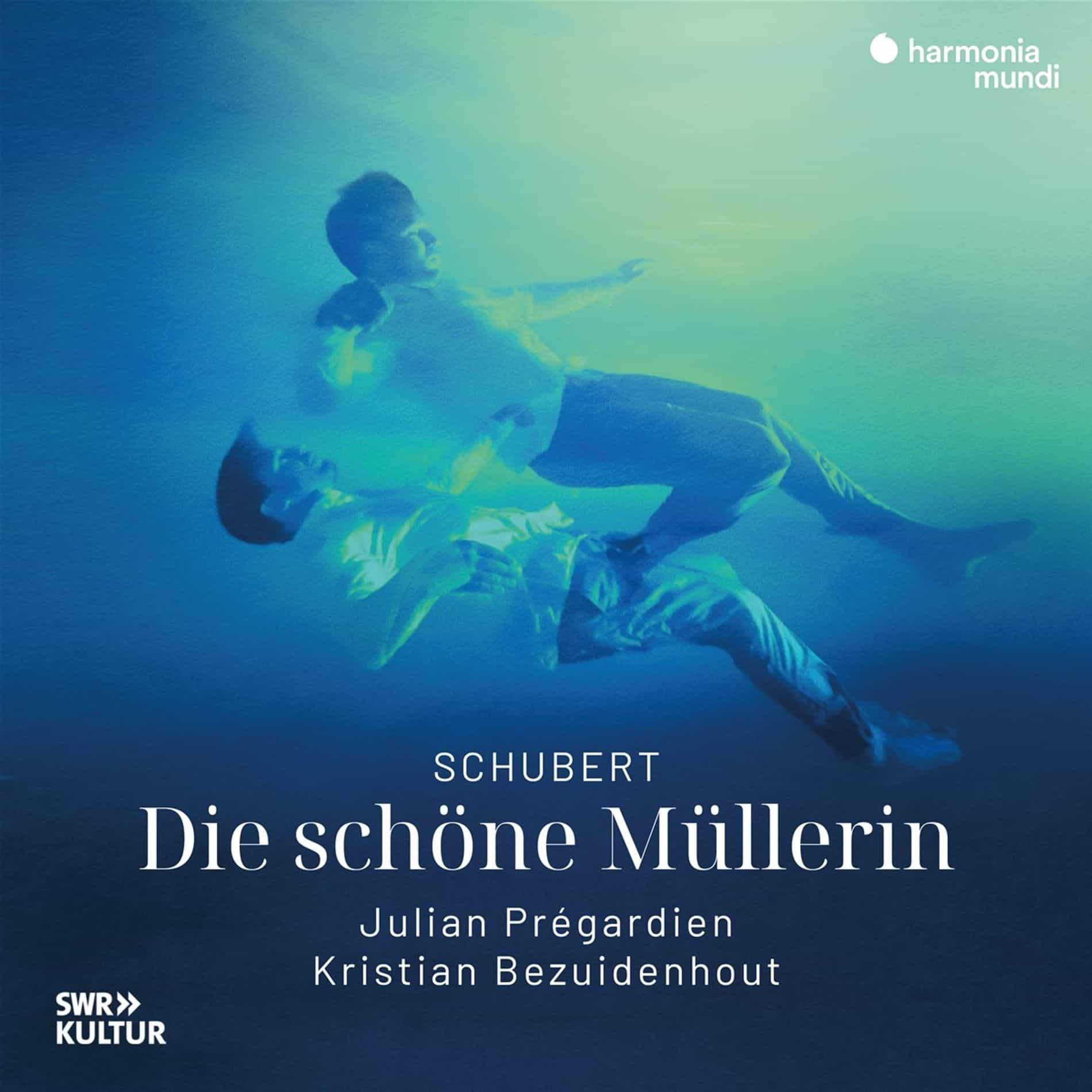
Schubert: Die schöne Müllerin D 795
Julian Prégardien (tenor), Kristian Bezuidenhout (fortepiano)
Harmonia Mundi HMM 902739 • 61' •
Recording: Nov. 2023, SWR Funkstudio, Stuttgart
Schubert composed Die schöne Müllerin during a period when things were certainly not going well for him: neither mentally nor physically. Financially, he never had it easy: he couldn't even afford to buy a piano.
For the song texts of Die schöne Müllerin, he drew in 1823 from the Sieben und Siebzig Gedichte aus den hinterlassenen Papieren eines reisenden Waldhornisten by Wilhelm Müller (1794-1827). Simple texts that undoubtedly penetrated directly into the composer's musical heart. Schubert selected twenty songs from the collection for his 'beautiful miller's daughter' cycle, a musical 'action' that progresses from the optimistically toned 'Das Wandern' to the deeply felt tragedy of life's end (where in the final song, 'Das Baches Wiegenlied', it remains unclear whether death actually occurs, or whether it is merely longing for it). The MDZ, the Münchener Digitalisierungs Zentrum, has included the original edition of Müller's 77 poems in its collection and these are consulted here.
In a sense, the texts chosen by Schubert form a cliché as it was current in the 'Vormärz' in various, also artistic circles: that of the typically German Michel who served as a personification of narrow-mindedness, sluggishness and passivity, but at the same time also humorous, mocking, stereotypical.
Schubert saw through the mostly oversentimental, excessively florid content of Müller's poems and distanced himself from it by focusing on precisely the non-Biedermeier aspects of them, which had consequences both for the song texts he used and their order, while he had no qualms about adapting the titles as he saw fit.
We cannot be certain, but it is highly likely that Schubert's tenor voice roughly corresponded to the one for whom the Müllerin cycle was initially intended: the amateur tenor Karl Freiherr von Schönstein. On one point, however, there is no doubt whatsoever: that the fortepiano served as the most obvious medium for instrumental accompaniment at the time; and it could well have been an instrument by Conrad Graf (Vienna, 1825), a replica of which, made by Christoph Kern (Staufen im Breisgau, 2019), is played on this recording by Kristian Bezuidenhout. The tonal qualities come across on this recording in truly fantastic fashion: the warm and glowing middle register, the transparent, almost harp-like treble, the clearly defined yet equally sonorous bass, and not least the damping system that was certainly advanced for its time. Schubert himself never owned such a fortepiano, but he undoubtedly played it or at least heard it at friends' and acquaintances' houses.
Strictly speaking, the texts are not so extraordinary, and certainly not as we twenty-first-century listeners view them. Moreover, the subject matter, in all its conceivable variations and degrees, is well-worn: the painful collision with love, the essential distinction between dream and harsh reality, insatiable longing and ultimate rejection, joy and loneliness. What is remarkable here is the binding natural element that carries this cycle – also as a metaphor for never-ceasing change – water, which even in the final song continues its dominant role in 'Des Baches Wiegenlied'.
While simple folklore may dominate textually, musically the cycle testifies to great refinement, both in terms of balanced drama and subtle characterization, with melancholy manifesting itself beneath the surface and unfulfilled longing. And this for a cycle whose songs are mostly written in major keys!
Die schöne Müllerin as a prosaic tale of unrequited love, anchored in the text by teacher and librarian Wilhelm Müller, who had experienced it himself, who had suffered from what remained unattainable for him: the poet Luise Hensel, an intelligent and attractive figure who many a man's heart went astray for, but with whom Müller struck out.
To what extent Schubert's own experiences resonate in these strophic songs we do not know, but we do know that syphilis had been diagnosed in him shortly before and that he shaped the cycle partly during his stay in the hospital.
In this performance, Julian Prégardien follows in the footsteps of his father, Christoph Prégardien, when it comes to carefully weighed accentuation in conjunction with expression (expressive power is more important than meter) that characterizes the joy and especially the sorrow of the miller's boy. But the delivery as a whole also offers only positive points, both in its uncomplicated and plastic character, as well as in the imaginative and intelligently anticipatory atmospheric images and mood shifts.
Prégardien's light, sweet timbre ensures colorful nuance and subtlety, so that not only the tragedy but also the liveliness and anticipation come across well. Moreover, it is vocal flexibility and ornamental artistry that make this interpretation even more fascinating than it naturally is. Here, moreover, everything sounds as fresh as dew, without any artifice, alternately feather-light, masculine and even hypnotic. Prégardien also dares to make bold strokes, as in 'Eifersucht und Stolz', although phrasing does suffer somewhat as a result. But what does it matter? After all, we hear here a performance that combines the qualities of a miniature opera, and Die schöne Müllerin is certainly not the worse for it!
The Graf fortepiano played by Bezuidenhout reveals itself on this recording as an outstanding instrument in every respect, further enhanced by the sparkling playing of this acclaimed fortepianist, here in the role of an equally overwhelming storyteller who combines insight with flair and has given each song its own distinctive character. This is why the collaboration between Prégardien and Bezuidenhout can be considered ideal.
It is a shame that the studio performance recorded on video by Südwestrundfunk (SWR) in the series Kulturmatinée (click here) was not included with the cd, as picture and sound would certainly have provided considerable enrichment. Especially since the cd edition was produced in collaboration with that same SWR. But…with this cd recording, the glass is nonetheless considerably more than half full!