
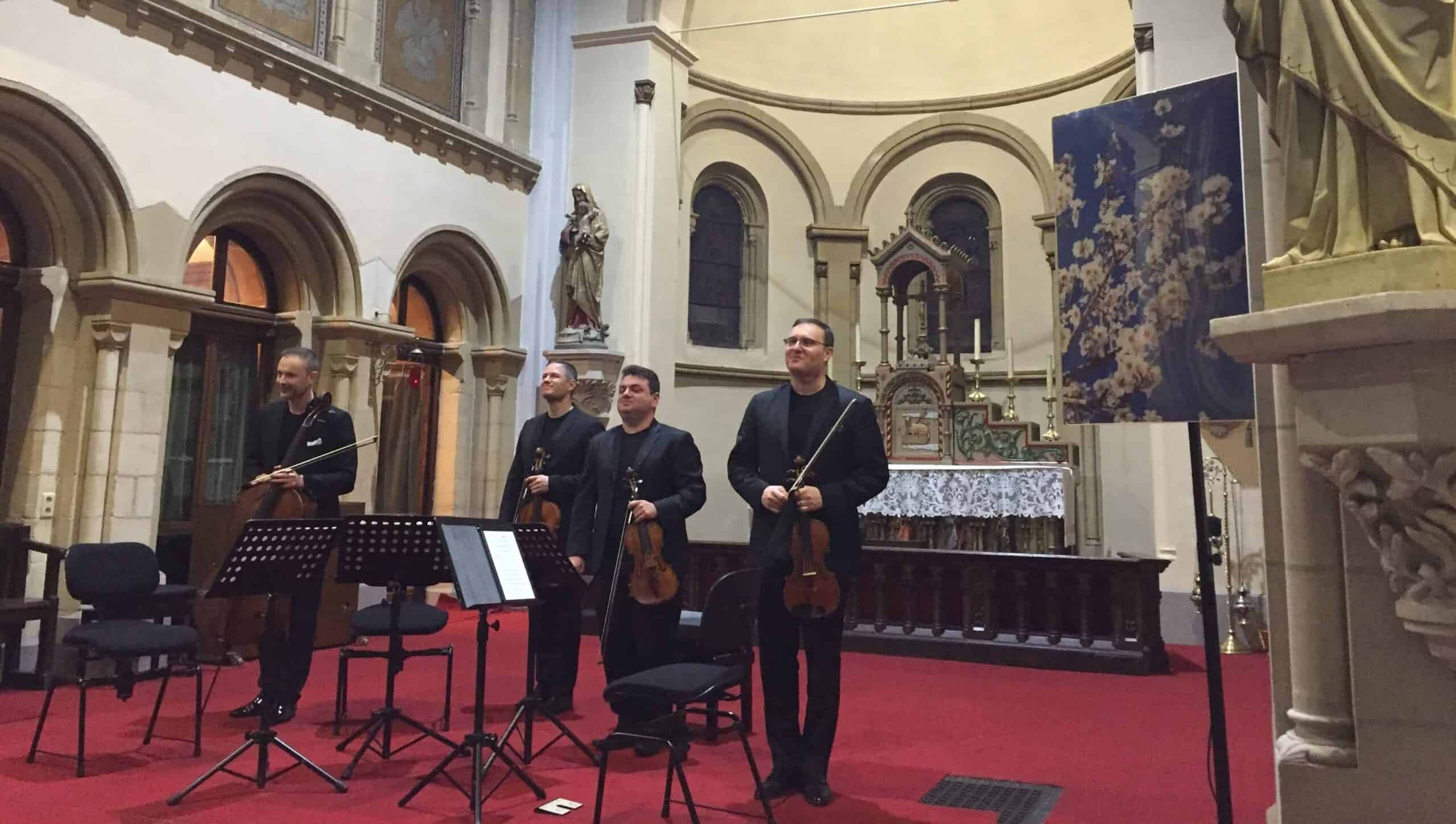
Worth the detour: that is the least you can say about the series of chamber music concerts that Cultuurcentrum Maasmechelen programmes in the sub-municipality of Leut. This week, the Sint-Pieterskerk welcomed the world-renowned Jerusalem Quartet. One would cross the national border for less.
It is something different from the Wigmore Hall or the Théâtre des Champs Elysées. The grandeur of these halls is nowhere to be found in rural Leut, but the renowned Jerusalem Quartet is not deterred by this; quite the contrary: the ensemble is known for also doing its thing on smaller stages. And how! The quartet had brought along some classics from the repertoire for this occasion. The four gentlemen began with the quartet nicknamed "The Lark" by Haydn (1790), one of the composer's most popular examples. It is a work written by a man in his late fifties, yet it nonetheless brims with vitality. The Jerusalem Quartet has also been on stage for more than twenty years by now, but it still plays this music with just as much freshness. The cheerful opening movement (Allegro moderato) was characterised by tight ensemble playing and impeccable timing. The first violinist showed considerable verve – like a little bird singing according to its nature – but was equally happy to involve itself in the rest of the group when needed. The serene Adagio cantabile moved through the surprisingly varied timbres that the quartet assembled: what depth and richness of colour! And what impeccable intonation as well. The neatly accented minuet (Allegretto) was followed by a short but energetic finale (Vivace), in which, alongside pointed articulation, the dynamic climax during the contrapuntal intermezzo particularly impressed.
Romantic discontent
Before the interval, the sizeable audience in Sint-Pieterskerk was presented with Leoš Janáček's first string quartet (1923): a great leap in time, but above all a world of difference in terms of emotional mood. This accounts for much of the exceptional programmatic character of this music. Janáček, as a composer rather a late bloomer, was inspired by The Kreutzer Sonata, a novella by Tolstoy about infidelity within an unhappy marriage in which the eponymous violin sonata by Beethoven arouses feelings in the main character that ultimately lead to the murder of his wife. The translation of these fateful events into notes is undoubtedly gripping. With no fewer than sixty-one tempo changes and twenty-five meter switches, this score demands an extraordinarily great capacity for empathy and adaptation. The Jerusalem Quartet, which recorded this tetralogy for Harmonia Mundi on CD several years ago, demonstrated its great mastery and ability on both counts this evening. In each of the movements, there was a constant interplay between tension and relaxation. The intensity was palpable in every bow stroke, whether it was expressive legato, chilling tremolo or biting sul ponticello. The musicians continually interrupted each other in an incisive manner. The light-footed motif of eight measures that in the first movement (Adagio – Con moto) is first repeated in the cello, then in the first and finally also in the second violin, and which later passes from the second violin via the viola back to the cello, each time received a slightly different phrasing. In the subsequent Con moto, the interplay exhibited a sometimes healthy dose of aggression, which served the musical fury particularly well. And the contrast with Haydn's jovial serenity could not have been greater in the third Con moto either. The finale (Con moto) also sounded deeply moving. Right up to the double bar line, the quartet drew from a wellspring of inspiration and expressivity. The enthusiasm of the churchgoers spoke volumes: "Phenomenal" or even "fantastic" were the words heard.
Brahms's first string quartet was to be the centerpiece of this concert. He put the finishing touches to it in 1873, and like with the symphony, the self-critical composer struggled for many years to follow in the footsteps of the great predecessors. While his first symphony, notably also in the same key of C minor, was somewhat condescendingly dismissed as the tenth of Beethoven, Brahms sought with his first quartet rather to connect with the idiom of the Razumovsky Quartets (opus 59). The result is a serious, hermetic and above all thoroughly crafted work. With spare means, Brahms creates a gripping first movement that consists almost entirely of the development and working through of this scarce basic material (Allegro). The Jerusalem Quartet made it an insightful yet nonetheless tumultuous whole. The four parts were constantly strongly engaged with each other and at times fired each other up vigorously, which culminated in an early climax. The Romanze that followed was played with such deliberation and equal finesse that the harmonic splendor of this glowing atmospheric piece (Poco adagio) emerged now subdued and then sighing. In the Allegretto molto moderato e comodo, a languishing interlude that Simon Vestdijk characterized as an "impressive manifestation of romantic discontent," movement was the trump card. What delightful music this is … Mindful of Vestdijk's characterization, it was also amusing to see how the musicians regularly seemed to nod approvingly at each other. Only in the finale did the impassioned music not come fully into its own. Curiously enough, balance problems arose twice in the Allegro, whereby the agitated staccato passages of the first violin were unfortunately drowned out and the movement lost its force. As if suddenly not everyone was giving their all. Strange, because in the rest of the turbulent finale this flaw did not appear again.
The mishap does nothing to detract from the fact that this was a wonderful concert. The Jerusalem Quartet undeniably belongs to the circle of top ensembles in the genre. Kudos also to CC Maasmechelen, which with illustrious names such as these convincingly continues a long tradition. It is already a matter of looking forward to who will visit the Maasland next season. On 23 May the new program goes online. Chamber music lovers, be sure to keep an eye on this website.
- WHAT: Joseph Haydn (1732-1809), String Quartet in D, opus 64 no. 5, "The Lark" – Leoš Janáček (1854-1928), String Quartet no. 1, JW VII/8, "The Kreutzer Sonata" – Johannes Brahms (1833-1897), String Quartet no. 1 in C minor, opus 51 no. 1
- WHO: Jerusalem Quartet [Alexander Pavlovsky (violin), Sergei Bresler (violin), Ori Kam (viola), Kyril Zlotnikov (cello)]
- WHERE: Sint-Pieterskerk, Leut
- WHEN: Wednesday 18 April 2018