

'Klassiek Centraal sends out its sons' as the saying goes, and they cross the borders of our country which is small in area, but culturally belonging to the greats. There is very much to do in our own country where we cannot be present, so why then follow concerts abroad?
That is the result of press invitations from organizations that learned to know our website and absolutely want us to be there once. If someone can then – that doesn't always work – we are happy to respond to such a request. So the undersigned was at the world congress of the carillonneurs in Mafra, Portugal and immediately afterwards in the Swiss historic border town on the Rhine, Rheinfelden.
[caption id="attachment_57300" align="alignleft" width="300"]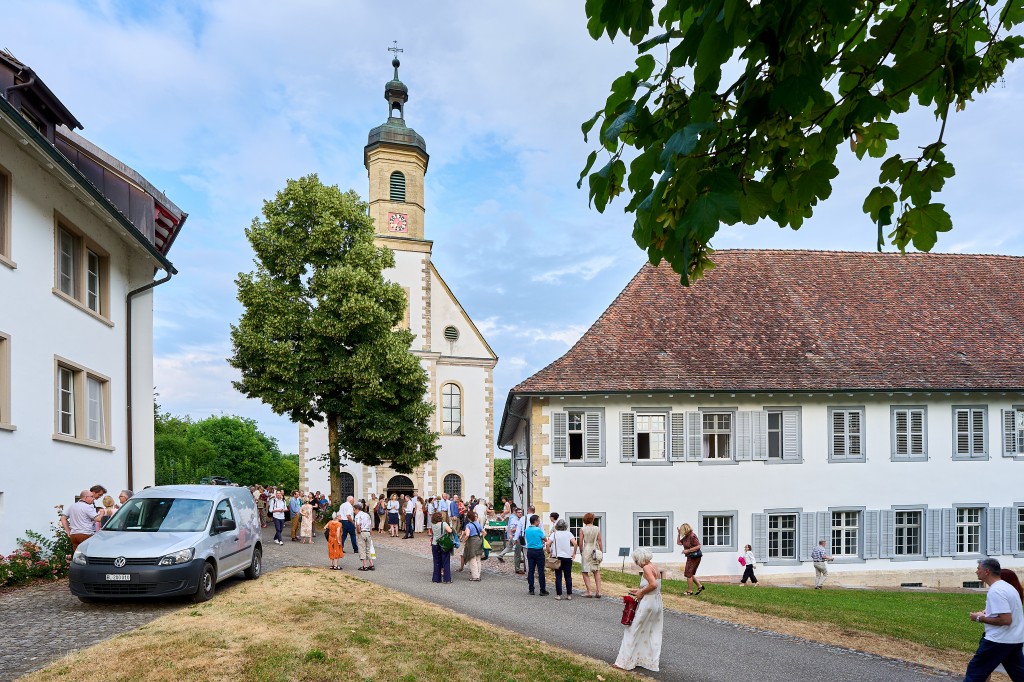 Monastery Olsberg during the Solsberg festival[/caption]
You won't find Solsberg on the map, Olsberg with some luck. It is actually an old monastery, situated high enough to never flood when the Rhine is temperamental. In the area around there lives and works the renowned cellist Sol Gabetta. She established a chamber music festival there and it was named after a contraction of Sol and Olsberg to Solsberg. Swiss Rheinfelden is small and exceptionally beautiful with much history. The bridge over the Rhine is not only a border bridge between two countries, it is also the border of the navigable river. German Rheinfelden is a younger city from the 19th/20th century that became larger than its neighbouring country due to industry that came there, but does not have as many picturesque corners and edges and certainly is not rich in historical buildings. The border is cultural, and yes, also partially linguistic. Swiss German and Swabian (the German of the Black Forest to the west of Bavaria so to speak for convenience) differs in sound formation, vocabulary, expressions and Swabian itself is remarkably different from the schoolbook High German that I learned. So much for our linguistic and tourist introduction.
Solsberg Festival is a hit
We can strongly recommend you, should the opportunity arise, to visit and discover both Swiss Rheinfelden and its surroundings and to combine that with attending all or parts of the Solsberg festival. It is worth your while across the board. Beautiful music performed at its best in an environment inspired and soothed by history and nature, where you can also pamper your inner self nicely, is that not ideal?
Vsevolod Zavidov: a phenomenon
On the first evening of my stay, the then unknown 20-year-old Russian pianist Vsevolod Zavidov played a recital in the monastery church Olsberg. Zavidov is an unusual, remarkable figure with the bearing of a seasoned older pianist. His fingers are lightning-fast and very strong, he makes no mistakes or at most a very small one, all notes stand apart from each other, legato playing you should not expect. It is rather sensational and remarkable than purely musical to hear him at work.
By Rachmaninov (1873-1943) he played an arrangement of Bach's partita no. 3 for violin BWV 1006. Stormy, overwhelming, dazzling and then again extremely quiet, barely audible, from my feeling much too fast then strongly slowed down. I found his Schubert (1797-1828) unrecognizable, the four impromptus opus 90 (D 899). During this performance I felt lost, not knowing what to think of it and how to describe that. Theatrical is not the right word although it was just that. It was not romantic and yet… Masterful, remarkably clever sounded the work that I never liked before and now absolutely do: the Trois Mouvements de Pétrouchka by Stravinsky (1882-1970). As Zavidov performed it here, you won't hear it a second time. This was worthy of recording. Thus the recital was concluded by a pianist who reminds me of Volondat…
First final concert Solsberg Academy
The festival has more in store than just concerts where the cello takes center stage. Younger musicians, all teenagers bursting with talent, had the chance to take a masterclass with Ivan Monighetti. Of the six who performed, we certainly remember three who made music at a very high level. Two others will certainly be able to make a healthy career and one raises question marks. Let us briefly review these six young people between 12 and 19.
The Spanish 19-year-old cellist Luis Aracama is the young man of the question marks. He plays very hard, aggressively, with very much forte and fortissimo, very technically but unmusical. Very disturbing is his incessant heavy snorting and exhaling throughout his entire performance. Very different was the playing of 12-year-old Chinese Keruixi Ma. However fragile and small she may be, she plays enchantingly romantic, full of love for the music, the instrument and the audience. Remarkable was that she played the Fantaise sur deux Airs Russes op. 13 by the Flemish composer Adrien-François Servais (1807+-1866). Much feeling, great warmth and pure bows in a broad legato playing, with full power, singing and phrasing. Bravo!
Emilie Richter (Switzerland) performed the cello sonata by Zoltán Kodály (1882-1967) in too sharp a manner with sometimes scratching attacks of the bow. It is an especially difficult work, full of tricks to still mean something. Difficult to judge someone on this work. Where you can judge someone is on Johannes Brahms (1833-1897) for example.
The 14-year-old Rey Gergov from Vienna performed Brahms's sonata no. 2 for cello and piano. The accompanist was pianist Alessandro Tardino who conducted himself modestly and played in service with the young cellists. The Brahms sonata demands energy and Gergov had it in abundance, playing with strong nuance and total control. This was confirmed in his interpretation of the first part of Dmitri Shostakovich (1906-1975) his cello concerto no. 1. I do not exaggerate in stating that he played at the level we heard a month and a half earlier in the final of the KEW Cello. If this boy does not make a future as a cellist, who then?
Yiqi Chen from China played exactly the same works as Luis Aracama. Never before have I heard such a world of difference in musicality, in interpretation, in insight into the score and the composer. This 19-year-old cellist is ready for the big stages and will always know how to charm his audience with the most beautiful cello sounds. The Bach – excuse me but the cello suites are actually refined finger exercises – he elevated to a rarely performed excellent beauty. The second work by Alfredo Carlo Piatti (1822-1901) now sounded, instead of a composition too much as a fragile, sensitive work, rich in song and nuances as only exists in the romantic era. Even György Ligeti's (1923-2006) cello sonata became a dialogue full of phrasing and Chen knew how to elevate the value of the work to a higher level.
The Luxembourger Matis Griso, also 19 rounds off with generally well-performed variations on a rococo theme by Tchaikovsky (1840-1893). You could have enjoyed it more, had also this young cellist been made clear that snorting breathing is disturbing and really does not belong.
[caption id="attachment_57301" align="alignleft" width="200"]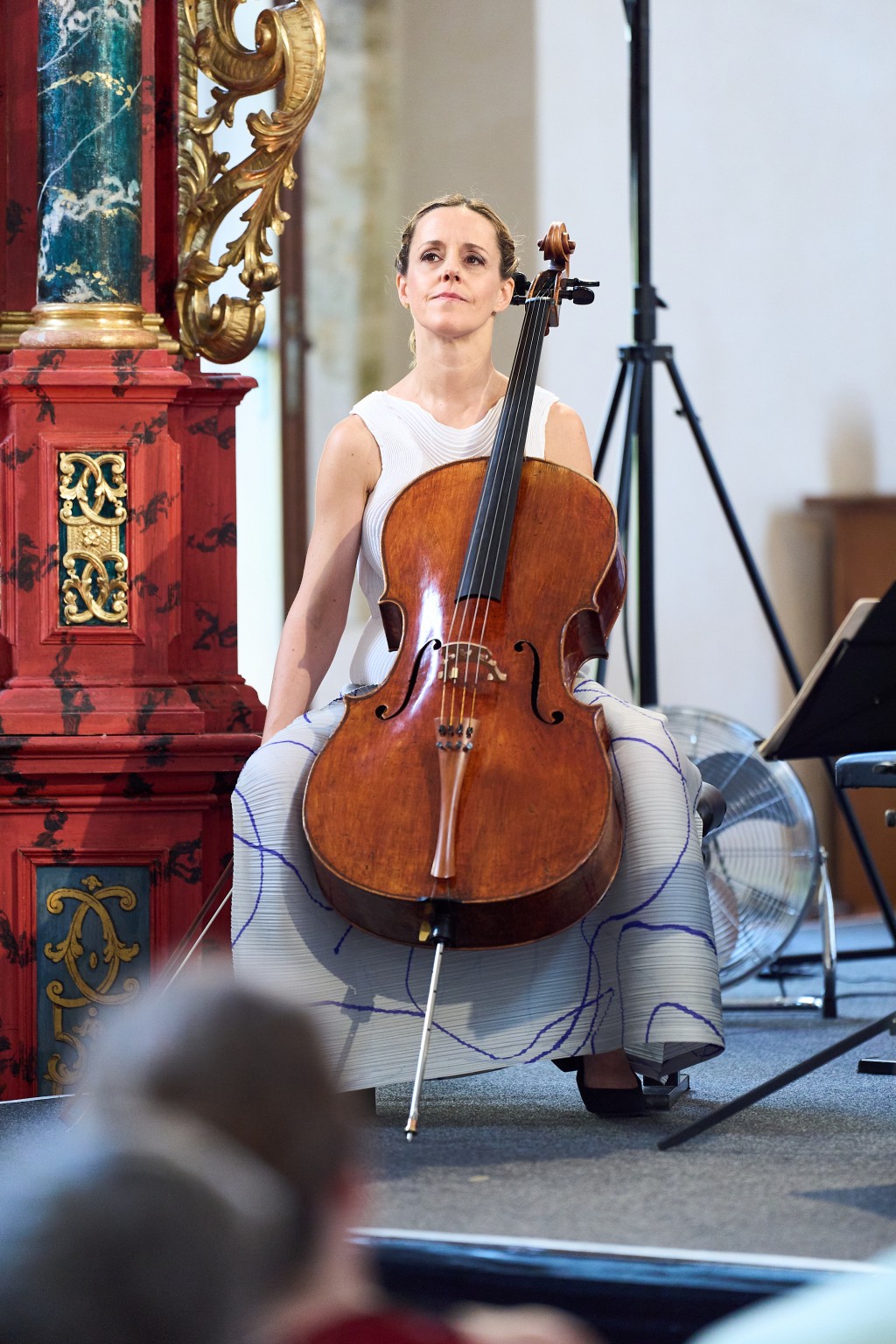 Sol Gabetta[/caption]
Sol unleashed!
The closing evening featured a trio of violin, cello and piano with works by Karol Szymanovski (1882-1937), Shostakovich and Mieczyslav Weinberg (1919-1996). A work by the latter composer was full of painful violence, a feeling of loneliness and absolute uncertainty. Not a pleasant closing piece, it can make listeners depressed. The performance by Sol Gabetta on cello, Bomsori Kim on violin and the excellent pianist Yulianna Avdeeva was of a very high level, although it could not diminish the darkness of this piece. Previously, listening to a violin sonata by Szymanovski, a rather intellectual work where passion was not highlighted by the violinist. The pianist did so, and however inviting she was, the violinist did not follow. Then the cello and piano sonata by Shostakovich was much better in all respects, indeed excellent. Gabetta and Avdeeva play very fluently together, the balance cannot be better. Intimate warmth resonates in a broadly sustained captivating performance, rich in emotions, very sensitive, mysticism fills the church space and mystery as well. Prayer, that is the most fitting word for this work.
The concert and immediately the festival was closed with the first movement from a piano trio by Mendelssohn as an encore. Delightful music, infinitely beautiful.