
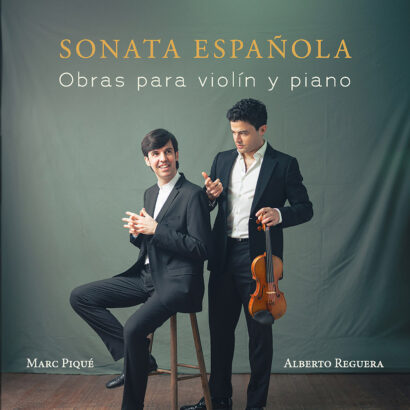
After the conversation I had with Alberto Reguera (violin) and Marc Piqué (piano) for Klassiek Centraal (https://klassiek-centraal.be/niet-zomaar-een-ansichtkaart-uit-spanje-alberto-reguera-en-marc-pique-over-hun-cd-sonata-espanola), I listened to their recording Sonata Española repeatedly. What initially seemed like a solid introduction quickly grew into a cd that gains in expressiveness with every new listen. That was reason enough for me to revisit it in greater detail.
The programme presents a series of thoughtfully chosen works by Gaspar Cassadó (1897–1966), Joaquín Turina (1882–1949), Manuel de Falla (1876–1946), Xavier Montsalvatge (1912–2002), Pablo de Sarasate (1844–1908) and Eduard Toldrà (1895–1962), repertoire that is virtually never performed in our region but in this interpretation comes together in a remarkably natural way. There is no search for contrast for contrast's sake, but rather for a fairly consistent, stylistically coherent approach to the Spanish idiom. Reguera and Piqué proceed from a clear shared vision that remains audible throughout: clarity of structure, refined phrasing and a carefully maintained balance between both instruments – something that also became evident during our conversation, when both musicians emphasised the importance of that intense listening to each other, for them the essence of chamber music.
This results in a recital that feels natural from beginning to end. In Cassadó's sonata, the lyrical middle section in particular receives a restrained warmth, while Turina's sonata allows a little more space for a dance-like, rhythmic charge. The build-up of tension is laid out with great naturalness, without ever imposing pressure. Everything remains in proportion, but that certainly does not mean the music is held back here. On the contrary, it is precisely that restraint that creates a calm but constant tension that carries the whole convincingly. The piano does not fade into the background but functions as an equal partner, which gives the dialogue clear added value.
Manuel de Falla's Suite populaire espagnole forms a particularly strong moment within this cd. The choice for a restrained and controlled approach is followed through consistently and works intriguingly in Nana and Asturiana. There the music receives precisely the right soberness, making the lines come through even more clearly. The result is an interpretation that does not seek effect, but inner expressivity, and precisely because of that becomes stronger as it develops.
In Montsalvatge's Paráfrasis concertante a more playful and rhythmic character emerges, with moments where virtuosity is more clearly addressed. Yet here too everything remains in fine balance, so that the architecture remains clear and comprehensible. The short works by Sarasate and Toldrà close the programme in a decidedly lyrical atmosphere, with much attention to line and sound. These are miniatures that work remarkably well here and that in this context gain more weight than you would expect beforehand.
What makes this recording so strong is the naturalness with which it unfolds. The conversation with the musicians left a strong impression, particularly of their drive to give this lesser-known repertoire a contemporary yet respectful sound image, but it is only upon repeated listening that the recording fully opens up and reveals its internal logic. The balance between both performers, the meticulous attention to detail and the consistent stylistic choice make this cd gradually reveal itself as a particularly well-balanced and rounded whole, that does not display its qualities but quietly unfolds them.
Sonata Española is a remarkably successful and stylish recital in which Reguera and Piqué opt for clarity, balance and subtlety over effect. The result is a thoughtful, mature cd that convinces naturally and gains strength as it progresses. Not a postcard from Spain, but a musical space in which light and shadow continually meet each other – and one that rightfully deserves a fine place in everyone's cd collection.