
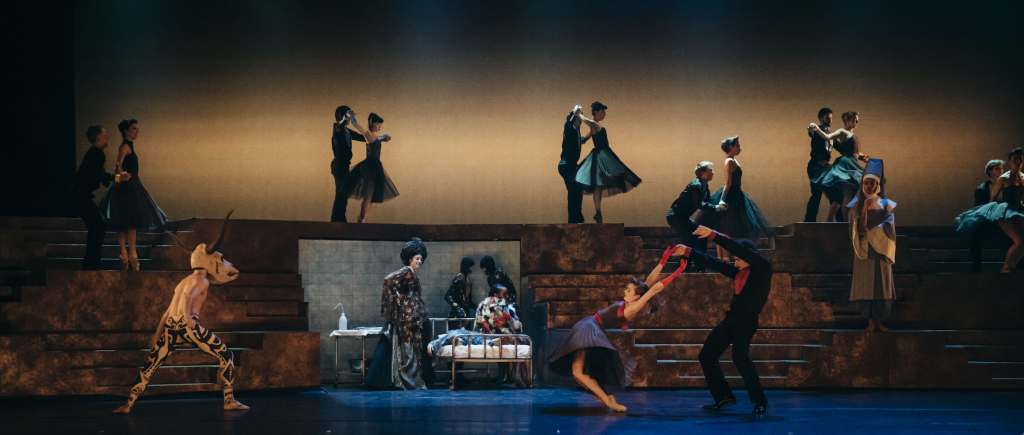
Opera Ballet Vlaanderen, a favored meeting place, is delighted to bring the great ballet classics with a facelift. Artistic director Sidi Larbi Cherkaoui deliberately seeks out choreographers who create a new, fresh version of the classics. He invited the promising Argentine choreographer Daniel Proietto to create an update of La Bayadère by Ludwig Minkus, specially for Ballet Vlaanderen's 50th anniversary.
Origin and new context
La Bayadère (The Temple Dancer) is one of the showpieces of the classical ballet repertoire and was first performed by the Imperial Ballet at the Bolshoi Theatre in St. Petersburg in a choreography by Marius Pepita on February 4, 1877. The ballet combined the exotic setting of 19th-century India with the remarkable virtuosity of Russian ballet technique. The original story tells of the forbidden love between a temple dancer and the warrior Solor.
Choreographer Proietto relocates the story to the 21st century and contemporary India, highlighting the West's neocolonial gaze upon the East. Structural factors such as social and cultural norms. The bayadères still exist in India but have lost all social status. The bayadère in RASA is a genderfluid prostitute who encounters the boundaries of a misogynistic world. The ballet thus takes on a completely new coloring. It highlights phenomena such as gender, community, isolation, and power relations. Which results in a complete contrast with the original work. Between past and present lies an enormous gap. You cannot erase the social order of the 19th century. The attempt to call this production a 'contestation' is far-fetched.
In his choreography, Proietto combines techniques from classical ballet with elements from traditional Indian dances and contemporary movement.
Swedish composer Mikael Karlsson wrote a completely new score with different types of music and influences from all corners of the world. It is performed live by the Casco Phil Orchestra conducted by Benjamin Haemhouts. A good match: the dramaturgical analysis fed the musical interpretation and vice versa. A surprising appearance is the apostle of the ballad Guido Belacanto who performs as a tuk-tuk driver. With his long gray locks, he is the embodiment of a wise man who has gained insight into the winding paths of love through his life experience. The monumental staircase spanning three different heights with small plateaus in between offers many opportunities for play and dance. The costumes by fashion designer Tamai Hirokawa are worth seeing.
Performance
Giving a ballet content, tension and relaxation, resistance and compliance, cultural backgrounds in a connected vision is an extremely difficult task. Daniel Proietto wants to do it too well. When it comes to performing arts, we live in an age of hybridization, mixed forms, and crossovers, and there is nothing wrong with that—it is usually enriching—but the audience comes to watch a ballet mainly to enjoy dance.
Part One
This young choreographer pulls out all the stops and goes into overdrive. It is a tired cliché, but less is more. The story is drawn out endlessly and fragmented into anecdotes and a mishmash of styles to give the whole some lightness. The robotically moving nurses, the raging Queen Victoria and Empress of India (Zoë Ashe-Browne) being wheeled around in a wheelchair, the constantly ranting Faker in a rhetorical flood (Matt Foley). It becomes somewhat of a pastiche. The action and storyline jumps from here to there like a ball in a pinball machine. Yet there are beautiful scenes among them, such as the duet between the street boy Nicky who struggles with his gender identity (Daniel Domenech) and Solor danced by the charismatic Cuban guest dancer Osiel Gouneo in an intimate, intense interaction. Touching is the small street urchin who tries to seek education and be noticed in society. There is also a skillful duet between Solor and Gamzatti (Nicha Rodboom), who are forced to marry. Solor reacts coldly and dismissively, Gamzetti submissively. Only at the end of part one is there real dancing in an explosion of zest for life and the whole takes on a cabaret-like character.
Part Two
Choreographer Proietto cannot completely break free from the original work. The 'Kingdom of Shadows' receives a particularly intriguing and hallucinatory interpretation from him. Solor wanders lost among the white shadows, a technical feat and an aesthetic experience. It looks metaphysical. The figures wander lost in the borderland where shadows move like waves in a haunting storm of images. The dead and the living brush past each other in their comings and goings, and the present and past touch and overlap.
Part Three
In this final scene he pulls out all the stops once more with a water sequence in which star dancer Osiel Gouneo shines. Again, an abundance of images: a prancing elephant, bulls, monkeys, dancers with little wings, strongly stylized Indian dance, exuberant Bollywood dancers in the water sequence, everyone gets a place on stage in an eclectic mix. Solor is alone in the crowd. Gradually the stage empties. What remains are a few beggars among whom Solor wanders and brings the audience back to the opening images. The circle is complete.
The audience no longer sees a 'ballet' but a gesamtkunstwerk that has resonance and aims to appeal to and move people on a spiritual, intellectual and emotional level. However, choreographer Proietto does not entirely succeed in this. The whole thing slips through your fingers like water, lacking tension and sparkle. The audience left wanting more, which was evident in the felt but not directly enthusiastic applause. This young choreographer undoubtedly has talent but is still searching for himself and wants to display too much. Nothing but praise for the dancers of Ballet Vlaanderen.
- WHAT: RASA (after La Bayadère)
- WHO: Ballet Vlaanderen,
- CHOREOGRAPHY: Daniel Proietto
- COSTUMES: fashion designer Tamai Hirokawa
- MUSIC: Mikael Karlsson (composer), Casco Phil Orkest conducted by Benjamin Haemhouts
- PHOTOS: © Filip Van Roe
[embed]https://youtu.be/l_bFzWUxdXs[/embed]
[embed]https://youtu.be/oIibjUnG9_E[/embed]