
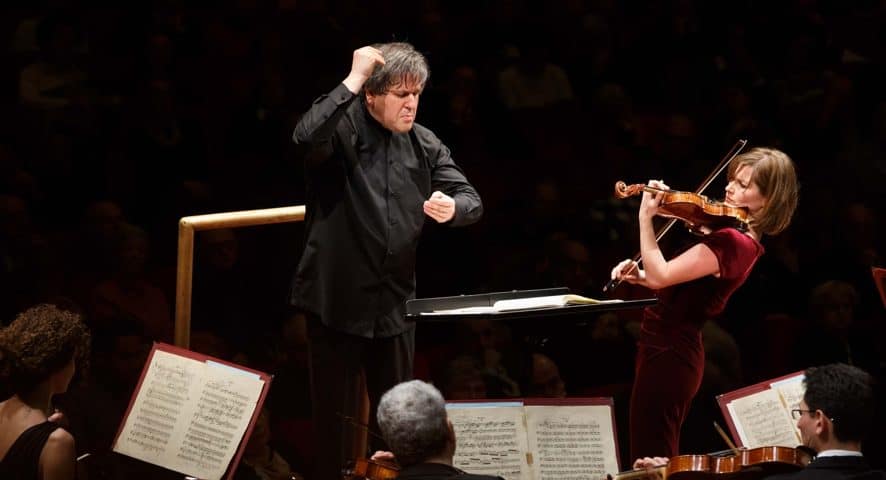
The Accademia Nazionale di Santa Cecilia came on its tour with chief conductor Antonio Pappano to the Philharmonie in the German city of Essen. Not too far away and especially fascinated by Pappano's increasingly dramatic approach, we went to listen to the original programme, which also featured star violinist Lisa Batiashvili. As expected, the trip was well worth it.
The programme opened with Modest Moessorgski's Night on a Bare Mountain. The symphonic painting of the witches' sabbath on the night of St. John, from 23 to 24 June, immediately gave the orchestra the chance to depict the wild witch dance in all its violence. Shrill wind instruments take on brilliant strings. Incantatory chords and harsh timbres create a demonic effect, which the orchestra brought across with great energy and conviction. A successful overture.
Béla Bartók's first violin concerto strikes a more sensitive chord. Bartók composed it between July 1907 and February 1908, when at twenty-six years old he had fallen head over heels in love with the seven-years-younger Stefi Geyer. The concerto is dedicated to her and is at the same time an idealized portrait of the violinist. He regarded the first movement (Andante sostenuto) as an intimate portrait, the second (Allegro giocoso) as an expression of her self-assured and extroverted character traits, while a third movement was to suggest the cool, distant Stefi Geyer. However, that third movement never came about, mainly because Bartók experienced the music as very direct while Stefi had meanwhile broken off her relationship with Bartók. As an additional consequence, the manuscript was not released until after her death and the two-part concerto only had its premiere in 1958 after the deaths of both.
Impressive Simplicity
In this pure confession concerto, Bartók's interest in harmony and rhythm based on folk music shines through gently. But the main tone is certainly still set by the sensitivity and lyrical longing of the love theme. Lisa Batiashvili was a perfect and deeply felt advocate for it. The soloist opens the concerto alone, with a motif full of longing that is gradually framed by the strings, which Pappano with his sublime precision gestures encourages into a tender cantilena and lets grow into a climax. At the end of the movement, Batiashvili astonishes in the highest register with the expressive repetition of the Stefi motif. After the warmth and lyricism of the first movement, the merrier and jovial second movement is a homage to Stefi's virtuosity. Batiashvili convinces with a solid and assertive approach, in which here and there the folk music elements ring out clearly in the dialogue with the orchestra. Orchestra and soloist were clearly on the same emotional wavelength. Batiashvili's presence – in an elegant black-silver-grey dress – was of a simplicity that made an impression. A concerto that manifestly requires excellent interpreters like this one to come into its own in all its intensity.
With Scheherazade, the symphonic suite based on One Thousand and One Nights by Nikolai Rimski-Korsakov, we enter a fairy-tale world in which the orchestra tells scene after scene. Scheherazade is the princess who manages to use her charm and especially her storytelling skills to cure the sultan of his wicked habit of killing his bride each night only to choose a new one the next day. Her story captivates the sultan so much that she must continue telling, for one thousand and one nights. This way she stays alive and heals him of his madness. The colourful orchestral world of this symphonic work inspires Pappano to let his orchestra sound like a storyteller. The fairy tale from One Thousand and One Nights, which Korsakov based his work on, is beautifully introduced by the motif of Scheherazade in the violin solo. Gradually each orchestra section takes over the theme, until it sounds in the full orchestra. This happens so seamlessly that it creates a suspenseful effect and draws the listener into the story. Each movement paints with characteristic instruments (clarinet, flute, harp) and motifs the episode being told: the storm at sea, the meeting with Prince Kalender, the lyrical Andantino passage of the prince and princess, the feast in Baghdad and the shipwreck. The Accademia perfectly conveys the magic and Oriental atmosphere of the work, and the repetition of the beautiful Scheherazade motif in violin and harps at the end brings all the rhapsodic elements to a delightful conclusion.
The hall at Theater und Philharmonie Essen was not completely full. But the discerning audience that was present thanked the Accademia Nazionale di Santa Cecilia and its chief conductor Antonio Pappano with enthusiastic applause.
- WHAT: Modest Moessorgski (1839-1881) – Night on a Bare Mountain | Béla Bartók - Violin Concerto No. 1 (Sz 36) | Nikolai Rimski-Korsakov (1844-1908) - Scheherazade (opus 35)
- WHO: Lisa Batiashvili (violin), Orchestra dell'Accademia Nazionale di Santa Cecilia conducted by Antonio Pappano
- WHERE: Theater und Philharmonie, Essen
- WHEN: Friday 24 May 2019