
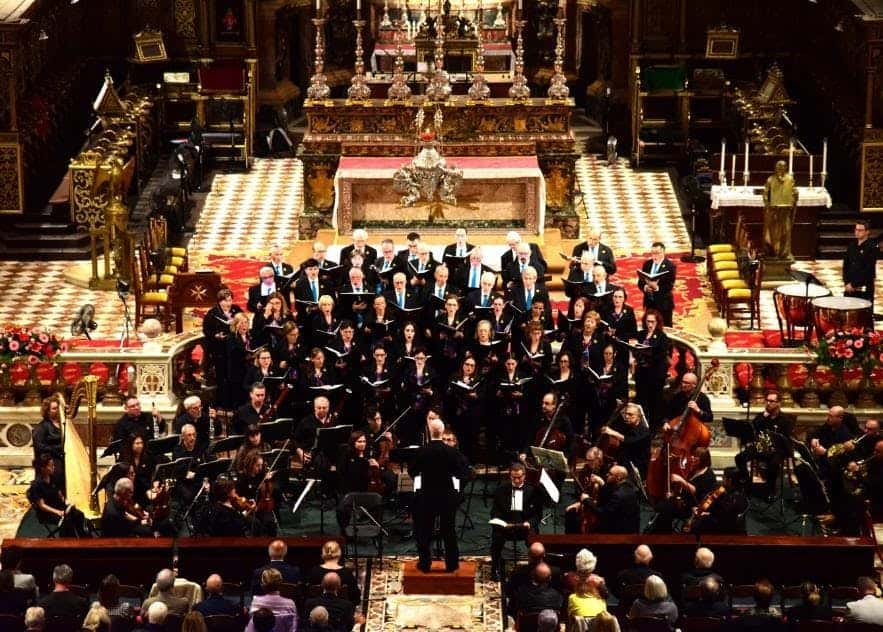
On Saturday, August 30, the Antwerp Sint-Jacobskerk received distinguished visitors from Malta. The St Paul Choral Society, a choir with an impressive international track record, presented a concert that extended far beyond mere musical aesthetics. A subtle yet palpable resonance emerged between sound, space, and devotion.
Since its founding in 1998, the ensemble has grown into one of Malta's leading cultural ambassadors. Under the direction of Hugo Agius Muscat – physician and musician – and with Elisabeth Conrad at the organ – doctor in environmental sciences and versatile musician – the choir presented itself as a committed collective, rooted in tradition yet with an open gaze toward the world.
The program was clearly structured in three parts and encompassed music from the 16th to the 21st century. Although the choral sound was not always impeccable in terms of intonation, the performance convinced through genuine commitment and expressive power.
Polyphony and Devotion
In the first, a cappella section, two works by Giovanni Pierluigi da Palestrina (1525–1594) stood out particularly. His masterful motet Sicut cervus, based on Psalm 42 – As a hart longs for living water – flowed like living water itself. The music movingly embodied the thirst and devotion of the psalm text. The choir sang with simplicity and measured breath – each voice found its place in the greater whole.
Loquebantur variis linguis – a musical evocation of the Pentecost story – received a fiery performance. The lively counterpoint and rhythmic drive gave the work something ecstatic, as if each of the voices spoke its own apostolic language converging in one common profession of faith.
Very different, yet equally moving, sounded Ubi caritas by Maurice Duruflé: Gregorian reborn in a harmonic fabric of tenderness. The restrained performance honored the essence of the text: love and mercy as the source of divine presence.
A surprising highlight: the organ
After this meditative section came a surprising intermezzo. In many choral recitals, an organ solo feels like an obligatory piece, but here it became an unexpected highlight. The organ of the Sint-Jacobskerk – a historic Snetzler instrument from 1777 – was discovered by the Agius Muscat couple during a preparatory visit to Antwerp. Specially for this concert, conductor Hugo Agius Muscat and organist Elisabeth Conrad performed the three-part Duet for Organ in C major by Samuel Wesley (1766–1837): a playful, stylish work with a clear nod to Bach.
What sounded was pure dialogue: two voices finding each other in interplay, ornamentation, echo, and contrast. The fugue in the closing section was a masterful display of color, with the organ registration bringing to life trumpets, flutes, and regal clarity. A rare refined moment that made visible the musical and human connection between the two performers.
A hidden story: how this Snetzler organ came to be here
Since late 2017, the Antwerp Sint-Jacobskerk has possessed a third organ, alongside the Charles Anneessens organ and the Forceville/Devolder organ. This instrument found a new home after serving for years as a centerpiece in the music salon of notary Baudouin Cols, a well-known Antwerp art lover. In his residence, house concerts regularly took place in which this organ played a prominent role. After his death and with the planned sale of the house, his daughters searched for a new location – with the clear wish that the organ would retain a public function. This performance proved how valuable that choice was. Hopefully we will hear more interesting programs on this instrument.
Choir and organ in harmony
In the third part of the program, choir and organ merged. Particularly noteworthy was the focus on Marian works. After restrained pieces by Camille Saint-Saëns (1835–1921) and Gabriel Fauré (1845–1924) came three compositions from Maltese soil, the first two conducted by assistant conductor Cecilia Agius Muscat.
For many in the audience, this was a first acquaintance with composers such as Francesco Azopardi (1748–1809), Carmelo Scerri (1905–1981), and Hugo Agius Muscat (b. 1961) himself. One solid, heartfelt work after another, underscoring the power of cultural exchange – for recitals by foreign ensembles always open new windows.
The concert ended festively with I cieli immensi narrano by Benedetto Marcello (1686–1739), a Baroque work full of Italian rhetoric and theatrical flair. The rich acoustics of the church and the warm sound of the choir made it a fitting and convincing final chord.
A musical pilgrimage in one's own city
The Sint-Jacobskerk is increasingly establishing itself as a hotspot for international choral music. After English ensembles in July and this Maltese choir at the end of August, a Swedish choir is scheduled for Saturday, October 4. Thus emerges a musical pilgrimage through Europe – right in the heart of Antwerp. A city that listens, welcomes, and gives resonance to the world.