
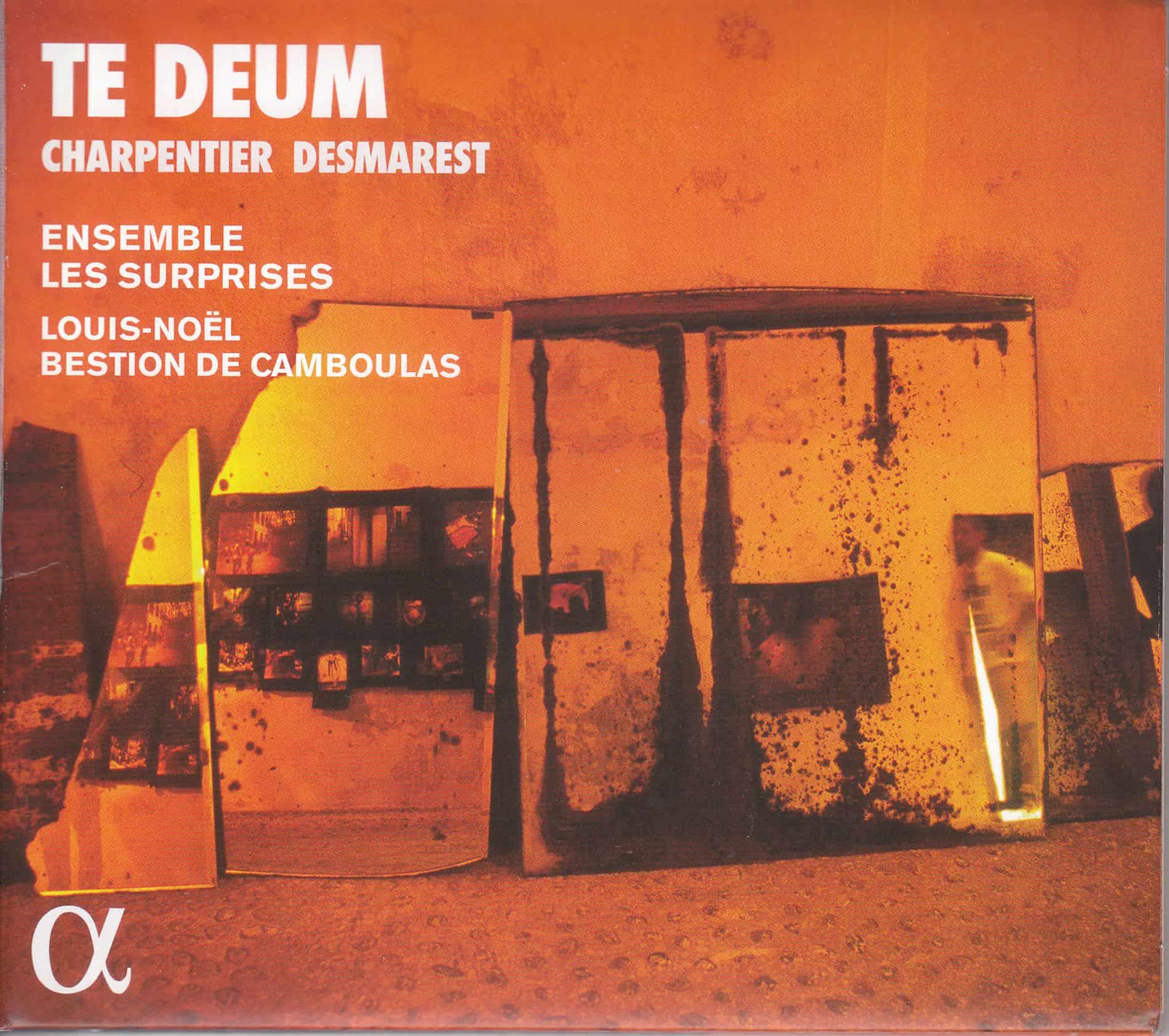
The Te Deum as a hymn of praise to God, but also as an invocation of Christ the Saviour and as a plea for mercy, thus the content of this hymn dating from the fourth century which is attributed to Saint Ambrose, bishop of Milan and which appears in all sorts of settings. In the rite of the Roman Catholic church the Te Deum plays an important role, forms part of many liturgical celebrations, but also appears in processions or at special occasions
It is an inspiring text that has appealed to many composers, including great names such as Berlioz, Bruckner, Händel, Haydn and Verdi. And thus also Marc-Antoine Charpentier (1643-1704) and Henri Desmarest (1661-1741), two French contemporaries who on this new album are each represented with a Te Deum as a 'grand motet'.
Certainly in the France of the 'ancien régime' the Te Deum fulfilled an important function in court circles around Louis XIII and later Louis XIV, both from the perspective of the text and from that of the music, both directed unanimously at what the reigning kings in those times needed most: fear and awe, among the notables and the lower echelons. The Te Deum, naturally in grand format, more than adequately met this requirement, with soloists, choir and orchestra. The surviving music gives us a representative picture of this.
But even outside the church walls the Te Deum proved its excellent services, regardless often of the occasion: even when there was something military to celebrate or commemorate the Te Deum served as an almost ideal atmosphere-maker; and all the more so if it was well composed. In court circles the Te Deum was even indispensable at the most varied ceremonies, such as those surrounding birth, marriage, illness, jubilee or coronation. In the cloisters, on the other hand, the hymn was identified with simple Gregorian chant, or elsewhere in villages and towns no less soberly after, for example, the pronouncement of a royal or episcopal proclamation. That was the hymn in its purest form, without any frills.
The two 'grand motets' recorded on this cd are occasional works that may be regarded as specimens of the vocal and orchestral splendour that was so much appreciated in and around the palace of Versailles. No wonder, for the hymn text gave composers all imaginable scope to pull out all the stops and on that almost 'golden' rule Charpentier and Desmarest were no exception; as was also the case for composers such as Lalande, Lully, Bernier, Gilles, Destouches and Campra.
Of the oeuvre of Desmarest (little is known of him) it can be said that it remained discographically undernourished for decades, but that fortunately a turning point has come in recent years, including recordings of a number of operas and 'grands motets'.
Desmarest can boast of a successful escape attempt to evade the death penalty. Shortly after the death of his wife he had fallen in love with a minor pupil (possibly the relationship had existed longer), after which a legal struggle broke out that forced teacher and pupil to hastily leave the country. The first destination was the safe Brussels, after which course was set for Barcelona, where Desmarest – and with him many French musicians - entered the service of Philip V. Until that too came to an end after the Spanish king, during a stay in Italy, had been so impressed by the Italian musical style that upon his return he promptly banned the French style established at the Spanish court, thereby at one stroke rendering the French musicians unemployed. Desmarest too had to pack his bags, but did not become destitute, for Lunéville, not far from Nancy, was beckoning, the seat of Leopold I, the Duke of Lorraine. At his court awaited him the position of 'surintendant de la musique'.
Desmarest's first Te Deum (1687) was intended for a special ceremony, as a hymn of praise for the speedy recovery of the king after a painful fistula had been removed from his majesty. At such an occasion the Te Deum was a musical fitting. The second setting (with the addition 'de Lyon'), which is heard on this album, must have been composed between 1713 and 1727, when Desmarest was in the service of the Duke of Lorraine.
The bringing together of the two Te Deums (Charpentier, incidentally, wrote no fewer than six!) proves to be an excellent choice not only because of the similarities with regard to instrumentation, but also because of the always fascinating interplay between solos and choir-tutti in this decidedly unusual ripieno setup. As for the works themselves, what strikes one especially is the technical mastery and their inspiring sparkling character, aspects which are in excellent hands with Ensemble Les Surprises under the direction of Louis-Noël Bestion de Camboulas. No more than that, for instrumental and vocal colouring and precision are just a fraction less sharply profiled than with ensembles such as Les Arts Florissants, Le Concert Spirituel, Pygmalion or Les Talens Lyriques. Against this is the fact that there is imaging and plastic musicianship and that the contrast treatment bearing witness to good taste and insight lends extra lustre to these interpretations. The fractionally over-bright vibrato of some vocal soloists fortunately detracts little or not at all from the whole, which naturally bears the stamp of historicising performance practice. The atmospheric recording rounds off the whole nicely.
This release is particularly interesting because this is the first recording of Desmarest's Te Deum