
With a new production of I lombardi alla prima crociata, the ORW presents us with a rarely performed opera by Giuseppe Verdi. A compelling opportunity to discover this work.
Verdi could boast of the overwhelming success that Nabucco had brought him and immediately received a new commission from the Scala in Milan. Temistocle Solera, – regarded as the librettist of Verdi's "patriotic" operas – chose I Lombardi alla prima crociata drawn from the romantic poet Tomaso Grossi, contemporary and friend of the better-known author Alessandro Manzoni. (I promessi sposi). He gave each act an appropriate title.
Private intrigue in political context
The plot revolves around two brothers, Arvino and Pagano, who are both in love with the same woman. Viclinda marries Arvino. Pagano is banished as punishment for an attempted murder of his brother. The father of the two brothers is also a victim of hatred and revenge. This prehistory, told in the first act, gave Verdi the title: "La vendetta". The opera then takes place in Antioch, near Jerusalem. The daughter of Arvino and Viclinda, Giselda, has ended up in a harem of the Saracens and has fallen in love with Oronte. Pagano lives in a nearby desert as a hermit ("L"uomo della caverna") to atone for his crimes. The Lombards led by Arvino approach as crusaders. Oronte is wounded and Arvino curses his daughter. Pagano baptizes Oronte who dies as a Christian. ("La conversione"). In the final act (Il santo sepolcro), there is no drinking water left. Giselda has a vision in which Oronte shows where they can find water. The crusaders resume the battle and attack Jerusalem. Pagano is mortally wounded. Arvino grants him forgiveness. As the crusaders triumphantly enter Jerusalem, Pagano dies.
Typically Verdi, the pseudo-historical scenes form the framework for a harrowing family story. It is Verdi's fourth opera and the epic dimension delivers gripping musical scenes and beautiful choral passages. After the success of the famous chorus Va Pensiero from Nabucco, in the context of the Risorgimento the hope for a united Italy was rekindled. Verdi indeed struck a sensitive patriotic chord again, as Italians identified themselves with the crusaders who had to be liberated from the Saracens – in their case the Austrians.
Sober decor serves individual tension
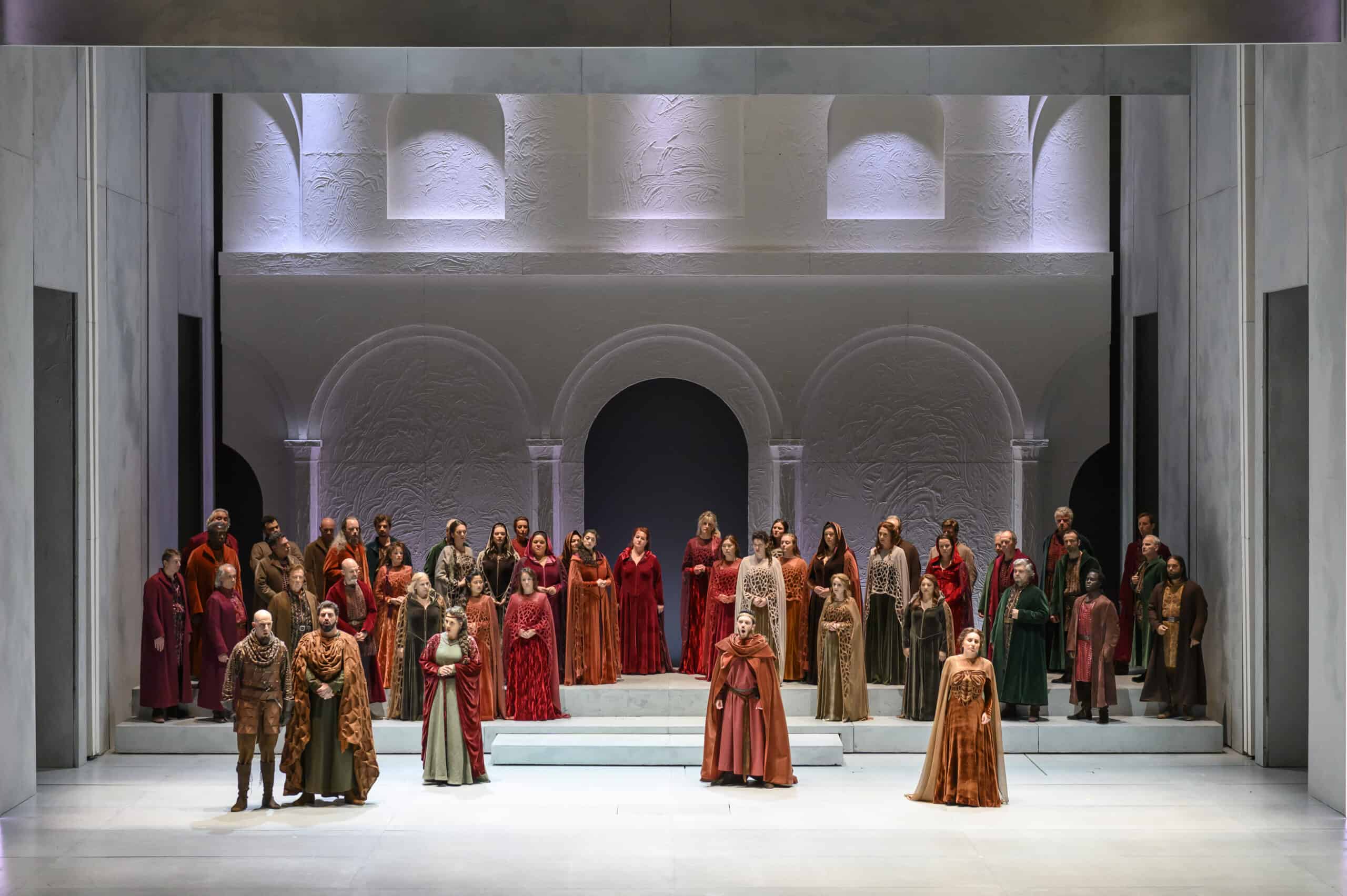
Director Sarah Schinasi opts for a sober staging in which she deliberately keeps the decor timeless. It consists of geometric gray surfaces that slide over each other as needed to create the necessary space. The classical arches in the first act suggest an ancient tragedy. The large choral passages unfold like an impressive Greek chorus. Giselda's chamber is like an inserted private space, the hermit Pagano's cave a suggestion of rock. The flat space gives a constant unity to the scenes, with the characters receiving absolute focus. The costumes in the production allude to the time in which the story takes place with veils and turbans. The props are quite simple and sometimes bordering on cartoonish, such as the curved swords wielded by the Saracens. The small column on which Giselda sings her very beautiful aria No!No! giusta causa non è d'Iddio at the end of the second act also seems rather simple. It aligns with the director's idea that Giselda brings a message of unity and peace: "comme une figure mythologique de grande prêtresse" (quotation from program booklet) and as an individual transcends political boundaries.
The crusaders are not presented as heroes, but as characters with human flaws. In the comic strip-like simplicity of the scenes, the focus in the opening scenes falls on the tension between the brothers Pagano and Arvino with the tragic murder of the father. Through the emptiness, one feels Giselda's fear in the foreign environment among the Saracens. Her gradual trust in Oronte is portrayed credibly and their long duet of rapprochement and love confession is therefore one of the most gripping moments of the production. The vocal performance of both Salome Jicia and Ramón Vargas contribute essentially to this.
Gripping musical scenes
Already from her opening aria Salve Maria it became immediately clear that Salome Jicia possesses the pure voice and perfect legato of an authentic bel canto soprano for this role, with which Verdi still stays very close to the typical bel canto style while at the same time requiring dramatic power from his protagonist. The long duet with Oronte proves that brilliant coloraturas pose no problem for her and that she simultaneously brings dramatic tension to her voice. In the final aria with its madness-like vision, she stretches her voice to extremely high notes that she holds flawlessly. A magnificent performance. Ramon Vargas is a worthy partner who defends his love with a radiant voice but conveys the changing emotions with less vocal nuance and lacks somewhat in tenderness and poetry. The other performers are also well cast, with the lighter voice of Matteo Roma as Arvino as second tenor and Goderdzi Janelidze as the determined Pagano. The large choral parts are excellently executed. The orchestra's fine performance deserves special mention. It is crystal clear that Daniel Oren proves himself as a convinced advocate of this early Verdi opera. He spurs the orchestra with mime and gesture to unceasing attention and engagement—and with results! Yet he also allows space for lyrical passages from the strings and poetry from the flute, harp and clarinet in the love duet. The violin solo in the third scene is like a miniature violin concerto and underscores the sadness of the beloved Oronte's death. Oren rightly invited the violinist on stage for the justifiably exuberant final applause. A performance that offers the opportunity to appreciate this scarcely known opera at its true worth.
WHAT:Giuseppe Verdi I Lombardi alla prima Crociata
WHO:Daniel Oren, conductor Sarah Schinasi, director With: Salome Jicia, Ramon Vargas, Matteo Roma, Goderdzi Janelidze
WHERE:Opéra Royal de Liège
WHEN: