
Pikovaïa Dama is together with Evgeni Onegin one of the best-known and most popular operas by Piotr Ilitch Tsjaikovski. The passionate love of the aristocratic girl Liza, thwarted by the gambling obsession of Herman, a man of lower standing. Tsjaikovski based his opera on the eponymous novella by Poesjkin and wrote the libretto together with his brother Modest. The opera premiered at the Mariinski Theatre in 1899.
Director Maria-Lambert-Le Bihan rightly places great emphasis in her production on the aristocratic milieu in which the tragic love story unfolds. Unfortunately, that setting requires so much attention that the essence of the tragedy between the protagonists sinks into anecdote. The performance opens with the evocation of a celebration in a country garden, with charming scenes, with the choir of children playing soldiers naturally having an immediate strong effect (and naturally reminiscent of the children's choir in Bizet's Carmen). Unfortunately, from this first scene onwards, the focus is too little directed at the characters around whom the piece revolves: Lisa, Herman and Yeletski. Herman is passionately in love with Lisa, but because he is not of the same station, he feels compelled to accumulate wealth to have a chance. His rival is Yeletski, Lisa's official fiancé. In the first two acts of the opera, the character direction is particularly weak. Herman's first major announcement that he is betting on cards he simply makes in the foreground of the stage. Also the love duet between Lisa and Herman at the end of the first act is staged very conventionally.
In the second act the masked ball is presented very playfully, with the ballet about Daphnis et Chloë as a play within the play, with costumed sheep that look so ridiculous that the interpretation as a parody of eighteenth-century ballet seems obvious.
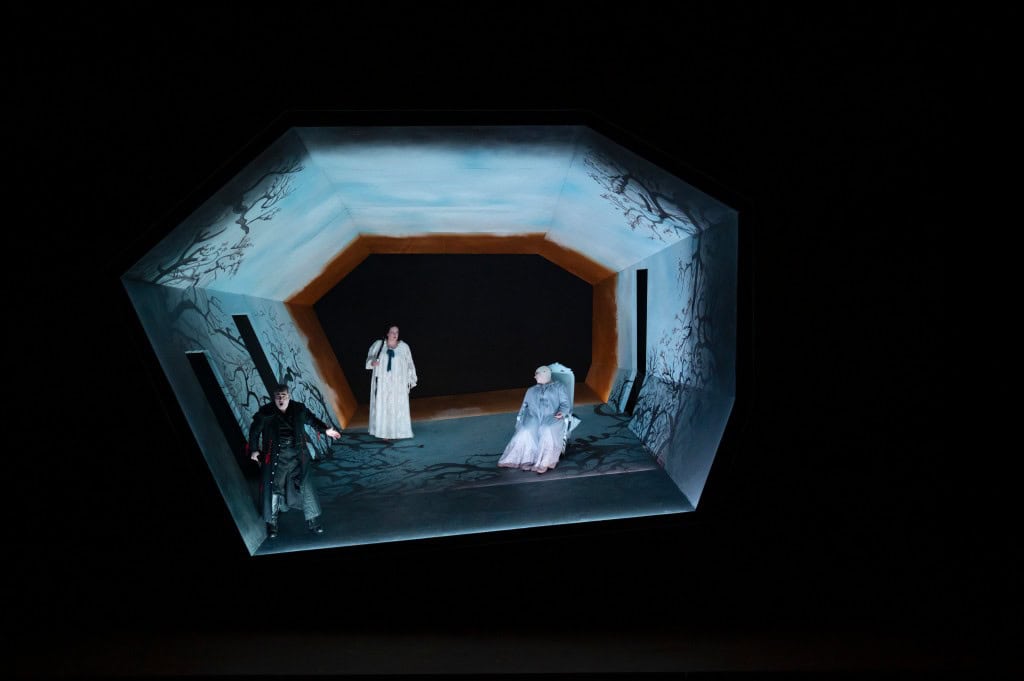
From the second scene of the second act, there is a real directorial break. Suddenly the complete scene is no longer played, but a heptagonal structure is placed on the stage. Within it the core of the opera unfolds. The walls of the structure are painted with a deathly, bare tree structure, as a symbolic reference to downfall and death. In that room he meets the old countess, grandmother of Lisa, who has the secret of three winning cards (Tre karti). In this enclosed scene it is only about Herman and the countess. But when Herman tries to wheedle the secret out of her, the countess dies. Herman only learns the secret of the three cards when the countess appears to him again as a ghost. The directorial device of the enclosed frame makes this confrontation particularly sharp and moving. Also the rejection by Lisa because of his obsession is now bitterly tragic.
It is unfortunate that the director then returns to the anecdotal nature of the drunken soldiers' life for the final gambling scene, in which Herman loses his chances and also his beloved, who kills herself. The suspense of the wrong card is unfortunately too little played out in this context, and even when Herman takes his own life, the scene hardly grips.
Giampaolo Bisanti unites aristocracy and fate
In Pikovaïa Dama we recognize on the one hand Tsjaikovski's talent for depicting the social context in which the story takes place. There is the aristocratic atmosphere but also the rural nature of the opening scenes or the exuberance of the drunken gamblers in the final scene. On the other hand, his great art is the precision of the psychology of the protagonists. For this the arias of Liza and Herman are of course exemplary, and certainly the passage with the sinister appearance of the countess. Bisanti's top priority of absolutely performing this opera in the ORW he has magnificently realized here. He guides and drives the orchestra to the most moving passages, but equally to emotional intimacy. The motif of "tri karti" immediately takes on something ominous as soon as it sounds in the first scene. The soloists manage to totally immerse themselves vocally in their roles. Olga Maslova has a clear, especially powerful voice as Liza, though we would have liked a bit more nuance at times. The same applies to Arsen Soghomonyan as Herman. The loudness of his voice sometimes makes it monotonous and thus prevents conveying the richness of emotion. Olesya Petrova was a good Grafinya, but not the most impressive. Nikolai Zemianskikh made a positive impression as the lyrical Yeletski. The choir, which certainly plays an important role in this opera, was brilliant in every passage.
Despite the somewhat strange nature of the "broken" direction, the performance of this grandiose work by Tsjaikovski made an impression.