
And what Czechs! A real one from Brno, Leos Janacek whom we know quite well from his operas. But there was also Erwin Schulhoff, a Czech who wanted to take lessons with Debussy but couldn't get along with him and let himself be more seduced by American jazzy tones. And then there was the Czech who later moved to the States, Bohuslav Martinu. In that Sunday "Czech That!" programme all three came up for discussion. An expanded Pavel Haas Quartet opened the concert with the String Sextet (1924) by Erwin Schulhoff. You do wonder how that music was received by the concert audience back then and especially how all those sometimes atonal sounds managed to survive until now and remained appreciated. Remarkable indeed. Sometimes soft as silk and then again percussively hard with lightning-fast strings. Quite different from the String Quartet No. 2 by Janacek. A must of course when you're talking about this composer. It bears the subtitle "Intimate Letters". Introducer and Festival director Pieter Bergé told how Janacek wrote more than 700 actual letters to his, admittedly married, beloved Kamila Stösslová. Langorous and passionate it sounded at times, as you might expect from such a musical letter. And also so grippingly played by the Pavel Haas Quartet. It is not the first time this quartet has performed excellently for the Festival. It bears the name of Czech composer Pavel Haas, who perished in Auschwitz. In this first concert there was yet another String Sextet, this time by Bohuslav Martinu. The opening sounded almost like an orchestral arrangement close to a 'standard' from the American Songbook with some swing in between but also atonal touches. And a Lento that is laid out very melodiously and (neo)classically. In the following two sections sometimes vigorous playing together, little solo work but with a lot of unison, almost unison playing by the entire ensemble. Like a pearl of gentleness it sounded.
A very different ensemble came on stage for the second part of the afternoon concert and with different sounds too. Those were I Solisti, an eminently wind band orchestra. But this time the piano of Jan Michiels stood very dominantly in the middle. And for the first work there were also strings, the Concertino by Leos Janacek. Airy animal adventures set to music with sound effects for the hedgehog, the squirrel, a forest owl... A work therefore for prime soloists: horn, bassoon, clarinet but it is the pianist who must hold everything together, at the end supplemented by the strings. A musical joke Janacek called this little work.
And the next work also brought a pleasant note: La Revue de Cuisine by Bohuslav Martinu. Conceived as a ballet but call it a humorous jazz suite where the instruments on stage had to play "kitchen" instruments to settle a kitchen quarrel. And they did that according to different rhythms than those from the classical ballet repertoire, with, among other things, the Argentine tango and the American charleston. But (and to stay in kitchen terms) that sounded rather like a reduction of those popular music styles. It was a nice and amusing parody in any case.
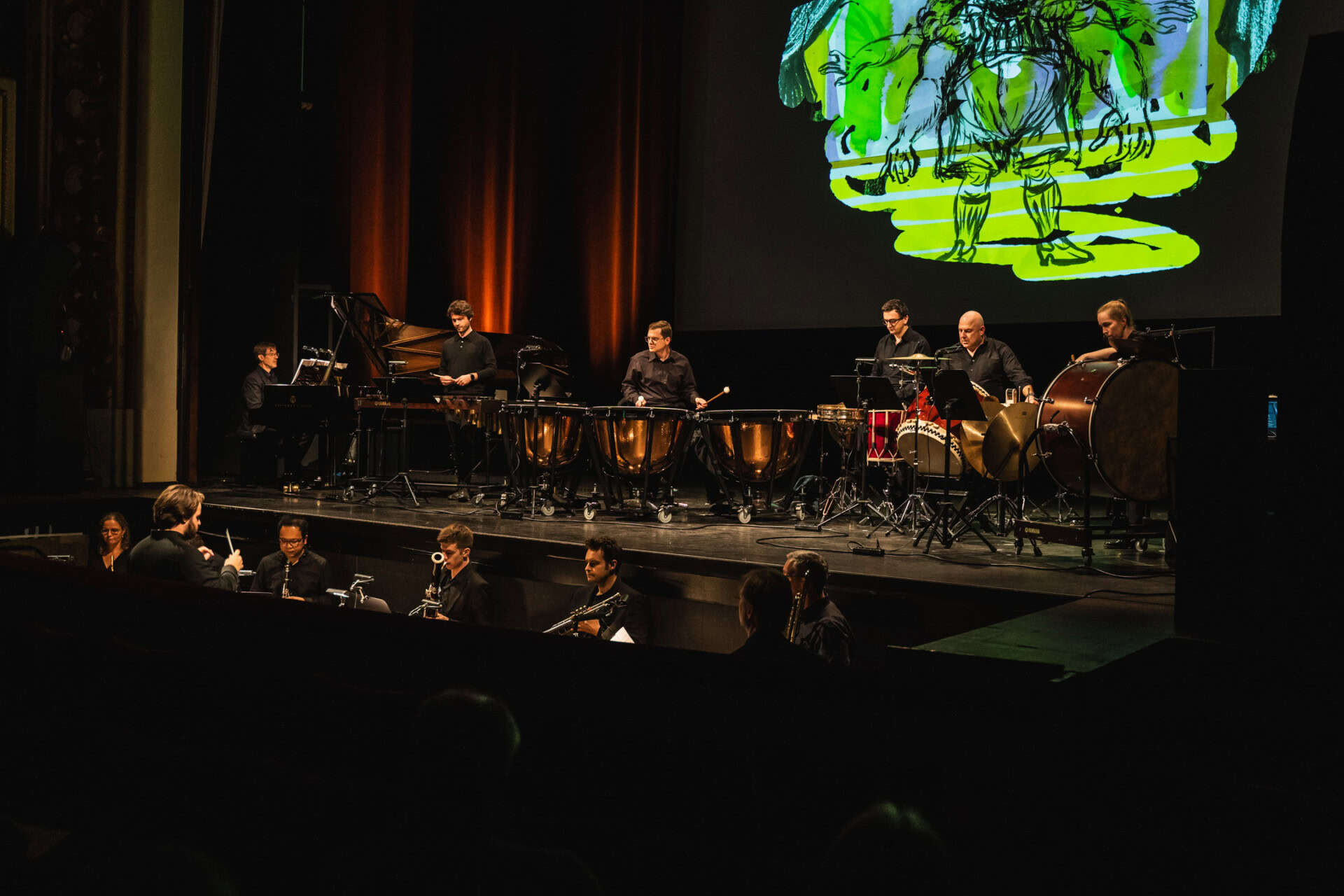
Back to Janacek with yet another airy, playful and cheerful musical piece Mladi (Youth). Now it's the turn of wind instruments only. Still interesting to once only see and hear a group of excellent wind instruments busy, you don't often come across that in a concert hall. Then a break was needed, because more people came onto the stage. That had to be for that sparkling finale, a parody of Le Bourgeois Gentilhomme, Molière's play once set to music by Lully. But now in a version by Erwin Schulhoff. Ballet music was the intention, the outcome was pure dance music. You could still hear Stravinsky in it but even more it sounded jazzy. How could it be otherwise, with 5 percussionists on stage and another 7 wind players in the orchestra pit. And those sounds were all quite contradictory to the names of the sections such as Aria, Sicilienne, Napolitana... Lully was nowhere to be found but the whole thing sounded worthy of Stravinsky. And above them hovered an imaginary Bourgeois Gentilhomme all the time in a video by Gerda Dendooven. So another discovery at this Festival which celebrated its 30th anniversary with a reception. Pieter Bergé presented his Manifesto there which opens with the sentence: "Difficult" music does not exist. Would that also be the case for you? If so, then Festival 20·21 has certainly helped you with that!