
Some concerts sound. Others happen. Some touch the ear, others open the soul. What Maxim Emelyanychev, the Scottish Chamber Orchestra and percussionist Colin Currie brought on Thursday 25 September in BOZAR was more than a performance. It was a ritual – a musical breath between creation and liberation, a journey from sound to revelation, with Ludwig van Beethoven (1770-1827) and James MacMillan (°1959) as guides.
Prometheus awakens – music as becoming
No traditional overture opened the evening, but a moment of creation. Beethoven did not stand on the stage as an exalted hero, but as a primordial force. Die Geschöpfe des Prometheus sounded as if it were being formed on the spot. Emelyanychev conducted not from control, but from imagination. His gestures – light, tentative, sculptural – seemed to free the music from silence. Accents grew naturally, phrases danced. In the three dance fragments (nos. 9, 10 and 16) a subtle dramaturgy emerged: from hesitant elegance to seething tension, to the promise of ecstasy. Prometheus was not punished here, but transformed – not as a hero, but as a human being. La Tempesta, the brief intermezzo, brought no thunder, but reflection. Rain became longing, wind a vague memory. The orchestra breathed as one body. The storm did not unfold outside us, but within – as a heartbeat that coincided with our own.
Veni, Veni, Emmanuel – an enchanting sound ritual
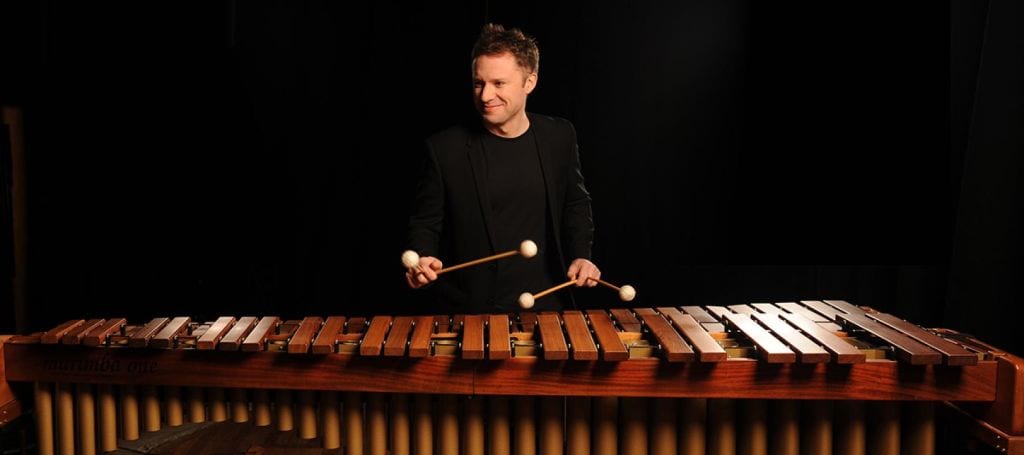
After the hushed storm, the programme descended into something fundamental: the spiritual foundation of our humanity. James MacMillan's Veni, Veni, Emmanuel is officially a percussion concerto, but functions as a sound ritual – no bravura, no spectacle, but intensely charged seriousness. The work, deeply rooted in the idea of Advent, thrums with a waiting that is not still, but tense. Centre stage: Colin Currie. Not a soloist in the traditional sense, but a sound medium – a mediator between earth and transcendence. His instruments – from marimba and vibraphone to gongs and bells – produced not noise, but meaning. Currie did not play, he spoke. Every stroke – however small – had direction and weight. The marimba whispered, the vibraphone glimmered, the drums unleashed something archaic. Rhythm became trance.
Personally, this work touched a nerve. Years ago I heard it for the first time on CD. But the live experience, here in BOZAR, was of another order. What remained abstract in a recording now acquired body and breath. Experiencing Veni, Veni, Emmanuel live is not an auditory event, but an immersion. MacMillan's use of the Gregorian Veni, veni Emmanuel theme is subtle: rarely explicitly audible, it permeates every moment. The structure is living: eruptions follow stillness, expectation builds in waves. In the finale, that theme slowly came to the surface. Currie let the great bells sing, the orchestra rang small bells. The ending was not a climax in the traditional sense, but a portal: an opening to silence, a crack toward the unspeakable.
Beethoven dances – on the edge of light
After MacMillan's spiritual intensity, not rest but rebirth followed. Beethoven, often presented as a granite icon, took on a different face under Emelyanychev's direction: living, rhythmic, earthly. His Seventh Symphony in A major, op. 92, was described by Wagner as "the apotheosis of the dance". But this is no graceful dance – it is rhythm as necessity, as foundation of existence. From the first bars of the Poco sostenuto you felt it: Beethoven breathes. Emelyanychev let the introduction grow from silence, not as a formal opening, but as sound finding itself. The transition to the Vivace was not acceleration, but liberation: an energy that did not become explosive, but continued to flow. Emelyanychev gave that movement breath – not triumph, but rapture. Striking was the rhythmic clarity. Emelyanychev saw rhythm not as a metronome, but as a living organism. The orchestra followed effortlessly. Syncopations trembled, phrasings sounded like muscle contractions of a body in motion.
The famous second movement, Allegretto, became not a funeral march, but a memory. Low-drawn chords formed a rhythmic foundation. The melody that grew from it was hushed, without pathos, sustained by melancholy. The tonal balance was impressive: dark strings held their weight without becoming heavy, while the woodwinds drew gossamer threads of light through the texture. The Scherzo brought capricious vitality: rhythms jumped, pulses thrust forward. Here spoke the Dionysian Beethoven – the composer as impulse, as body, as unbridled energy. The arrangement with double basses at the top created a threatening foundation – a sonic ground that not only supported but pushed. The pastoral Trio became a moment of letting go: breath between eruptions. The finale, Allegro con brio, sounded like ritual. Not heroic apotheosis, but a trance in motion. Emelyanychev kept the tempo taut, but inspired. Energy built up layer by layer – like a fire that burned without consuming.
The texture remained transparent: no layer disappeared, everything sounded. Syncopated bass lines pushed forward, high voices danced like flames. In this performance, flutes sounded unusually bright. This Seventh moved on the sharp edge – between instinct and form, between inspiration and control. What remained after the finale was not victory, but breath. A physical catharsis. Not Beethoven in bronze, but as a living being – dancing on the edge of light.
Listening orchestra, inspiring direction
The Scottish Chamber Orchestra played as one organism: agile, transparent, in constant dialogue. Virtuosity was present, but never self-satisfied. Everything served expression. The encore too – an arrangement of Scottish folk songs – was thoughtful, fresh and witty. A welcome release after the evening's intensity. Emelyanychev conducted not with authority, but with presence. His gestures were suggestions, not commands. He did not breathe life into Beethoven, but revealed him – as the voice of today. And Colin Currie? He lingered on. Like whispering light in memory.
Epilogue – Music as Encounter
Some evenings are more than a concert. They are an encounter: between sound, space, time – and what lies still between them. They ask not for a report, but for presence. What happened on 25 September in BOZAR was precisely that. Not a performance of classical works, but a ritual of music and breath. An encounter between the audible and the unspeakable. Beethoven did not shine as a monument, but breathed. MacMillan did not speak in notes, but opened an inner journey. And Prometheus? He did not steal the fire. He passed it on – from hand to hand, from soul to soul. This evening reminded us why music continues to move us. Not for the sake of tradition or technique, but because it speaks in a language that the heart understands. A language of silence, storm, breath and promise.