
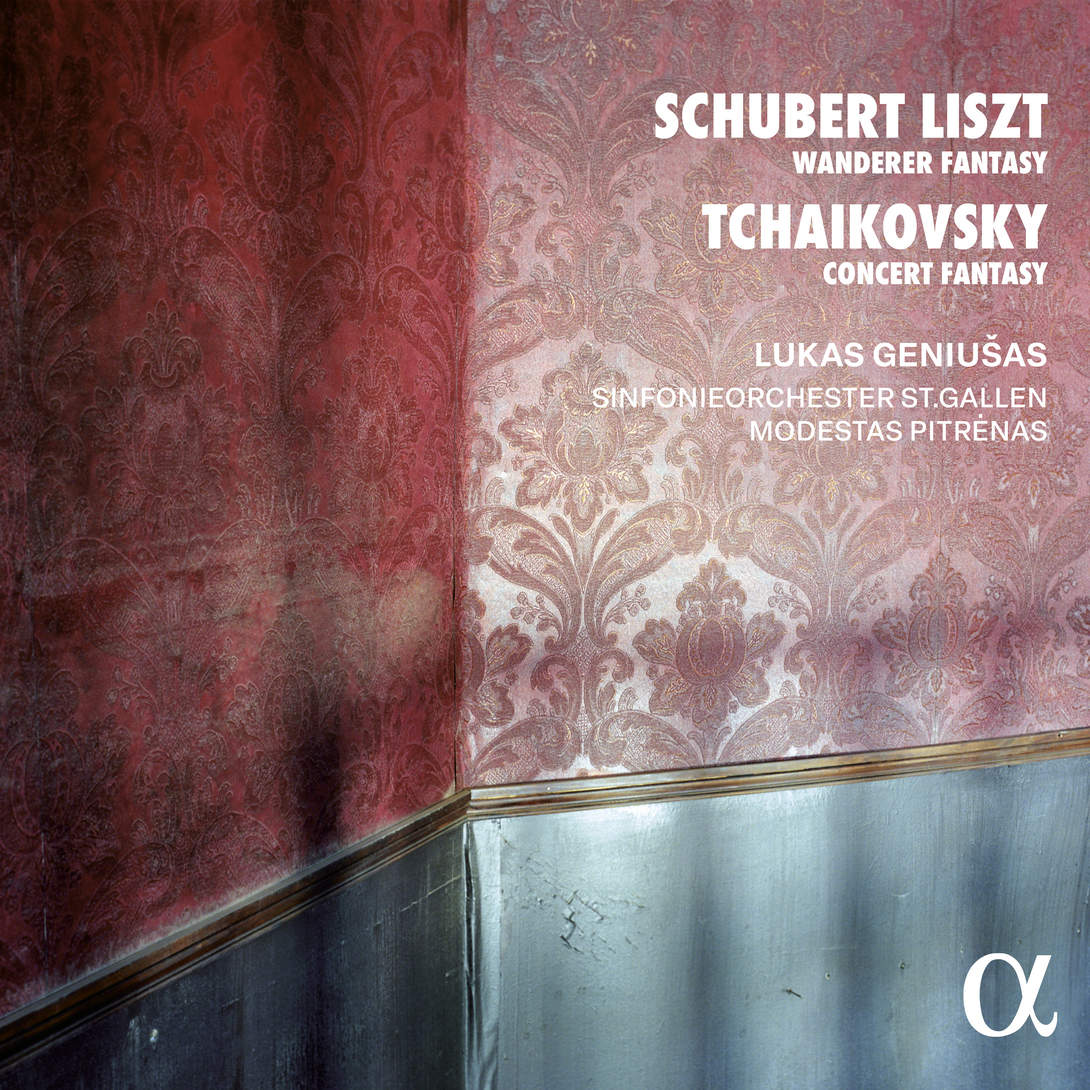
Creating original programming is one thing, making it musically convincing is another. On this Alpha Classics release, pianist Lukas Geniušas (°1990, Moscow), the Sinfonieorchester St.Gallen and conductor Modestas Pitrėnas bring together two works that at first glance appear to have hardly any common ground: the Wanderer Fantasy by Franz Schubert (1797-1828) in the orchestral arrangement by Franz Liszt (1811-1886) and the Concert Fantasy by Peter Tsjaikovski (1840-1893). Apart from their titles, the two works seem to have little in common, but this very contrast sheds surprising light on the divergent meanings the concept of 'fantasy' could assume in the nineteenth century.
Schubert's Fantasy in C, D.760, originated in 1822 from the song Der Wanderer. The well-known melody from the Adagio forms the emotional heart of a work in which four movements flow into each other without interruption. The characteristic long-short-short motif returns in all sections and holds the work together. Liszt saw in it more than a pianistic masterpiece: he recognized a latent symphonic concept in it. His orchestral arrangement from 1851 increases the richness of color and dramatic dimension without doing violence to Schubert's architecture. The result is not a traditional piano concerto, but a fascinating synthesis of Schubert's formal rigor and Liszt's theatrical imagination.
Tsjaikovski's Concert Fantasy from 1884 starts from a completely different aesthetic. Despite its virtuoso allure, it seeks less the romantic adventure than a classical clarity of form. Not by chance did Richard Taruskin describe Tsjaikovski as a classicist within romanticism. The two-part structure, with a substantial Quasi Rondo and the contrasting final section Contrastes, moreover reveals the close relationship with the orchestral suites from the same period – the material was originally even intended for the Third Orchestral Suite. That the work never achieved the popularity of the piano concertos says more about its reception history than about its intrinsic quality.
Lukas Geniušas, laureate of both the Chopin and Tsjaikovski competitions, proves an ideal guide through both scores. His playing never seeks effect for effect's sake, but departs from the structure of the music. In the Wanderer Fantasy he maintains an impressive arc of tension over the four uninterrupted movements. Even in Liszt's densely orchestrated version, the pianist articulates clearly, so that the underlying motivic connections remain constantly audible. The Adagio breathes a natural simplicity, while the fugal finale impresses above all through rhythmic discipline and transparency, not through gratuitous display.
Perhaps even more convincing is his interpretation of Tsjaikovski's rarely performed Concert Fantasy, a work for which he has long established himself as an advocate. The monumental cadenza in the first movement possesses all the freedom of an improvisation without ever losing the larger line. Virtuosity and elegance remain carefully balanced, allowing the music to retain its aristocratic character. In Contrastes, moreover, a refined chamber musical dialogue unfolds between piano, orchestra and the beautifully played solo cello, allowing the inventiveness of Tsjaikovski's score to come fully into its own.
Active since 1877, the Sinfonieorchester St.Gallen under chief conductor Modestas Pitrėnas has developed into an orchestra that does much more than accompany. The orchestra sounds transparent, alert and colorful. Especially in the Schubert-Liszt, care for balance stands out: the rich orchestration remains airy enough to give the piano all the room it needs, while symphonic grandeur nowhere compromises clarity. Those expecting a more massive Romantic sound may wish for somewhat more weight, but this lighter approach aligns excellently with the analytical clarity of Geniušas.
In Tsjaikovski too, the orchestra convinces completely. The woodwinds color subtly, the strings retain warmth without sentimentality, and the recording, made in May 2024 in the Tonhalle of Theater St.Gallen, presents the whole in a natural, beautifully balanced sound image in which soloist and orchestra remain constantly in dialogue with each other.
The great plus of this release is ultimately not only the high performance quality, but especially the intelligent programming. By placing Schubert-Liszt alongside Tsjaikovski, the concept of 'fantasy' gains a much broader meaning: from existential quest to brilliant concertante experiment. Geniušas, Pitrėnas and the Sinfonieorchester St.Gallen transform that idea not into a musicological proposition, but into a living musical reality. Above all, Tsjaikovski's still underestimated Concert Fantasy benefits from a performance that convincingly demonstrates why this work deserves more attention.