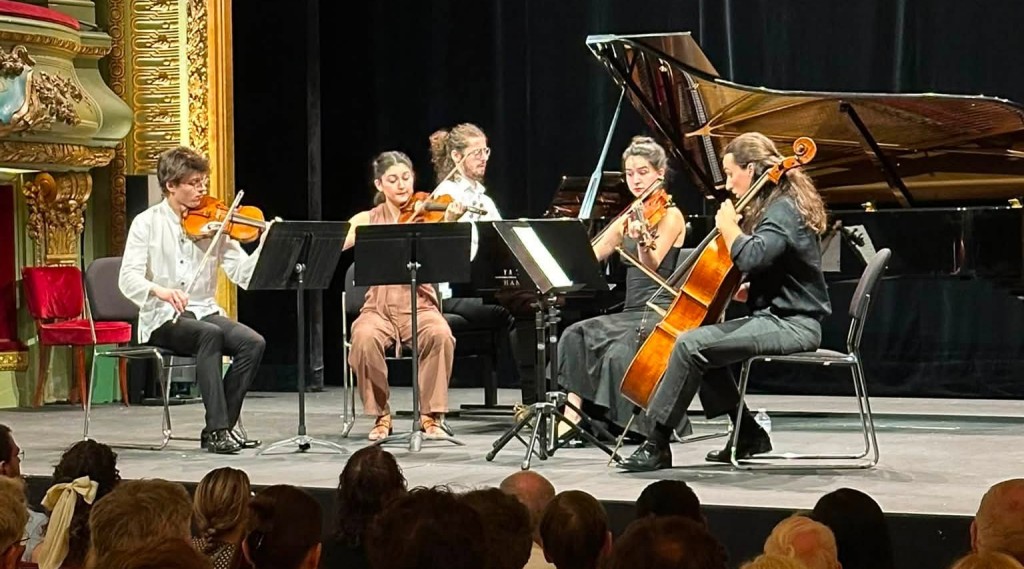
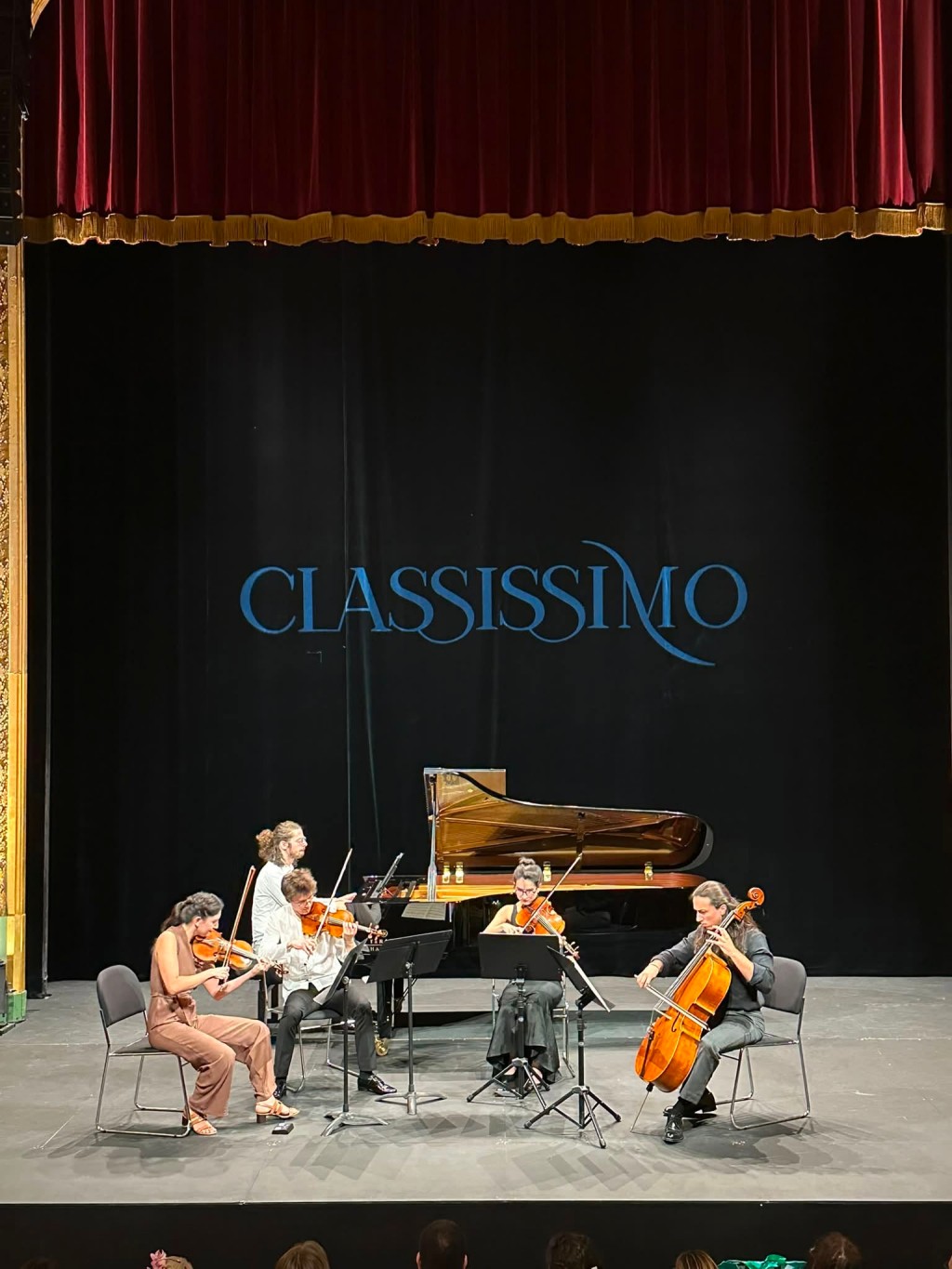
Someone who has so much classical music knowledge and has become increasingly selective in their listening, ultimately considering the genres of Piano Duo, -Trio, -Quartet and -Quintet as the absolute pinnacle, was lucky on Saturday at the Brussels Théâtre du Parc.
A decor to dream about, an interested audience, a stage full of enthusiastic young talents, trained at the Kapel Koningin Elisabeth and two giants of Piano Quintets, Dvorak and Brahms. Monuments in the history of their creation that no one can make sense of! The initiative came from Valère Burnon, third and only Belgian laureate in the Koningin Elisabethwedstrijd Piano 2025, who brought together some friends in a chamber music setting.
We know Burnon as a brilliant soloist. He is so accomplished and convincing in 'Gaspard de la Nuit' by Ravel and so keen on lesser-known composers as Lyadov and Sergei Protopopov, that I sometimes call him 'Gaspard Lyadov'. But chamber music is also close to his heart. True to his first instrument, the violin, he cherishes a deep connection with the chamber music repertoire and has been teaching chamber music at the Conservatoire Royal de Liège since 2022.
 A flood of enthusiasm
In Dvorak, Burnon was the driving force behind the overwhelming Swiss-Austrian violinist Amia Janicki, the somewhat more modest second violin of the Polish Adam Suska, the ever attentive viola player Héloise Houzé (France) and the very personal cello playing of Jorge Giménez from Mallorca. Their enthusiasm was so compelling that some listeners didn't manage to count to four before applauding.
Never ending story
After the tumultuous Dvorak, a meditative but eloquent Brahms brought more balance. The work began as a long story, intriguing, promising and charged, in which Burnon integrated himself perfectly. The two violins had switched places and roles and Adam Suska revealed himself as an inspired first violinist. The flow remained intact and led from the quiet certainty of the Allegro non troppo, through a second movement like one rhythmic wave and a driven Scherzo to a Finale that compelled breathless listening and enjoyment.
After this scorching confrontation, I have only one description for this ensemble, 'The Burnings'. Meanwhile, the week of classical discoveries from Classissimo is coming to an end. For twenty years now, this festival has been synonymous with ambition, diversity, surprise, accessibility, success, innovation and knowledge transfer between generations.
The heart of Classissimo found its embodiment in the new artistic director and successor to the late Georges Dumortier, the ever active and charming Marc Grauwels. His perfectly bilingual welcome, the cozy luxury of a centuries-old theater, where Sarah Berhardt once performed, the modest entrance fee, free concise programme, useful handout fans, request to note suggestions, possibility of meet and greet, isn't that what they call 'customer loyalty'?µ