
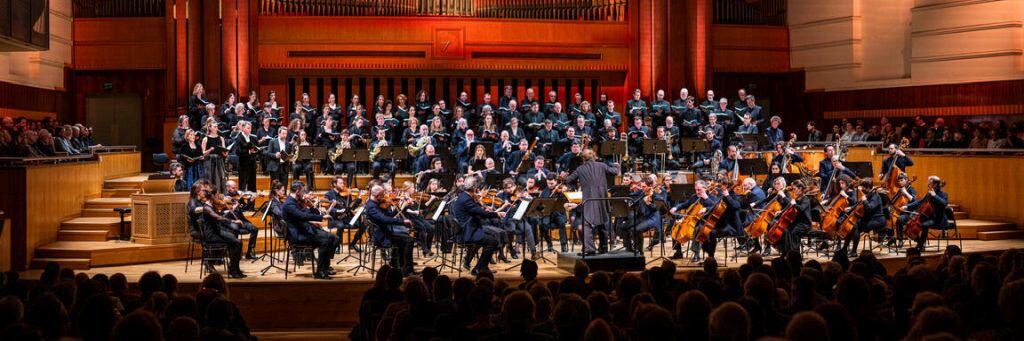
In a world that is increasingly coming apart at the seams, Brussels Philharmonic under the direction of Kazushi Ono brought an evening of beauty and hope to Flagey on Friday, September 26. The theme of the evening was love – not only the romantic kind, but also its fraternal, spiritual and idealistic facets. The title Une Déclaration d'Amour proved to be no gratuitous allusion, but a carefully considered programmatic line, featuring works by Annelies Van Parys (°1971), Nadia Boulanger (1887–1979) and Maurice Ravel (1875–1937).
What made this evening so exceptional was not only the outstanding quality of the performance, but also the coherent thought behind it. The works offered a profound reflection on love in different time periods and forms. Thus music became not only a reflection of how love endures through time, but also an expression of its fragility.
A dream evaporates
The concert opened with the recently created composition EUtopia, in which Van Parys explores – and deconstructs – the European ideal. The work was originally conceived as a tribute to connection and brotherhood, but Van Parys managed wonderfully to show the complexity of the European project, in which the hopeful ideals of solidarity slowly give way to alienation and crisis.
From the very first measures we heard echoes of Beethoven, but muted, obscured – as if Alle Menschen wurden Brüder were being recycled in a world that has long lost its faith in that ideal. This early association with Beethoven gives the work a tragic undertone, as if the ideals of unity and brotherhood have faded forever. The orchestration – masterfully balanced – was reminiscent of both Mahler and Ligeti: layered, abrasive, sometimes threatening. At times, the orchestra was both the symbol of an idealistic future and the tragic dismantling of it. Kazushi Ono led his musicians with a firm hand through the complexly constructed structure with a keen sense of dramatic buildup. The audience at times remained hushed: Van Parys had something essential to say, and it resonated.
A forgotten voice
Although Nadia Boulanger is often seen as the 'mentor' to countless well-known composers, her own work unfortunately remains in the shadows. Too often reduced to her role as pedagogue – she who trained Copland, Glass, Piazzolla and numerous American musical theatre composers – her own music is rarely performed. Unjustly so, as became clear from this refined and elegant Fantaisie variée pour piano et orchestre, a work that is not only technically virtuosic, but also offers a deeply personal and emotional expression.
The music breathes late-romantic nostalgia, but also the early impressions of French impressionism. The orchestration in this work reflects the delicate balance between the piano and the orchestra, with each variation bringing a different emotional state to the music. Boulanger proves herself not only as a form-conscious composer, but also as a sensitive tone poet: controlled, but not cold. That she once called the work "useless" testifies more to her modesty than to its artistic value. It is surprising that this richly nuanced score from 1912 has not been performed on a Belgian stage since 1913, as this intricately woven orchestration can perfectly hold its own alongside other concertos from this period.
Pianist Alexandra Dariescu proved herself a true ambassador of Boulanger. Her playing emphasized the sensitivity of the work, bringing the complexity of Boulanger's composition to life with great precision and emotional nuance. She understood that this music does not call for virtuosity, but for attunement, introspection, trust. Brussels Philharmonic accompanied Dariescu with velvety precision, and together they offered the audience a rare musical gift. With a nimble and playful encore of Heitor Villa-Lobos (1887-1959), Dariescu concluded by demonstrating once again her mastery at the piano.
Daybreak and rapture
With Daphnis et Chloé, the evening reached its sensual and emotional climax. Ravel's symphonic ballet sounded in its complete version – including the rarely heard choral passages – which gave the audience an exceptional opportunity to experience the work as the composer intended it: as a total experience of color, light and physicality. Although there were no dancers on the stage, the choreographic character remained unmistakable. The orchestra itself seemed to dance: musical phrases became gestures, dynamics became breath. The music pulsed like a living organism – sometimes whispering, then again in waves of sound and movement. Brussels Philharmonic maintained the balance between precision and freedom flawlessly: clear in articulation, refined in dynamics, always serving the atmosphere. Daphnis et Chloé is not a virtuoso work in the traditional sense, but requires a profound understanding of nuance, color and timing. Both orchestra and choirs impressed with a sound that faded into transparency, only to suddenly burst forth with fiery energy.
Conductor Kazushi Ono led this with great control: his approach was not spectacular for spectacle's sake, but clear in structure and rich in imagination. His tempi breathed along with the music. Especially the buildup to the iconic Lever du jour was constructed masterfully: fragments of melody like dew, woodwinds evoking birds, a crescendo that slowly filled the space with light. Ono forced nothing, but allowed the moment to unfold like a vision.
The Flemish Radio Choir and Octopus delivered vocal lines that not only supported the orchestra, but flowed through it like an invisible current. Their sound gave the work an extra dimension: transcendent and earthly at once, deeply rooted in the physical. The apotheosis – the ecstatic union of Daphnis and Chloé – became an outburst of surrender. Orchestra, choirs and conductor melted together into an eruption of sound and emotion that almost physically touched the hall. Not a conventional final chord, but a celebration of love, longing and the power of music to make both palpable.
Between artifice and art
In the quest to find new ways to renew the classical concert, multidisciplinary additions are often employed today. While that can yield compelling results, the integration of poetry in this programme was not convincing. The artist duo Lisette Ma Neza and Pitcho Womba Konga provided poetic introductions to both works before the interval, but their contributions remained superficial. The texts were too cautious and failed to sufficiently engage with the depth and societal charge of EUtopia. This flattened the layering of the composition rather than strengthening it.
After the interval too, with Daphnis et Chloé, the poetic framing remained stuck in generalities. The original text by Longus is rich in symbolism and inner tension, but that barely came to life here. The projections during the performance, intended as visual support, moreover worked more as a distraction than illumination: they were awkwardly projected over the organ pipes and singers, disturbing the visual peace. A more restrained, more thoughtful concept – with minimalist cues – would have allowed the music to come into its own. Less would clearly have been more here.
Love as deed
Une Déclaration d'Amour was not a slogan, but a musical statement – artistic, emotional, existential. This evening made love palpable as more than a private feeling: a shared, human experience that carries both comfort and pain. Radical in vulnerability, inevitable in power. The programming underscored that vision. Kazushi Ono presented the different works not as separate entities, but as parts of an organic whole. His approach testified to a deep dramaturgical insight: he built the evening as an inner journey, with narrative arcs running beneath the surface.
Pianist Alexandra Dariescu proved herself a storyteller at the keyboard. Her interpretation of Boulanger's Fantaisie was nuanced and deeply felt – every phrase sounded like a confession, every inflection a meaningful choice. The choirs, more than accompanists, functioned as emotion made sound. They gave voice to what cannot be captured in words, and made of music a physical experience. "Love," Plato wrote, "is a memory of a higher world." In Flagey that world became tangible for a moment – in sounds that touched, silences that sang, voices that connected. An ode to love – and an invitation to take it seriously.