
In most opera houses the 2018-19 season has now ended and the new one usually starts in September. Not so at the Scala in Milan, where the official season opening is always on 7 December – the feast day of Sant'Ambrogio, the patron saint of Milan – but the seasons flow almost seamlessly into each other. Only in the last week of July and in August is there nothing on the programme.
So I was able to attend a performance of I Masnadieri by Verdi at the Scala. It is a little-known or rarely performed opera, the eleventh by the composer, who wrote the work specially for London. The opera premiered on 22 July 1847 at Her Majesty's Theatre. Andrea Maffei designed the libretto based on the play Die Räuber by Schiller. Verdi composed the role of the only female character, Amalia, specially for Jenny Lind, 'the Swedish Nightingale', and thus wrote one of his rare roles for a lyric coloratura soprano. For the theatre's principal cellist, he provided an andante for solo cello and orchestra as a prelude. In Milan, I Masnadieri appeared for the first time on the Scala's programme in 1853. A second series followed in 1862, after which the opera was not performed again until 1978. The conductor was then the young Riccardo Chailly, who made his Scala debut with it, the opera house where he is now music director.
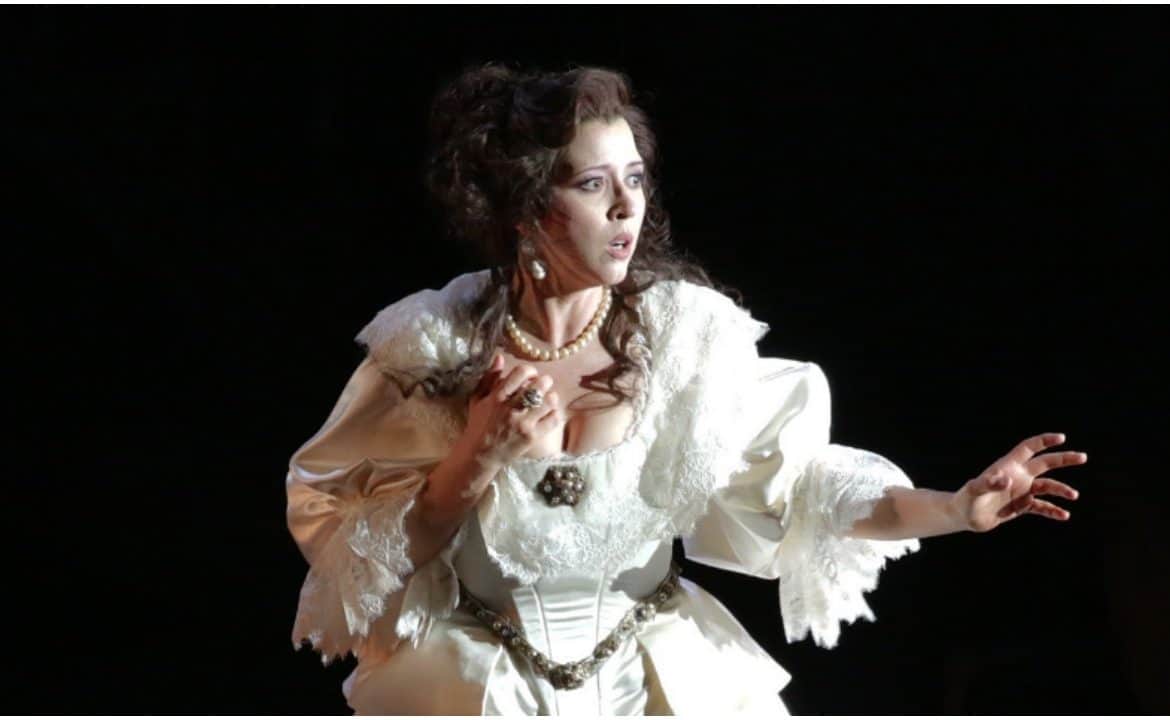
The conductor this time was Michele Mariotti, the celebrated maestro who made his name as music director of the Bologna opera (2015-2018), is a regular guest at the Rossini Festival in Pesaro and is now building a remarkable international career. With cellist Massimo Polidori he provided a fine opening, but in the course of the performance he did not always seem able to make the score sound with the desired nuances. This was due to the numerous interventions of the chorus, which as true robbers rather undisciplinedly and usually very noisily threw itself at the music and, albeit to a lesser extent, of tenor Fabio Sartori, who with his strong voice regularly opted for forte. He is Carlo, the son of the old Count Massimiliano Moor disinherited by his brother Francesco's intrigues, who is now the leader of a band of robbers to whom he is bound by an oath. Francesco spreads the rumour that Carlo is dead and wants to marry his betrothed Amalia. She discovers the truth and sets out to find Carlo. Together they free Massimiliano from Francesco's hands, who wanted to have his father murdered. Carlo confesses what life he now leads and this forces him to kill Amalia and surrender himself to the mercy of the robbers. Sartori has the necessary metal in his voice, but unfortunately cannot cut a very credible figure on stage. This is not the case for Massimo Cavalletti, who gives Francesco a convincing portrayal but whose fairly bright baritone could have used darker tones and more bitterness. Lisetta Oropresa, who recently won over the Munt audience with her splendid interpretation of Isabelle in Meyerbeer's Robert le Diable, was the tormented Amalia, a role for which she can draw on youth, sensitivity and dramatic expressivity. She sings like an angel with the required virtuosity, but the part does demand from time to time a fuller and more powerful voice. Michele Pertusi gave Massimiliano vocal and scenic nobility. Alessandro Spina made an impression as Moser, and Francesco Pittari and Matteo Desole satisfied in the roles of Arminio and Rolla.
This leaves the staging by David McVicar in a set by Charles Edwards with costumes by Brigitte Reiffenstuel, lighting by Adam Silverman and choreography by Jo Meredith. Where the Scottish director usually tells the story in a believable way and respects the libretto, in this case he has moved the action to the 18th century, and that in a unit set that can be both a barracks and the castle of the Moor family. In which a row of beds serves as a cemetery and the chorus and extras go about their business boisterously. In which Francesco seems to move about among the robbers and it is unclear who is who! Moreover, McVicar has added a character to the action (Schiller?) who walks through the action the whole time and makes the whole thing even more confusing. Fortunately, there were the singers who brought their characters to life as best they could.
Woody Allen and Students
In this somewhat calm transition period of the season, the Scala also offers students of the Scala Academy the opportunity to present themselves in a project set up especially for them, accompanied by experienced artists. This time a double bill was chosen consisting of Prima la musica e poi le parole by Antonio Salieri and Gianni Schicchi by Puccini. The Academy orchestra was conducted by Adam Fischer and in both one-act operas the experienced Italian baritone Ambrogio Maestri was the focal point and the mainstay for the young singers.
Regarding Prima la musica e poi le parole, a world premiere at the Scala, I can be brief. It is a trivial, extremely weak, long-winded piece consisting almost exclusively of recitatives and becoming tedious very quickly. The staging by Grischa Asagaroff and the set design and costumes by Luigi Perego did nothing to make the whole more palatable, quite the opposite in fact, and Ambrogio Maestri also seemed somewhat lost in it. For Puccini's Gianni Schicchi, last performed at the Scala in 2008, a production borrowed from the Los Angeles opera was used. There, also in 2008, Woody Allen staged his very first opera in a set by Santo Loquasto: a production that was now rehearsed in Milan by Kathleen Smith Belcher. Woody Allen was indeed present at the premiere at the Scala and was reportedly warmly applauded, but his staging of the Puccini one-act opera received a less enthusiastic response. Woody Allen moved the action from Dante's Florence to the 1960s of the previous century, a homage to the neorealism of De Sica and Fellini. And the 'homo novus', the character from the XXXth Canto dell'Inferno, became a mafia boss with a cigar. That is simply the stereotypical way an American artist views Italian affairs, the critics thought! But there was agreement that it was a well-structured, smooth, comic plot. The characters were indeed well drawn, with here and there some unexpected accents. For instance, Schicchi's daughter Lauretta was certainly no naive girl. The young singers of the Accademia formed a good ensemble and Ambrogio Maestri delivered his experienced Schicchi. Adam Fischer conducted with attention to detail. And the musicians of the Accademia? They did their best.
- WHAT: I Masnadieri | Guiseppe Verdi (1813-1901)
- DIRECTION: David McVicar
- VOICES: Michele Pertusi, Fabio Sartori, Massimo Cavalletti, Lisette Oropesa, Alessandro Spina, Francesco Pittari and Matteo Desole
- ORCHESTRA: Filarmonica della Scala conducted by Michele Mariotti
- WHERE: Teatro alla Scala, Milan
- WHEN: Sunday 7 and Monday 8 July 2019
- PHOTO: © Marco Brescia / Rudy Amisano